Today in the Dauphin Herald – January 30, 1919

Winnipegosis

Miss Pearl Wilson, who for some time has been assistant in the post office here, has left to accompany Mrs. Wilson on a visit to Victoria, B.C. Miss Wilson has served the public well. She will be missed by social as well as business friends and our best wishes go with her.
Fishing operations here are quiet, owing to the dull market. It is reported that a number of fishermen have taken out their nets.
The Red Cross weekly entertainment of last week, under the management of Mr. C.L. White, was a bright and pleasant event and quite a number were present.
Miss Olive Hawkins, of Dauphin, has arrived to take the position of assistant at the post office.
Mrs. J. Campbell, of Sifton, is spending a few days in town.

Today in the Dauphin Herald – January 23, 1919

Bicton Heath

Winnipegosis, Jan. 20th.
William Little was a visitor at the home of Tom Toye. Seems like old times to see Bill around again.
Mr. Lonn has bought the Seiffert farm on the Mossey. He has also bought section 11, the Grenon farm, and has bought his seed from the Bicton Heath seed farm for the coming season.
James Playford is going to turn the land upside down on the Hudson Bay holding. This land has been waiting for just such treatment for a long time.
James Laidlaw is busy hauling logs on to his homestead to build. Jim is a hustler and we would like to see a few more of his kind come to this district.
What about the corduroy leading to the Bicton Heath School? Is has not yet been completed. Does this mean that the children living on the east of this swamp are going to have another summer holiday? It is about time that the government stepped in and saw the work done.
Co-operative Grain Growers’ meeting will be held at the Bicton Heath schoolhouse on Wednesday, January 29th, at 7. Every farmer should be present.
Mr. Dumas, from North Dakota, has bought John McAuley’s farm in this district, and will be here in the early spring.
George Lyons was through this district this week. George is a good fellow, but is not always welcome in his capacity as tax collector.
Frank Sharp will leave shortly for Winnipeg. Frank says that there will be no mistake this time.

Fork River

Miss Katie Robertson has left on a visit to Neepawa.
Reeve Venables and Coun. Hunt are attending the convention of the Union of Municipalities at Winnipeg this week. Mrs. Venables accompanied Mr. Venables to the city.
Geo. Lyons, of Winnipegosis, was a recent visitor to our town.
F.F. Hafenbrak, M. Cooper and H. Hunter went to Dauphin to attend the degree meeting of Coronation lodge, L.O.L.
Mrs. D. McEachren and son Donnie are visiting in Winnipeg.
Ed. Humphreys has returned to town. He is still smiling.
Miss Nellie Briggs, of Hartney, is a visitor at the home of Mr. T.N. Briggs.
Mr. D. McLean and Miss Birdie McLean have gone to Regina. Birdie intends to spend the rest of the winter with her aunt, Mrs. Vance.

Today in the Dauphin Herald – January 16, 1919

Dauphin Flour in Belgium

Our readers will remember that shortly after the first reports of the suffering among the Belgian people, due to the Hun invasion in 1914, reached Canada, the Dauphin Milling and Creamery Co. Limited, ground a carload of flour from wheat donated by farmers and others in Dauphin and adjoining municipalities. This carload was duly shipped to Belgium but no official record was ever received of its having reached its destination. The following letter received a few days ago by the company makes very interesting reading, and it is gratifying to note that at least part of the donation reached the people for whom it was intended:
“52 Rue De Mondigny,
“Charleroi, Belgium.
“Dec. 1, 1918.
“Dear Sir,—You will no doubt be greatly surprised to receive this letter from a person that you have never seen nor heard of before, and your surprise will be still greater when you hear that it is written at your request.
“One day, early in 1915, I was present at the opening of a bag of flour which, with several others, had just arrived from Canada. At the bottom of the sack was a strip of paper bearing these words, ‘Whoever gets this bag of flour write and let us know if it is good.’ I would have written at once only the Germans, with their usual kindheartedness, made things so easy for us that letter writing was out of the question. I hope never to see a German again as long as I live. ‘The best of them are bad.’
“Your flour was excellent; it has not been our luck to have such good quality since. For the last three years our bread—it really doesn’t deserve the name of bread—was composed of everything except flour, thanks to Fritz.
“You would not recognize your flour sack. It has been transferred into a beautiful sofa cushion and occupies a prominent place in our drawing-room It is the admiration of all visitors.
“Last week the Canadian troops came to Charleroi; they received a warm welcome on all sides. Everyone here speaks highly of your compatriots, many English regiments passed two or three days in this town before entering Boschland. With every good wish for Xmas and with kindest regards.
“Believe me, yours sincerely,
(Signed) Andree McDonnell.”

Mossey River Council

The first meeting of the council of 1919 took place at Fork River on Jan. 7th.
The clerk swore in the newly elected members – T.B. Venables, reeve; J. Yakavanka, councilor for Ward 1; E.A. Marcroft for Ward 3, and J. Namaka for Ward 5.
Bylaws were passed making the councilors’ fees $4 per day and appointing D.F. Wilson sec.-treasurer at a salary of $875.
The bylaws of 1918 appointing the solicitors and health officer were confirmed for 1919.

COMMITTEES
Finance – Hunt, Marcroft and Paddock.
Bridges – Coun. Reid and Hunt.
Public Works – Coun. Marcroft, Paddock and Namaka be public works committee for Wards 3, 4 and 5, and Coun. Yakavanka, Hunt and Reid be public works committee for Wards 1, 2 and 6.
Paddock-Marcroft – That the bridge committee examine the bridges that are needing repairs and make an estimate of the material that will be required for the season’s bridge work and report to the clerk who is instructed to purchase same.
Hunt-Namaka – That the assistance which has been given to the family of the late Peter Smith be discontinued.
Hunt-Marcroft – That each councilor make a diagram showing the work in his ward which he would prefer to come under the working of the Good Roads Act for the yea 1919, and forward said diagrams to the sec.-treasurer, who is instructed to make a diagram from them showing the whole municipality, which diagram is to be forwarded to the Good Roads board.
Marcroft-Paddock – That the clerk instruct the solicitors to prepare a bill legalizing the assessment roll of 1918, and that the member for the constituency be asked to bring it before the legislature at the coming session.
Marcroft-Hunt – That a grant of $50 be made to ex-Reeve Lacey for miscellaneous expenses.
Hunt-Marcroft – That the assessment roll for the year 1919 is hereby adopted for the years 1919 and 1920.
Reid-Namaka – That Reeve Venables be a delegate to the convention of the Union of Manitoba Municipalities and that the delegates receive $25 for expenses.
Council adjourned to meet at the call of the reeve.

Fork River

Mrs. James Rice, of Northlake School, has returned from a trip to Winnipeg.
Mrs. R. McEachren and daughter Helen were recent visitors to Dauphin.
A car of young fat stock was shipped out last train. Good prices were realized by the sellers.
Mr. and Mrs. Harry Little have returned from a short visit south.
H. Swartwood, International Implement Co., general agent, was at Fork River last week to hook up the orders of the local agent, W. King, for the coming season. Agent Billy K. is most optimistic as to the coming season’s business and to show his faith, has placed liberal orders.
Sunday school in All Saints Church every Sunday at 2 p.m.
Mr. Jarvis is now teacher of the Mowat School.
The continued fine weather is very favorable to stock and they are in fine condition.
Grain and cordwood are coming to market in considerable quantities every day.
The following are the officers of Purple Star Lodge, L.O.L., No. 1765, for the ensuing term:
W.M., Bro. C.E. Bailey; D.M., W.J. King; chaplain, Edwin King; rec. secretary, Wm. King; fin. Secretary, A. Hunt; D. of O., F. Cooper; treasurer, Sam Bailey; lecturer, F.F. Hanfebrak; dep. lecturer, Sam Reid. Committeemen – M. Cooper, H. Hunter, W. Russell, Ed. Morris, S. King, Jos. Bickel.

Sifton

A crowded schoolroom showed the appreciation of the residents of Sifton district of the Wycliff School Xmas concert. The hit of the evening was a three-piece sketch called “Santa and the Fairies.” Joe Reid acted as Santa, Miss Tilly Farion as Queen of the Fairies, and Witch Doubletongue was impersonated by Mary Braschuk. Patriotic songs opened the program, while several part-song contributed much to the enjoyment of the evening. An effective item was a serenade by the school children, clustering in a semicircle on the platform, with a flashlight playing on them for the darkened auditorium. Mrs. J.A. Campbell contributed the piano and violin accompaniments.
A good old-time dance, at which there was a large attendance, followed the concert. The dance music was given by Mrs. Campbell and Messrs. Marcott, Potoski, Kuczma, Halinski, and others.
The proceeds of the evening, totaling $56.75, have been placed in the bank as the Wycliff School Children’s Amusement fund. Part of it is to be applied at once to the repair of the school toboggan slide, a new concert platform, and ropes for the swings.
The teachers of the school, Mr. Bousfield and Miss Trew, and the children are grateful to the friends who gave the ample and excellent refreshments; to Mr. Paul Wood for the loan of his piano and for the willing assistance given by friends before and during the evening.
The fudge and taffy were provided by the children from their own lunch as a treat to adults, enjoying the Christmas spirit. The artists responsible for the blackboard scenes of the stage were Leslie Kennedy and Tilly Farion.

Winnipegosis

Old Josey Campbell, who resides near Water Hen, had his house and content totally destroyed by fire last Friday. The house was a new frame building, and the loss is ruinous to old Josey.
The council of the Village of Winnipegosis held its regular meeting last Tuesday. The council has been shorthanded for several months but is now complete, being reinforced by the addition of two new councilors, J. Willis and Chas. Denby. The council donated $400 to the Red Cross and discussed the building of a hospital and giving the town better fire protection. These last two matters will come up again at next council meeting.
The interment of the infant son of Mr. and Mrs. D. Kennedy, Ochre River, formerly of this town, took place on Tuesday. Rev. Mr. Hook conducted the service.

Today in the Dauphin Herald – January 9, 1919

Major Barker’s Great Record

Major W.G. Barker, Canada’s third air V.C. now holds the record for fighting decorations, according to the Canadian Daily Record. He holds, beside the V.C., the D.S.O., with two bars; the D.F.C.; the M.C., with two bars; the Croix de Guerre, and the Italian Cross of Honor. His record for enemy planes destroyed is 50.

Bicton Heath

Winnipegosis, Jan 4.
W.C. Cooper’s barley averaged 60 bushels to the acre. At present prices this proved a paying crop.
Mr. Waddell’s youngest son died from influenza. He has the sympathy of the neighborhood in his great loss.
Thos. Toye is just recovering from an attack of the Flu. Even King Flue had to retire from the ring when he tackled an old stager like Tom.
Willie Bennett, who has been very sick, is recovering.
Robt. Marshland will soon be on his rounds with his sawing and crushing outfit. Bob is back from the war, but before his return he helped knockout Kaiser Bill.
F. Sharp has left for Winnipeg. It is not expected he will return a one.
A Grain Growers association will be organized in this district shortly.
Tom Toye still swears by his muskrat story and maintains the weather so far has been correctly indicated by the little water rat.
A petition is being circulated praying that the council to pass a by-law permitting stock to run at large at nights.
I see that ex-Reeve Lacey wants to Kaiser shot. Fred is far being alone in his desire.

Winnipegosis

Orville McGinnis, whose leg was crushed by a block of ice falling upon it, and who had to have it amputated above the knee, is doing well.
John Dempsey was charged before Police Magistrate Whale with breaking open a fish shed belonging to Ben Hechter. The magistrate referred the case to Dauphin where the accused was committed to take his trial at the next assizes. In the meantime Dempsey is out on bail.
In spite of the loss of a number of nets through floating ice at the beginning of the season, and accidents in the nature of teams falling through the ice, the fishermen are making a large catch of fish.
There is a movement on foot in this vicinity to have a grain elevator established at Winnipegosis in the near future. The farmers have been hauling their grain to Fork River, but this proves too expensive and reduces the profits.
The flu epidemic has struck Winnipegosis. Four families have been down with it recently but are picking up again. There have been no deaths as yet.

Today in the Dauphin Herald – January 2, 1919

Big German Gun for Dauphin

While nothing has been definitely settled regarding the disposition of much of the spoils of war captured from the Germans enough is known that Dauphin will have the refusal of one of the big cannons. The railway board, it is understood, is willing to grant sufficient of the right-of-way in front of the Grand View Hotel for a foundation upon which to mount the monster.

Reeve Lacey Wants the Kaiser Shot

To the Editor of the Herald:
SIR—The following is an extract from a letter received from a relative in English since the signing of the armistice and return of the prisoners of war from Germany:
“There have been several boys of Penarth, returned prisoners of war, and some of them have been treated most cruel. One has an eagle branded on each side of his face, his teeth knocked out, and a piece cut off his tongue. Another with an eagle and “God Blast England,” or some such words as that, and a torpedo on his forehead. There are quit a lot of Germans prisoners here and when one sees them one cannot help using strong language when you know they have had such fiendish thins done to our prisoners by these Germans.”
The above is one instance that is recorded out of thousands that are unfortunately too true. God grant that our representatives at the peace conference may not forget the horrible tortures inflicted on those French and Belgian women and children, and, on the noble men of the Allied armies and navies who voluntarily offered their liberty, limbs and lives by thousands to save the world from German bondage. We shall be robbed of victory if those fiendish war lords are not stripped of all they possess and led out and shot by some of the boys they have tortured. Let us back up our army and navy and insist on a death punishment for the Kaiser and his war lords: otherwise there will be no lasting peace.
Fed B. Lacey
Fork River.

Mossey River Council

The council met at Fork River on December 18th, all the members being present.
The minutes of the last meeting were read and adopted as read on motion of Coun. Hunt, seconded by Coun. Namaka.
Communications were read from St. Joseph’s Orphanage, the Bank of Commerce, the fire guardian, J. Rosenthal (re: sale of bridge), P.J. Robertson and T.N. Briggs (re: flooding of land next spring), the Navy League (re: grant), tax accounts of F. Thorsteinson and N. Syder, Lawrence municipality (re: boundary road) and the inspector of legal offices.
McDonell-Reid – That a grant of $250 be made to the Navy League of Canada.
Hunt-Yakavanka – That Constable Lyon push proceedings with a view to having the stable removed from the lane in block 1, Fork River.
Hunt-McDonell – That a rebate of taxes for 1918 of $13.60 be made on the Orange Hall property.
Reid-Yakavanka – That the accounts of Coun. McDonell ($134) and Hunt ($34.50) for letting and inspecting work be passed.
Hunt-Reid – That the account for culverts to be used on the Dauphin-Mossey River boundary of $195.20, at present charged to Ward 1 be transferred to the public works account and applied on the work for which the government grant is given.
Yakavanka-Reid – That the accounts as recommended by the finance committee be passed.
Hunt-Reid – That Wards 2, 3, 4, 5, and 6 be credited with $230 each of the Government grant, with the understanding that the money be spent on the main roads through the Wards.
Yakvanka-Paddock – That Coun. Hunt and Reid be authorized to obtain material for a bridge across Fishing River, on the west side of 2-29-19.
Reid-McDonell – That the Reeve and Coun. Hunt be delegates to the municipal convention to be held in Winnipeg on January 21st, 22nd, and 23rd.
McDonell-Reid – That the clerk put up notices asking for applications for the position of sec.-treasurer, and also advertise in the Dauphin Herald.
Hunt-Reid – That the council tender Reeve Lacey a hearty vote of thanks for his services to the municipality and wish them every success in the future.
The council then adjourned.

Fork River

Wm. Northam has returned from a two weeks’ visit to Weyburn, Sask.
The Chute brothers from Dauphin passed through here recently wit their teams. They intend to haul fish during the winter on Lake Winnipegosis. This is a local industry which puts an honest dollar within reach of our farmers.
Gordon Weaver, of Magnet, was a recent visitor at the home of Mr. T.N. Briggs. He has been in poor health for some time past and is going to the hospital for treatment.
Sid Gower is wearing that broad smile that won’t come off. It’s a Daughter of the Empire.
Mr. F. Cooper was a recent visitor to Dauphin.
Coun. Archie McDonell paid Dauphin a visit at the weekend. The genial Archie has just recovered from the flu.
Edwin King has gone to Winnipeg to take a business course.
The new council will assume office on the 7th inst. Your correspondent will watch carefully the moves of our representatives and note them for the Herald. Progress should be the watchword. There is a lot of work awaiting the activity of the council and we all hope they will prove equal to the occasion.

Winnipegosis

At the annual meeting of the Home Economics Society the officer elected were as follows:
President – Mrs. Houchin, re-elected.
Vice – Mrs. Dennett.
Secretary – Mrs. Spence, re-elected.
Treasurer – Miss R. Whale.
With the New Year we have a library of about 100 books belonging to the society and we hope to add another hundred books before the year is out. The January meeting will take the form of a social evening when each member is asked to bring a friend along.

Update to Mossey River Honour Roll

It’s been a while since I last updated the Mossey River Honour Roll in 2016.

With the passing of the hundredth anniversary of Armistice Day, I decided to make a big push to find and link all of the soldiers from the districts of:

  • Fishing River,
  • Fork River,
  • Ethelbert,
  • Oak Brae,
  • Sifton,
  • Waterhen
  • Winnipegosis, and
  • Valley River.

The stats are as follows:

WWI Honour Roll

Community Old Number New Number
Fishing River 0 1
Fork River 17 30
Ethelbert 0 10
Oak Brae 0 1
Sifton 0 28
Winnipegosis 35 101
Valley River 0 5
Waterhen 0 2
Total 52 178

That’s one hundred and twenty-six new names I’ve added!

There are still eighteen individuals who I have been unable to find documents for, but I haven’t exhausted all the venues yet. I’m going to do some cross-referencing to see if I can locate the missing documents. Additionally, there could still be some soldiers I’ve missed altogether.

Returning to My Projects

Over the past year, and then some, I’ve been on a hiatus of sorts as both my laptop and external hard-drive failed. Thankfully, the content on those drives was saved, however, I took a break from my genealogical work to focus on other projects. With a brand new internal and external hard-drive I’m ready to return to work on the Dauphin Herald, Marion Harland, and on genealogical sleuthing.

One of the reasons why I type out the text from these articles is because it makes it easier to do a keyword search for names, places, or other events. I can tag each post and zero in on the articles I think are of the most interest to myself and other folks.

While a website such as newspaperarchive.com is very helpful the technology to transcribe from poor photocopies is still not there and based on my experience sometimes utterly useless when words are turned into gobbledygook.

A lot of the work for the Dauphin Herald 1910-1919 has been completed but what has kept me from posting is that I’ve also tried to include links to soldier’s attestation records which has slowed me immensely as I like to have completed work before it goes up.

Seeing as there are still many blanks I’m going to change my strategy and post what I have completed in order to get it up as there is a lot of very interesting information especially from the war years. I can follow up on any missing information at a later date.

From here on out there should be more regular additions to content.


Mowat Pioneers Update

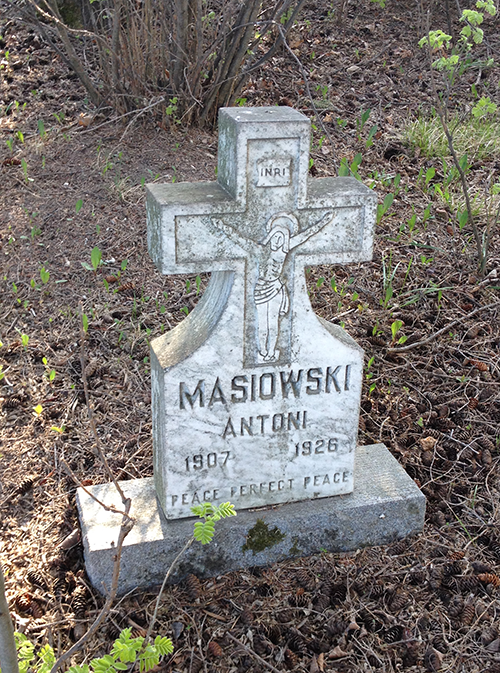
Well, it’s been another couple of months since my previous post in May. I was successful in finding my grand uncle’s grave within ‘St. Michael’s Cemetery’ at SW-14-29-18-W1.

st michael's cemetery

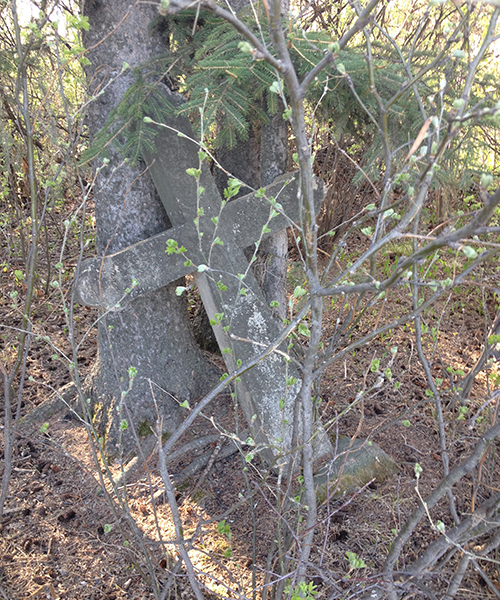
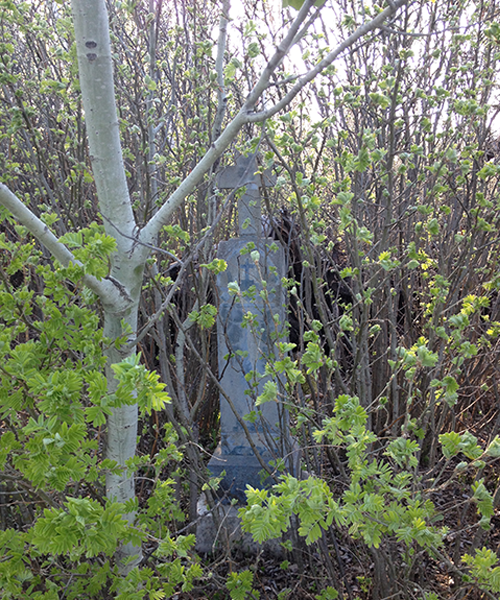
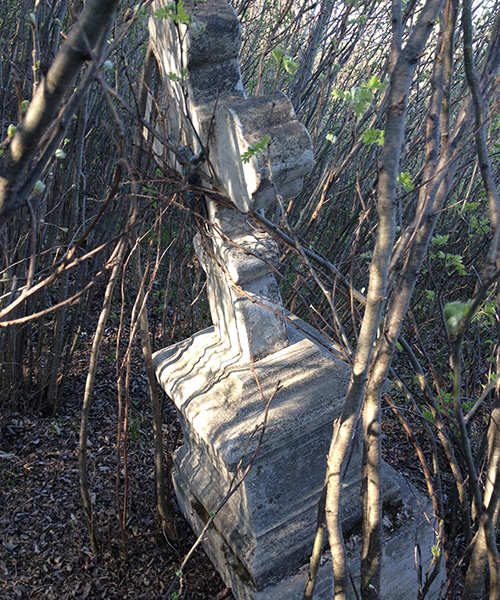
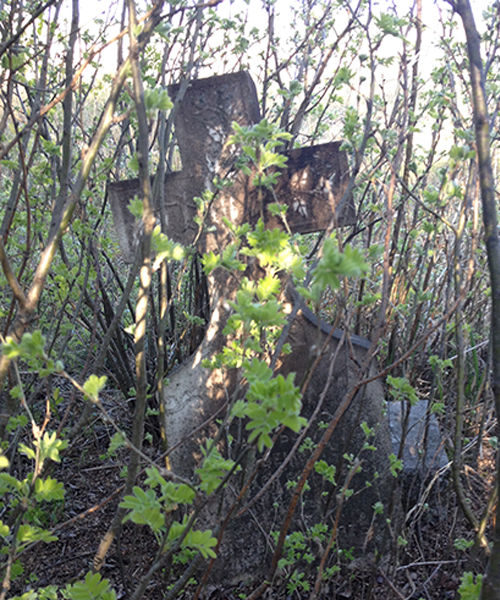
Unfortunately, the cemetery was overgrown and I don’t know how many other graves were suppose to be in there. Where I thought the graves would be located was just grass, unless the headstones have been buried, while the rest of the graves were found in the trees/brush.

Anton Masiowski's headstone

There were a handful of other headstones that I was able to take pictures of but I was unable to get all sides.

st michael's grave 01

st michael's grave 02

st michael's grave 03

st michael's grave 04

st michael's grave 05

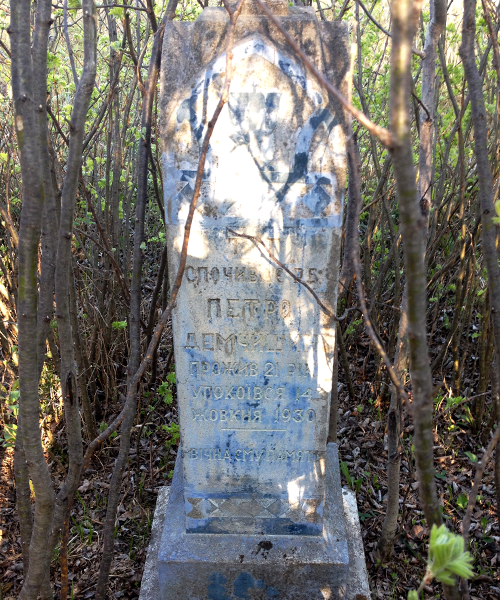
A surprising find was the grave of Peter Demczyszyn (1909-1930) who was murdered in a case of mistaken identity. You can read more in the previous blog post here.

Peter Demczyszyn headstone

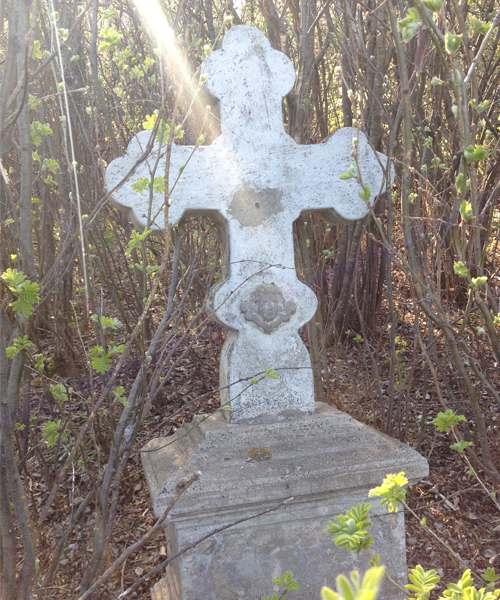
Another interesting find was this mysterious grave at the crossroads of Road 170 North and Road 105 West.

mystery grave 1

mystery grave 2

This is what I have been able to decipher from the headstone.

В. чесьт
славу най Сь
Серцю Г.Н.Ю
Христа

Памятка Се

триць з рок 1921
фундаторка

Анна Чорнобай

From what I can understand it is related to the Chornoboy family, specifically, Anna Chornoboy (1904-). If this is correct then Anna was only 17 years old when she died. Historically, burial at a crossroads was the method for persons who have committed suicide. Was this the case for poor Anna? I am going to do some more investigation in this case.

Update and Travel

It has been a very busy few weeks at my job and so I haven’t had much time to devote to my blog recently.

In order to let off some steam I decided to take a trip up north to Mowat to stay at the family farm.

My primary goal during this trip is an attempt to find my grand uncle’s grave and get a photograph of his headstone.

Anton Masiowski was born to my great-grandparents John Masiowski and Anastasia Kotlarchuk on Oct 10, 1906. He was their second born child in Canada. Anton was described as a sickly child and died on Oct 11, 1925 at the tender age of 19. I have it in my mind that he drowned in the river however I might be mixing up the cause of death with someone else.

I dug up somewhere, my memory alludes me exactly where from, that Anton was buried north of North Lake School No. 1431 (NW-11-29-18-W1), at SW-14-29-18-W1. I always thought he was buried by his lonesome, however recent research would indicate that his grave is likely in the Fork River Roman Catholic Cemetery. In all honestly I’m not sure why they named it after ‘Fork River’ as the cemetery’s location is actually closer to Oak Brae but I suppose Oak Brae might have already established a Roman Catholic cemetery.

Previously, I was under the belief that the Fork River Roman Catholic Cemetery was located across the river of the Fork River Cemetery, just before Fork River on Route 20, as this is where a number of my family members are buried who were Roman Catholics. I stand corrected. I suppose this is simply the burial spot for Roman Catholics within the Fork River Cemetery at SW-25-29-19-W1.

Now that I’ve hopefully located the correct coordinates of the Fork River Roman Catholic Cemetery I will be able to take photographs of not just Anton’s grave but of other family members who were buried there as well.

My only concern is whether vandals or time might have destroyed the graves at this cemetery such as what occurred at the Fork River Cemetery. I have better hopes as it’s on a quieter roadway and is away from the river where it’s less likely to flood or be damaged by ice.

Update

My series on Marion Harland’s School for Housewives is working out fairly well. No bumps or issues so far though I am now debating whether I should include the names of the articles also published on the same page.

I have also completed Today in the Dauphin Herald years 1911-1912, these have been back dated and can be found under THE DAUPHIN HERALD > 1910-1919, in the header above. I will be working on the years 1913 and 1914 although I have already nearly completed 1914.

Mowat School District History Spans 64 Years

Below is an interesting article I located about the Mowat School that was published on Aug 4, 1967 in the Dauphin Herald. Mentioned is my 2nd great-grandfather, Noah Johnston, as well as my great-grand uncle, George Basham. The article mentions that it cost $600 to furnish the school-house in 1903 and by using the Bank of Canada’s inflation calculator based on the year 1914 (earliest year available) it would have cost them over $12,430 based on today’s standards.

Mowat School District History Spans 64 Years

When Peter Rudkevitch of Whitehorse, Yukon, arrived in Fork River for his grand-niece’s wedding, everyone began renewing acquaintances and memories went back to school days. School days where? At Mowat school!

The general feeling was “Let’s get together and have some pictures taken for Centennial year.” The old school chums and classmates phoned around and the gathering took place at the new school, as they called it, on Tuesday, July 25. The result was the following history of Mowat school:

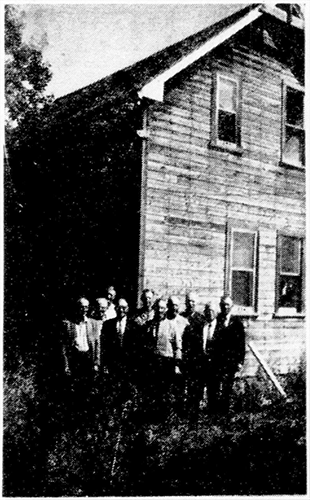
This is the original Mowat school located on the boundary of Mossey River and Dauphin.

This is the original Mowat school located on the boundary of Mossey River and Dauphin. Seen grouped in front of it are former pupils who attended school there prior to World War II.

From left to right, front row, are Joe Masiowski, Peter Rudkevitch, Jim Richardson, Joe Rudkevitch; second row, Metro Brezden, Jim Johnston; back row, Tom Miller, George Miller and Mike Brezden.

Mowat school was organized by George Lacey in the year 1903. He spent many days walking from home to home by trails, as there were may children of school age, but no roads or phones, but he felt the necessity of an education for all, and his many miles of walking resulted in a first general meeting being held at the home of Noah Johnston, N.E. ½ S12-29-19 in June of 1903.

The first trustees were George Lacey, Charles Clarke and Noah Johnston, with George Frame as chairman and Thomas Richardson as secretary.

The first school was built and furnished for approximately $600. The name was chosen to honour Sir Oliver Mowat who served as one of the Fathers of Confederation.

Students prior to 1939

This is a group of former pupils shown at the present school. They attended prior to World War I and prior to 1939.

They are from left to right, front row, Joe Masiowski, Joe Rudkevitch, John Zabiaka, Fred Solomon, Mike Brezden; second row, Earl Gower, Tom Miller, Jim Johnston, Mrs. Joe Masiowski, Henry Solomon; third row, Ernest Johnston, Metro Boreyko, Peter Rudkevitch, Mrs. L. Carriere, Mrs. Jim Johnston; back row, Jim Richardson and William Zabiaka.

In the Mowat school vicinity still reside Mrs. W. Mullen, formerly Hattie Lacey, and Joe Rudkevitch, who entered school when the doors were first opened in 1904 with George Basham as teacher. Mrs. Emma Rice and Jim Lintick were teachers well remembered prior to World War I.

Between the two World Wars, teachers who were spoken of at the reunion were: Miss Grace Beach, Mr. Jarvis, John Main, Miss Reta Breaker, and C.D. Voigt Others were mentioned, but names seemed difficult to recall.

  • In 1920 a new school containing two rooms was built to accommodate some 80 pupils. The primary room included grades 1 to 4, and the secondary room grades 5 to 11. in 1921 the present school inspector, C.D. Voigt was the primary teacher and D.A. Dahlgren (brother of C.N. Dahlgren, Dauphin) was the principal.
  • Since the Second World War, the two-room school was destroyed by fire and a one-room school was replaced by the Dauphin-Ochre Area board in 1951.

Many prominent men and women of Canada have been products of this country school. One in our Canada’s present field of education, John Slobodzian is federal inspector of Indian schools.

In September 1967, one hundred years after Sir Oliver Mowat prominently figured in Confederation, the school doors will open again for another year with Mrs. Stanley behind the desk to teach grades 1 to 7.

And so the school bell will still ring for Mowat school after a history dating back to 1903.

Fred Solomon and Peter Rudkevitch

It is a note of interest to learn that Fred Solomon and Peter Rudkevitch, right and left respectively, sat in a double desk in the school for seven successive years. The two seen here in happy frame of mind, no doubt have been reminiscing about some of the mischief they got into when teacher had her back turned.

Update

I’m well on my way to typing out the 1902-1905 articles I have of Marion Harland’s School for Housewives. I hope to have them put up weekly following the days that they were originally published in newspapers over 100 years ago. A number of these early articles are actually drawings with very little text to them. It has made me rethink how I should go about typing her column as I might add some of the pictures that were originally included in the paper article. I didn’t want to upload the whole newspaper page itself as Marion had other articles occupying the same page such as recipes and an advise column. Furthermore, an image of the newspaper page itself is not searchable for keywords although if someone would like a copy of the article I am more than willing to send it by email.

I have completed all the Today in the Dauphin Herald articles for 1910! These can be accessed under The Dauphin Herald and 1910-1919 list. If you are looking for a particular name or event you can also try the search function or tag cloud. I have tagged family names, cities/villages, illnesses (by illness, sickness, name of illness), as well as accidents, deaths, and Mossey River Council minutes. If there are other tags that you wish to be added to the list please drop me a line. I am now working on 1911 and 1912, however I had problems with these when I was in the Manitoba archives and the collection I have is incomplete. I have access to the Dauphin Herald from newspaperarchives.ca website though going through to find each column takes a long time on their system and the search function is hit and miss.

As you may be aware Library and Archives Canada has been digitizing the Canadian Expeditionary Force (CEF) records of veterans from the first world war. This is a wonderful project as it provides so much more information than the attestation records by themselves. The completion of this project is still some time away (1916) but as of Feb 17, 2015, there are 125,954 of 640,000 files are available online via our Soldiers of the First World War: 1914–1918 database.

Go check it out!

My present job has provided me an opportunity to visit Ottawa at the end of May and since I am going to be there for a short while I am thinking of visiting LAC to obtain the CEF files of a number of the Mowat and possibly Mossey River veterans. I am going to call the archives and see the feasibility of getting these records.

52 Ancestors – Week 5 – Nelson Carlyle Galbraith

The fifth theme in this year’s 52 Ancestors is “Plowing Through.” When presented with this theme I automatically assumed that I would focus on a ancestor who was a farmer as there are many of them in my family line. Instead, I decided to do more research on a relative who I had little information about before researching.

I was always curious about my grand aunt’s husband (Ellis Blake Galbraith) and his family as I had little more than a name and a tidbit that one of his relatives fought in the 1885 North-West Rebellion. In my research during 2014 I was able to find more information on my aunt’s husband, his siblings, parents, and even a bit on his grandparents.

This week I will be looking at the brother-in-law of my grand aunt named Nelson Thomas Carlyle Galbraith (1914-1994).

Nelson was born to parents Thomas Duncan Galbraith (1878-1957) and Mary Ellis (1882-1963) on Mar 29, 1914, in Dufferin, Manitoba and was the second eldest son of seven children. The eldest was Blake who married my grand aunt Ruth Elizabeth White.

As his father, Thomas Duncan, was a solider during the first world war he moved to Camp Hughes while the rest of the family resided in Winnipeg on the 1916 Census. The family is then found in the 1921 Census in the RM of Dufferin but without their father Thomas Duncan who I assume is somewhere else working for the Canadian Military.

galbraith 1916 census

1916

1921

1921

On Sep 8, 1939, two days before Canada officially entered the Second World War, Nelson signed up for military service and became part of the Winnipeg Grenadiers, B Company, 8th Platoon. It is likely that he served in Jamaica and Bermuda before the 1st Battalion landed in Hong Kong on Nov 16, 1941. Sadly, the Granediers would experience some of the first fighting in the Pacific when they lost in the Defence of Hong Kong to the Japanese on December 25, 1941.

galbraith, nelson carlyle

Galbraith, Nelson Carlyle

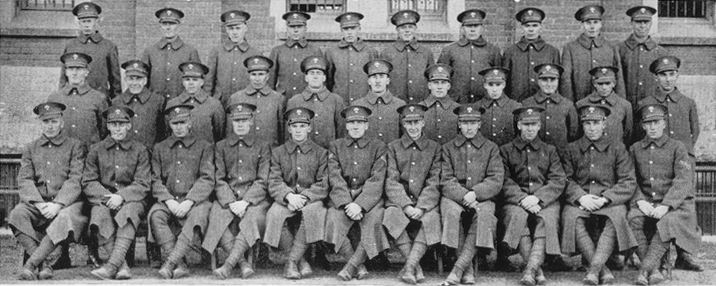
The photograph below is from the December 1939 photo album of The Winnipeg Grenadiers (M.G.) – Canadian Active Service Force. Nelson can be seen in the top 3rd row, second from the end on the right hand side.

Company B, Platoon 8

1st Row – Cpl. Stancove, A., Mabley, G.K., L-Cpl. Sexsmith, C.L., Wood, E., Wermie, M.R., Sgt. Foster, R.M., Lane, G.O., Maddess, C.R., Moore, W.S., Vibert, J.P., Cpl. Stanley, C.
2nd Row – McTaggart, H.P., Foster, S.P., Clubine, C., Nobiss, R., Lawrie, K.R., Donnelly, H.G., Bloomfield, B., Kincaid, C., Mallows, H., L-Cpl. Deacoux, M.J., Bilyk, M.
3rd Row – Cyr, L., Moore, J., Davidson, D.F.A., Pascal, J., Davies, J.C., Smith, R., Edgley, C., Knight, J.G., Galbraith, N.C., Olason, M.J.

Nelson’s name is listed in a Winnipeg Free Press article on Jan 1, 1942 in the pictorial articles These Men Made Valiant Stand in Hong Kong’s Defence. His name is mentioned a number of times more in several other articles of the Free Press during the course of his imprisonment.

Winnipeg Free Press – 19 Oct 1942 (page 1) (page 2)
217 More Hong Kong Prisoners Listed
Ottawa, Oct. 19. (CP) – Another group go names of men now officially reported prisoners of war as a result of the battle of Hong Kong was released today by the department of national defence. The list included 97 names which, together with 120 released last night and the number announced last week, brings the total number officially reported to be in the hands of the Japanese to 496. The original Hong Kong fore of two battalions and a bridge headquarters numbered 1985 men.All the names on today’s list were of men of the Manitoba regiment, of which the Winnipeg Grenadiers which fought at Hong Kong forms a part.So far no names have been announced of prisoners of war from the Royal Rifles of Canada, Quebec, the other battalion which fought at Hong Kong.

As the names are received by cable from Japanese authorities at Tokyo, it is expected the Royal Rifles its will start coming after the Winnipeg Grenadiers list is completed.

Last night’s two lists included one officer and 119 other ranks. All but one were names of members of the Manitoba regiment, presumably the Winnipeg Grenadiers.

It is expected that a complete list will be available from Japanese authorities shortly, through the International Red Cross.

Previous some 500 members of the force which fought at Hong Kong were unofficially reported prisoners on the basis of word from people who escaped and letters from prisoners.

The only officer in last night’s list was the sole man named who was not a member of the Manitoba regiment. He was Capt. John A.G. Reid, of Toronto, of the oral Canadian Army Medical corps.

The Canadian force at Hong Kong numbered 1985 men and the Japanese reported they took 1689 prisoners. It is officially assumed here from this that 296 Canadians were killed or missing.

Lt.-Col. J.?.R. Sutcliffe, officer commanding the Winnipeg Grenadiers, and several others are known to ave died while prisoners and there may have been other deaths.

The Hong Kong garrison consisted of Canadian, British and Indian troops. The battle for the British colony lasted from Dec 7 last year under its surrender Christmas Day.

Today’s list was the 178th Canadian (active) army’s overseas casualty list of the war, and last night’s the 176th and 177th.

Following is the 178th casualty list, with official numbs and next of kin.

WARRANT OFFICERS, N.C.O.’S AND MEN
Now Official Reported Prisoners of War
Manitoba Regiment

Galbraith, Nelson Carlyle, Pte., H6186. Mrs. Mary Galbraith (mother), Box 12, Roseisle, Man.

The camp where Nelson would spend the next few years of his life was called Oeyama and it was located 12 Kilometers from Miyazu Harbor. This camp was established on Aug 20, 1943, with the first POWs arriving on Sep 2, 1943. A total of 700 POWs would call this camp home.

Prisoners destined for Oeyama traveled on the Manryu Maru for 17 days, making stopovers in Taihoku (Taipei), Formosa (Taiwan); then 2 day stopover at northern point for stool tests, before being transported to Oeyama. Prisoners at Oeyama were forced to work mining nickel and work at the Nippon Yakin Nickel Refinery.

Winnipeg Free Press – 16 Sep 1944
Tone of Cheerfulness Found In Letters From Hong Kong
In general a cheerful tone prevailed throughout letters received by families of the Winnipeg Grenadiers and brought into the Free Press. All the letters wore written between June and October of 1942, from Hong Kong prisoners of war camp.

Says All Is Well

A letter from N.C. Galbraith, prisoner-of-war at Hong kong, to his mother. Mrs. M. Galbraith stating that all is well, came Saturday. He sands his regards to his family and friends and remarks that the weather is very unreliable.

Oeyama Camp was closed on Sep 2, 1945. Nelson was able to return to Canada shortly after his rescue, and he was able to return to Winnipeg in October 1945.

Winnipeg Free Press – 12 Oct 1945
Seven Families Welcome Their Hong Kong Men
It will be a happy week-end for the seven Manitoba families who welcomed their Grenadiers home Friday night at the C.N.R. and C.P.R. depots.

Given Merry Greeting

“Come on where’s the star of the family?” laughed Pte. Nelson Carlyle Galbraith, of Rise Isle, trying valiantly to get all his crowing nieces and nephew straightened out, when he arrived on the 7.45 train at the C.P.R.

With his little two-month-old niece, Diedre Galbraith, in his arms and his proud and beaming mother, Mrs. Mary Galbraith, who has been staying with another of her four sons, Bruce, of 2633 Elgin Avenue, Pte. Galbraith looked the picture of contentment. Even a siege of beri-beri and diphtheria and losing 60 pounds in weight could not take the twinkle out of his eyes.

Mrs. Galbraith had just, yesterday, received a letter from her son written in November, 1941. It had been sent air mail to assure quick delivery. “That’s pretty good service for the Japs.” said Pte. Galbraith. He had only received half a dozen letters during his imprisonment, no personal parcels at all, and just one and a half Red Cross parcels.

“The first time we knew there was anything ?? about surrender was Aug. 15 when the Japs held a meeting in their offices. We didn’t actually know until the 26th that they war was over, though we didn’t have to do any work after the 15th.”

“We were at Oeyama camp No. 3, where we worked at surface nickel mining. I happened to be a foreman so I didn’t get it so bad. But anybody doing the coal shovelling really got it,” Pte. Galbraith continued.

Pte. Galbraith came from Guam to San Francisco. “The Americans were really grand to us. The Canadian pay officer who met us in Frisco was a wonderful sight though. The next time we saw Canadians was at Bellingham Wash., where the Red Cross gave us cigarettes and things.”

On the Hong Kong Veterans Commemorative Association website Nelson’s name is found on a page for ‘awards’ was mentioned in a dispatch.

Nelson married Helen Peal Couser on Aug 16, 1946 in Winnipeg, Manitoba and the couple would have two children Graham and Shelagh.

Winnipeg Free Press – 26 Aug 1946
Galbraith – Couser
Home Street United Church was the scene of a wedding August 16 at 8 p.m., when Helen Pearl, youngest daughter of Mrs. E. Couser was united in marriage to Nelson Carlyle Galbraith, son of Mrs. E. Galbraith. Rev. C.E. Whitmore officiated. Miss Helen Young played the wedding music and Miss H. Wills sang.Given in marriage by her brother. Thomas Couser, the bride wore ivory satin, the fitted bodice fash- and lily point sleeves. The full skirt fell from the dropped waistline, into a slight train. A sweetheart head-dress held her fingertip veil. She carried red roses.Miss Margaret Davis was bridesmaid and Bruce Galbraith was best man. Ushers were Blake Galbraith and Jack Davis.A receptions as held at Peggy’s pantry. Following a short honeymoon, Mr. and Mrs. Galbraith will reside in Winnipeg.


Winnipeg Free Press – 24 Feb 1947
Japs Given Sentences for Cruelty
YOKOHAMA, Feb. 24, (AP) – Chogo Hashimoto, Japanese civilian coal mine foreman, has been sentenced by a United States military court to 15 years imprisonment for contributing to the deaths of to Canadian prisoners-of-war, G.R. MacLaughlin of Hamiota, Man., and Gerald Sneddin, Toronto. They died as a result of beatings and forced labor while ill.Sentences ranging from five years imprisonment at hard labor to hanging for the camp commandant, Chuta Sasakawa, were recently handed out to eight members of the personnel of the Sumidagawa camp. Five of them – Kiyoshi Yui, Shosaburo Fujita, Kasanori Takahashi, Kihari Suzuik and Yoshi Nishikawa – were involved in the mistreatment of George Belcourt, of St. Eustache, Man.

60 Manitobans

More than 60 Manitoba servicemen are among the Allied prisoners-of-war figuring in the charges against a Japanese, Kosaku Hazama, now on trial before a war comes court here Hazama was commandant of the Tanagawa camp, Jan. 5, 1943 – Aug. 21, 1942, and of the Oeyama camp from Sept. 1, 1943 – Sept. 1, 1945.

The Manitoba men whose names have been cited by the prosecution in the Hazama trial included: Kenneth Roy Johnston, George Auld, Michael Haddad, Edward Draho, Henry Albert Shayler (deceased), Gordon H. Bell (deceased), Henry Douglas Cameron, Emil Drahom, Ernest Charles McFarland, Nelson C. Galbraith, Fredrick G. Adams, Robert J. Turner, Jack Aubert, Edward H. Bergen, Clifford J. Carpenter, Howard G. Donnelly, Frederick A.E. English, William Fostey, Nelson C. Galbraith, Sydney Hiscox, Gordon Hollingsworth, Arthur H. Jackson, Oscar G. Jonasson, arthur M. Lousier, Bert McKinnon, Arthur S. Mack, Francis D.F. Martyn, Frank Neufeld, Raymond W. Pellor, Kenneth E. Porter, William H. Savage, Reginald A. Smith. William J. Smith, Marcel Van Damme and Thomas D. Weir, all of Winnipeg; George H. Townsend (deceased) of West Selkirk; Ralph C. Rees (deceased), McAuley; Carl J. Bross (deceased), St. Boniface. Ernest J. Paul (deceased), Carman; Joseph H.P. Bazinet (deceased), Deerhorne; George D. Delorme (deceased), Carman; Hartley M. Winram, Neelin; Bronik Lewicki, Falconer; Gordon Clark, Carman; William Achtymuchuk, Malonton; Lucien A. Brazeau, Roblin; Arlis Clark, Carman; Edward William Cole, Swan River; Alexander A. DeVlleger, Mariapolis; Alexander Favel, Pine Falls; Stanley Kennedy, McCreary; William James Lancaster, Tyndall; Henry G. Lawson, Oakdale; Wilburt H. Lynch, Neston Siding; George Merritt, Birch River; George E. Mitchell, Kenville; John Olason, Somerset; Richard P. Oomen, Bird’s Hill; Aime Paul, Haywood; Joseph Podosky, Portage la Prairie; Lloyd T. Poole, McCreary; John W. Pople, Cartwright and Percy A. Thompson, Union Point.

Death and disabilities were numerous at both Tanagawa and Oeyama prisoner-of-war camps where Hazama, a lieutenant in the Japanese army, was chief officer. Chief causes were working the sick and physically unfit men and neglecting to provide food, medicine, hygiene and other necessities, acceding to the charges laid.

Nelson retired from his position at Canada Post in 1971. Helen, his wife, died in 1988 after a short battle with cancer. Nelson died suddenly sometime in late Sep, 1994, at his home in Buffalo Point. While Nelson lived to the ripe old age of 80 I can only imagine what sort of influence his time as a prisoner of war did to shorten his life.

52 Ancestors – Week 4 – Mary Moxam

Better late than never I decided to participate in the 52 Ancestors Challenge this year. This is the fourth article in “52 Ancestors in 52 Weeks: 2015 Edition.”

This week’s theme is “Closest to your birthday,” which is June 21.

Out of the 2139 relatives that I have documented so far in my tree I was only able to find two relatives who shared the same birth date as mine (but it is important to note that there are many relatives who are still missing records to confirm).

Both are female and neither lived to see the age of thirty. I will only be focusing on one of these ladies as she is a closer relation than the second.

Mary Moxam (1877-1900) is my second cousin 3x removed. She was born to Emmanuel Moxam and Ann Johnston on Jun 21, 1877, in Bromley, Renfrew North and was the eldest of eight other siblings. This branch of the Moxam family would remain in the Renfrew area of Ontario until moving out west to Winnipeg in the early 1900s where they settled in Winnipeg.

On Dec 6, 1897, Mary married Arthur Henry McClurg (1870-1943), a blacksmith, and would have two children with him before her early demise. A daughter would be born on Oct 3, 1898, named Annie Margaret McClurg and later a son.

Mary died on Sep 22, 1900, of blood poisoning after three weeks of suffering. As she bore a son on Sep 2, William Emanuel McClurg, I make the safe assumption that the blood poisoning, also called sepsis, was caused from complications of giving birth. This could have been a result from a prolonged or obstructed birth, an infection following delivery, or illnesses during birth such as influenza.

Even today with better standards in health practice it is still possible for women to die of sepsis and it requires early detection and appropriate treatment.

Update

It has been several months since my last post.

Presently I have been working on creating a more concrete list of Marion Harland’s weekly column entitled “School for Housewives.” I have collected approximately 313 different articles published between 1902 and 1911 from various newspapers across Canada and the United States.

Considering there are 52 weeks in a year and the articles seem to have been published once a week over a 10 year period I should need to collect a total of 520 articles. This means I may still be missing 207 articles as I have not found a continuous publication of her column within newspapers to browse online.

Year Number of Articles Collected
1902 18
1903 31
1904 43
1905 38
1906 19
1907 39
1908 33
1909 27
1910 46
1911 5

I am hoping to post more regularly on these articles in the coming year on top of more regular blog posts including in the Dauphin Herald.

52 Ancestors – Week 45 – Fredrick John Childs Storrar

It has been several long weeks since I last updated 52 Ancestors but with Remembrance Day just around the corner I thought I would write up a post or two on some relatives who fought in the First Great War. For this week in Amy Johnson Crow’s genealogist challenge: 52 Ancestors in 52 Weeks, I will be writing about Fredrick John Childs Storrar (1893-1969) who is my first cousin twice removed.

Fred Jr. was born to parents Fredrick Alfred Storrar (1859-1934) and Ruth Edith Basham (1872-1948). Ruth was the eldest daughter to John and Ruth Basham who were my my 2nd great grandparents. Fred Sr. was born to William Storrar and Fanny Bishop though I do not know much about his family. It appears he is living with his maternal aunt and uncle at the age of 12 and later with his sister at 16 Ballance Road in 1891. This is where I suspect Fred Sr. met Ruth Basham as her family also lived on Ballance Road, 18 Ballance Road to be exact. Fred and Ruth married on Jul 31, 1892, Ruth was fourteen years younger than her new husband but I don’t believe such an age gap was an anomaly.

The young couple would have their first son, Fredrick John Childs on Aug 6 1893 in Homerton, Hackney, just over a year after they were married. Their baby boy was baptized in St. Luke’s, the same church that they had been married in. I must make note of one of Fred Jr.’s middle names – ‘Childs’. I always found this to be a strange name and often wondered if this was just a misspelling but in fact in one instance where the name ‘Charles’ was written on a document it had been crossed out and corrected to ‘Childs’. My best guess at this point is that there is some sort of relation to the surname ‘Childs’ but at present I have been unable to find one.

Fred was not an only child, in fact, he had several younger siblings named Owen Alfred, Edith Grace, and Eva May. Sadly both Owen Alfred and Edith Grace died before they reached their first birthday although both were baptized at St. Luke like their older brother.

After his children Owen Alfred and Edith Grace died the older Fredrick Alfred traveled on the S.S. Victorian to Canada in May 1905. Perhaps hearing how the Basham family had made a new start in Manitoba, Ruth, missing the support of her family, urged Fred Sr. to travel and find a job in the same area so they could be close to her relatives. He would work as a farm labourer in the Mossey River area at least until the age of 62 years.

Just over a year later Ruth would follow her husband to Canada on the S.S. Virginian along with her two young children Fred Jr. and Eva in Oct 1906. Ruth and Fred Sr., however, did not live together when she arrived in the Mossey River Municipality. Instead, Ruth and the children went to live with her older brother John Basham at SW-6-29-18-W1. Were the strains of marriage too much to handle or was it more economical to live separately?

Fred Jr. and Eva were 13 and 9 respectively when they arrived in Canada and I can only assume they attended one of the local school such as Mowat, however I have been unable to locate school records before 1916 to confirm this information. On Aug 21, 1915 Fred Jr. along with his cousin William Henderson Johnston traveled to Dauphin to join the military. Together, these two young men fought in the 31st Battalion that was also known as the Bell’s Bulldogs but only one of them would ever return to Canada again.

Fred Jr.’s sister, Eva, also worked to help support the war effort and moved to Winnipeg in 1916 to join the Red Cross. She would later marry Alexander Reader, an English immigrant, who joined the military and fought in the 45th Battllion. Eva would have two sons, Ronald (Ron) and Fredrick (Jack), but would not live to see them grow up. Eva died at the age of twenty four in Winnipeg, Manitoba.

Dauphin Herald – 7 Oct 1915
Fork River
Private F.J. Storrar is home from Sewell camp for a few days visiting his friends and looks quite spruce in his Kaki.

Indeed he did! Here is a picture of Fred Jr. Storrar in his military uniform. I wish I had a similar one of William Henderson Johnston in his uniform but I’m afraid I have no photographs of him at all. I would have also liked to see a photograph with clearer insignia but I am happy to have this picture which is in fact a postcard.

c. 1916

c. 1915

Dauphin Herald – 16 Jun 1916
Fork River
Max King is with the 61st Batallion at Shorn Cliff England. He writes that he was over and visited Billy Johnston, F. Storrar and the Lintick before they left for France and all were well.
Dauphin Herald – 11 Apr 1918
Fork River
Private F. Storrar has arrived home from England after being away two years. He is still suffering from the injury to his leg.

This article above mentions an injury to his leg. I was curious as to what exactly this injury was and how it affected him during the war and so I ordered Fred Jr.’s military files from the LAC. On one of the first medical sheets I came across there was a note that he had injured his left knee in 1915 and consequently he had constant aches and pains, swelling that made marching difficult, and could only flex his leg about 30 degrees.

Now, how exactly did Fred Jr. injure his knee? It was in Sept of 1915, not even a month after he enlisted, that Fred Jr. fell into a trench and twisted his left knee at Sewell Camp. He was put on light duties but returned to normal duties after several weeks. After contracting rheumatic fever in France in 1916 Fred Jr. received another injury to the same knee. No longer able to perform heavy work, Fred Jr. would go between light duties and the infirmary for his entire military career spending approximately 176-468 days in hospital.

These complaints eventually required surgery in Jul 1917 to remove loose cartilage. Further surgery to his knee occurred in Oct of 1917 but there would be little to no improvement. Fred Jr. now would walk with a permanent limp and would require a cane. Due to his injury Fred Jr. was discharged from the military on Apr 23, 1918 once he returned to Winnipeg.

Dauphin Herald – 16 May 1918
Fork River
On Friday evening May 10th a large number from Fork River and Winnipegosis met at the Orange Hall to welcome Private F. Storrar who has returned from the front. S. Gower read an address and Wm. King presented him with a gold watch and chair on behalf of the citizens. The ladies provided supper and dancing continued till morning.

In 1919 Fred Jr. began the purchase of 160 arces of CPR land at NE-5-29-18-W1 however this was cancelled on Sep 28, 1925. In the 1921 Census Fred Jr. is living in a small log home at 6-29-18-W1 with his mother Ruth. To my understanding this is the same home John Basham lived in that he passed down to his sisters Ruth and Ada after his death in 1920. After this I am not sure what happened to Fred Jr. but I am certain he remained living in the Mossey River Municipality to farm though he never married.

c. 1920

c. 1920

In the Mar 29, 1968 issue of the Dauphin Herald Fred Jr. shared two photographs, one is of a 490 Chev with Max King in the driver’s seat and beside him is Fred himself. Through the windshield standing near the building may be seen the late William King, the postmaster at that time, and the late T.N. Briggs Sr. I hazard a guess that this photograph was taken sometime in the 1920s after Fred Jr. returned from the war as the 490 was not built until 1918.

Fred Jr. passed away on Jan 25, 1969 at the Dauphin General Hospital in Dauphin, Manitoba and he is buried in Riverside Cemetery.

Thanksgiving baking, some delicious recipes…

I enjoy baking more than I enjoy cooking a main meal and this year I decided to make a few goodies for Thanksgiving this Monday. This lead me to one of the books I have in my collection, The R.M. of Mossey River Homecoming Cookbook 1996, that my family purchased while at the reunion.

One of the memories that sticks out during this reunion is helping my grandmother, Pauline Johnston, serve ice-cream. While I don’t enjoy eating Tiger, Tiger it stands out as one of the most pleasant memories I have with my grandmother. I also remember during one presentation during the festivities that a coordinator read a letter from my great-aunt, Ruth Galbraith, who was unable to attend but wanted to send well wishes as she taught at a number of schools in the area including Mowat.

R.M. of Mossey River Homecoming Cookbook 1996
ACKNOWLEDGEMENT
The publication of the cookbook was in honour of the celebration of he Homecoming of the R.M. of Mossey River held on July 19, 1996.Special thanks to all those who contributed their treasured recipes for our cookbook. The response was overwhelming, we had received almost 1600 recipes.Unfortunately we were not able to print all the recipes. Please accept our apologies for those recipes that space did not permit us to include and also any errors and/or omissions.As you read these recipes in this cookbook, we hope that it will become a cherished memento of an old school friend, an old acquaintance or neighbour, and that it will continue to be read by generations to come.Cookbook committee:
Emily Pylypchuk – Co-ordinator
Marlene Hafenbrak
Kathy McGill
Phyllis Momotiuk
Stella Monchka
Angela Pylypchuk

A special thank-you to Kathy McGill for the beautiful artwork on the cover and divider pages, also to Evelyn Remple of D&E Computer Services for helping us to set up the artwork and lettering. Thanks to Michelle Monchka for helping with the typing.

Many thanks to those who have supported us to make this cookbook a success.

This cookbook has been sponsored by the Fork River Community Hall.

RICE KRISPIE SQUARES April Mrozowich (Natrasony)
Darren – Fork River School
1/4 cup margarine 1/2 teaspoon vanilla
5 cups miniature marshmallows
or 40 regular, cut in half
6 cups Kellogg’s Rice Krispies
In a large saucepan over low heat, melt margarine. Add marshmallows, stirring until melted and well blended. Remove from heat, then stir in vanilla. Add, Rice Krispies, stirring until well coated. With a lightly buttered spatula, press into a buttered 9×13 inch pan.
** For a festive look drizzle with melted chocolate or sprinkle with cake sprinkles.

Very easy recipe but tasty none-the-less.

CARROT SPICE CAKE Freda Brown (Benson) – Odda School
In a bowl beat 4 large eggs with 2 cups of white sugar until light. Beat in 1-1/4 cups of vegetable oil, a little at a time, beating well after each addition. Stir in 2 cups sifted all-purpose flour sifted again with 2 teaspoons each of cinnamon and baking soda, and a pinch salt. Stir in 3 cups loosely packed grated carrots (1/2 pound). Add 1 cup chopped pecans or walnuts and teaspoon vanilla. Transfer to well buttered and floured 9×19 inch pan. Bake at 350 degrees F, for 35 to 45 minutes.
Icing
8 ounce pkg. cream cheese 2 cups icing sugar
1/4 cup butter 1 teaspoon vanilla
Cream icing ingredients together.

The carrot cake seemed a little dry by itself but when paired with icing it was a nice combination.

The recipe below is a family favourite. Whenever the grand-kids or great grand-kids went to visit grandma at the farm she would bake each child a whole ice-cream pail full of kiffles. These have a nice cinnamon sugar taste and are good on their own or with a little ice-cream or hot chocolate.

KIFFLES Pauline Masiowski
1 tablespoon yeast
1/2 cup warm water
1 teaspoon sugar 3 cups floor
1 tablespoons sugar 1/2 teaspoon salt
1 cup butter or margarine 1/2 cup water or milk
2 eggs
Soak first 3 ingredients; meanwhile mix as for pie crust the remaining ingredients, adding yeast mixture, knead until soft and place in fridge over night. In the morning divide dough into 4 or 5 pieces. Roll as for pie in sugar and cinnamon mixture (1 cup sugar and 1 tsp cinnamon). Cut into wedges of 8 per piece and roll from wide end to middle. Bake in over at 350 degrees F for 20 minutes or until golden brown.

Snake Island Fish Hatchery

While I have highlighted a few of my relatives with the help of 52 Ancestors I thought I would do something different this week. This week, instead of a person, I am going to focus on a government institution that employed a number of local men from Mowat and beyond, including my great-grandfather, who lived along the shores of Lake Winnipegosis.

This week I will be looking at the Snake Island Hatchery.

Now what exactly is a fish hatchery you may ask? Well, as Wikipedia has neatly written a fish hatchery is a place where artificial breeding, hatching, and rearing of fish occurs and is typically done to support the aquaculture industry.

Much of the information below can be found in the Department of Natural Resources Fisheries Branch 1984 report The Past, Present and Projected Demands on Manitoba’s Freshwater Fish Resources. The first records of commercial fishing in Manitoba date back to 1872 when a few men from Winnipeg established a fishing station on the Little Saskatchewan River, now called the Dauphin River. This early venture failed due to a number of factors such as poor transportation, the abundance of fish, and heavy competition with the Great Lake fisheries. Only in the following decade, with the introduction of efficient freight and fishing boats and the expanding market, did the industry became more commercially successful.

The success found on Lake Winnipeg opened up opportunities for commercial fishing on Manitoba’s other lakes including Lake Manitoba and Lake Winnipegosis. Growth in the industry can be attributed to the development of the railway as well as other modes of transportation. The commercial fishing industry on Lake Winnipegosis developed rapidly when the rail-line to the town was completed in 1897.

Lake Winnipeg, Lake Winnipegosis, and Lake Manitoba have been the three most important fisheries in the province while Whitefish was the most important species caught until their decline in the 1920s and 1930s. Advancements in equipment such as gasoline powered boats and stronger gill-nets made fishing quicker and easier than ever before and consequently with all the success there were also concerns of sustainability and depletion.

As early as 1892 a number of regulations were enacted in order to restrict and confine commercial fishing, some of these regulations include the size and limit of fish, the type of nets and boats used, as well as the start and close of the fishing season. The first fish hatchery in Manitoba was built at Selkirk and was constructed in 1894. This hatchery, however, was closed in 1914 and replaced by another at Gull Harbour that was later moved to the mouth of the Dauphin River. A number of different hatcheries were built to support the fishing industry on the three major lakes but I will only be taking a closer look at one of them.

The Snake Island fish hatchery was the first to be built on Lake Winnipegosis, 1909, and was located on the south end of the lake. In fact, Snake Island is one of the closer islands on the lake to the town of Winnipegosis, it was only five miles away. I can only speculate why it is called Snake Island but a note in a 2001 letter to the editor of the Dauphin Herald mentions little red Garter Snakes swimming out to the island on Lake Winnipegosis. While snakes might not be afraid to swim, five miles seem like a long way from the mainland, but I suppose the island could have made a good nesting ground for the snakes away from predators.

Below is a picture taken of Snake Island and what is suppose to be the hatchery however I believe the building in the photograph might actually be the building for the department of forestry that was also on the island.
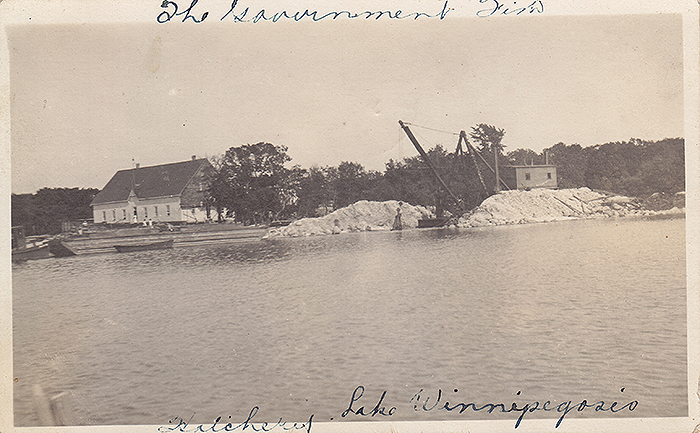
c. 1916

c. 1916

The first mention of the fish hatchery is in the Winnipeg Free Press in 1907. This small article writes that the building and its equipment have been put into place and they now wait for a dock to be built but it would be some time before the buildings would see any proper use. Two whole years would pass before the fish hatchery would officially open its doors and even then it was a rocky start.

Winnipeg Free Press – 22 Oct 1907
Fishing Season Wound
Winnipegosis, Oct. 19. – Fishing operations are wound up for the season and all are preparing for the winter’s work.
P. Wagner, of the department of the interior, is looking into matters connected with the department this week.
The fish hatchery is completed and the glass jars for the fry will at once be placed in position.
Work is expected to commence at once on the dock at Snake Island. The Island will assume its proper importance when it is made a port.

In 1911 a large scale report of recommendations was published by the Manitoba Fisheries Commission. Commissioners J.B. Hugg, D.F. Reid, and Edward E. Prince traveled all across Manitoba in 1909 and 1910 in order to examine the fishing policies and procedures of the day as well as to speak with fishermen in order to determine how to sustain the commercial fishing industry.

Winnipeg Free Press – 21 Oct 1909
Lake Winnipegosis Fishermen Place Their Opinions Before Commissioners

Fish Are Now Plentiful

Closed Summer Seasons Have Good Effect – Hatchery Would Be a Benefit

Winnipegosis, Man., Oct. 20 – The fishery commission continued its meeting here today, many of the oldest fishermen expressing opinions resection the fishing industry. Commissioner Prof. E.E. Prince gave the fish dealers and the fishermen to understand that they were there to investigate the fishing industry from every standpoint. The principal matter discussed today was as to what part of the lake the fishermen wished to be open for summer fishing, and it was learned that they wished the north end of Lake Winnipegosis to be kept open. Prof. Prince stated that the object of the inquiry was to make fishing regulations and to find out to what extent fishing should be allowed so as not to exhaust the lakes of fish, but to make the fishing industry a permanent livelihood for the fishermen and settlers of this vicinity and to arrange the matter so that the fishermen can get the best price possible for their fish.

Fish Do Not Migrate

The fishermen stated that they require to be allowed to use about two thousand wards of net for each man for winter fishing and about half the amount for summer fishing.

They also claimed that the fish do not migrate from one portion of the lake to the other, but each band of fish has its own home and there live and die. It was claimed that the fish are not now as plentiful as when fishing first began, but that the fish are of a better quality than when they were overcrowded, as then they were half starved. The opinion of the fishermen was that a hatchery would be a benefit, but they thought there should be the usual close season to allow nature to follow its course for keeping up the supply of fish in the lakes. It was sworn by the fishermen that the law regarding summer fishing can be observed.

The commission suggested that the amount of net for each fisherman should be five hundred yards, but this was objected to by the fishermen, who stated that a man could not make a living if this was enforced. It was also shown by the fish dealers and fishermen that the industry could not be carried on without exportation to the United States. The fishermen thought a good protection to the whitefish would be that nothing less than a five and a quarter mesh be allowed.

It was stated during the taking of evidence that the fish had increased considerably during the past three years, as the lake had been closed for summer fishing and the fishermen would like not to see the lake open again, but restrictions would be necessary to prevent the lake from being depleted.

The evidence given by the witnesses today was much the same as yesterday. The commission has not made any statements as to what changes will be made in the fishing laws, but they are in favour of putting the fish industry on a permanent basis so as to have it satisfactory to the fishermen and, at the same time, not to exhaust the lakes of fish. The commission will go to Snake Island tomorrow, where the fish hatchery is located, and will leave here Friday evening, which is the first train out of here. The prospects are good for the lake being opened for next summer fishing.

Two whole years would pass before the fish hatchery would open and even after it was a rocky beginning with the commissioners coming to inspect the building and its workings as part of their inquiry.

Winnipeg Free Press – 23 Oct 1909
Commissioners Inspect Hatchery
Plant at Snake Island, in Lake Winnipegosis, Ready to Commence Operations
Winnipegosis, Man., Oct. 22 – The Fisheries commissioners visited the fish hatchery at Snake Island, about five miles east of town, today. The attempt made in the forenoon failed. The commissioners embarked in a gasoline launch, but as it was turning into the Mossey River, leaving the landing place a rod broke, necessitating an hour’s work by a blacksmith in welding it. In the second attempt the party traveled a couple of miles out into the lake and there the machinery stopped and nothing could be done. Capt. Silton came out with his tug and towed the party back in time for dinner. A steam launch was later obtained and the trip made successfully in the afternoon, starting at 2:30 and returning at 4:30. Snake Island is said to be an ideal place for a whitefish hatchery. It is some two miles and a half in length, and narrow, comprising between 200 and 300 acres. Substantial buildings and up-to-date equipment for hatching purposes on a scale of considerable magnitude, have been provided, and everything is in readiness for operation as soon as the spawn can be brought in.

The Process of Hatching

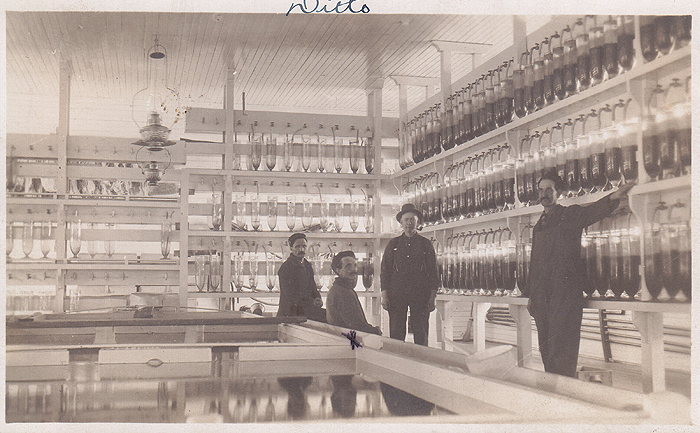
Mr. Finlayson, superintendent of hatcheries, of which there are thirty-give in the Dominion, is one on the lake making preparations for hatching the spawn, which is obtained at this time of year. Allowing for differences of a week or two between the different points on the lake, north and south, as this hatchery is now it is impossible to say even approximately how many whitefish can be hatched in a season, but if the spawn can be obtained in sufficient quantities to fill all the receptacles, there may be perhaps twenty to forty millions hatched each year. The spawn is placed in glass jars, in the centre of each is a glass tube, he top of which is connected by means of a rubber tube with a water tap, and water is pumped up from the lake and kept continually flowing through the jars, the spawn being thereby kept as nearly as possible in the condition in which it would be in the lake.In about six months the fish are hatched out then they are kept for some further time in large tanks through which, as in the glass hank previously, fresh water is kept constantly running. The final operation is the taking of young fish out and depositing them in the lake. Care must be exercised that the temperature of the water be as nearly as possible the same as that in the jars. What proportion of these grew to replenish the lake it is not easy to estimate.

The commissioners proceed to Dauphin tonight to take evidence there tomorrow.

In their interim report the commissioners indicated that more attention needed to be given towards hatchery operations to increase their efficiency. A starting note is that the commissioners found that the Winnipegosis scheme was a serious failure.

“We referred to the prevalent feeling in the province respecting the serious mismanagement which happened in certain seasons formerly, whereby some hatcheries practically were not in operation for one or two seasons…The evidence brought before the Commission clearly provided that on Lake Winnipegosis this was emphatically the case and that there was a serious lack of proper management, and that the system adopted for securing spawn was an altogether unreliable and undesirable one. We are aware that the department, when the matter came to its attention, had a special officer sent to Lake Winnipegosis and we have every reason to believe hat recently a great improvement has taken place and that matters have been put on a more workable basis (p. 15).”

Here is a picture take from the inside of the fish hatchery. My best guess is that it was taken sometime around 1916 as the individual with the X is my great-grandfather who worked at the hatchery. It is interesting to see the inside the of the building given the description of a hatchery from the article above that described the process of hatching.
c. 1916

c. 1916

Dauphin Herald – 20 Feb 1916
Fork River
W.J. Johnston arrived home and intends putting in a few months on the homestead. Johnny has been at the fish hatchery in at Snake Island all winter and says they have they best lot of spawn since the hatchery started.
Dauphin Herald – 17 Apr 1924
Winnipegosis
The government are starting to gather pickerel spawn in the Mossey River, and they have also a number of men destroying suckers in the creeks and small rivers. There is a one cent bounty paid for each sucker destroyed. The reason of destroying these suckers is to prevent them from eating the spawn of the better fish.
The Snake Island fish hatchery is turning out a larger production of fish than it has for years.
Dauphin Herald – 8 May 1924
Commendable Conservation Work
The Fish Cultural Branch of the Department of Marine and Fisheries at Ottawa, last year started a cur safe on the coarse fish in Lake Winnipegosis, particularly on the suckers, which play such havoc by devouring the eggs of the finer and more edible species such as whitefish, for which Lake Winnipegosis is internationally known.Last season upwards of 40 000 suckers were destroyed and a number of the parent fish were distributed to alkaline lakes throughout Manitoba and Saskatchewan, free of all charge.Suckers, being of practically no commercial value, but very prolific, are not fished for, whereas the Whitefish ave been fished very extensively for a great many years and to assist nature to maintain her balance the Department of Marine and Fisheries, some few years ago, established a whitefish hatchery on Snake Island which has proven most effective but it is obvious if the sucker is allowed to multiply unmolested it must eventually predominate.The Department has, therefore, launched a well organized campaign under the supervision of Inspector of Hatcheries S.J. Walker, of Ottawa, and H.J. Reid, Superintendent of the Snake Island Hatchery, and a bounty has been placed on the head of Mr. Sucker with the result that this year approximately 200,000 will be destroyed.To appreciate the result and the ultimate beneficial effect that this commendable action of the Department of Marine and Fisheries will have on the Lake it must be realized that each female sucker will produce, on a conservative estimate, 25,000 eggs, taking 50 percent of the above number destroyed to be females the destruction in eggs will reach the enormous total of 2,500,000,000.While the parent sucker is destroyed, a great number of their eggs are taken and fertilized by officers of the Department and distributed, free of charge, to applicants desiring this species; the sucker being of a hardier variety than most fish found in the Western waters, have a better chance of surviving in alkaline lakes than any other species.

Persons desiring a shipment of these eggs should make application to the Department of Marine and Fisheries at Ottawa, Ont.

Snake Island was not without accident or tragedy as seen in the following articles which mention destruction of property and even death.

Dauphin Herald – 9 Mar 1922
Winnipegosis
The dwelling house at the hatchery on Snake Island was burned to the ground Monday 27th. The maid, who was out milking, on returning to the house found it in flames, and quickly aroused the inmates, who all got safely out. Practically nothing was saved.The fishery overseer from Selkirk was here on behalf of marine and fisheries. He was investigating the need of nouns in the channels. He reports that it is necessary to have buoys, and also one buoy light at a dangerous spot further north.
Dauphin Herald – 30 Nov 1922
Drowned at Winnipegosis
A tragedy occurred at Winnipegosis on Monday evening, in which young Billy McNicol lost his life. Employed at the fish hatchery on Snake Island, he started to skate back the five miles from Winnipegosis just about dark on Monday evening, but never reached there. Being missed the next morning a search part started out, following his tracks, and found his hat on the ice where he had broken through, and the body was recovered about noon.
Mr. Martin, at other employee of the fish hatchery, started to skate across in the opposite direction on the same night, towards Winnipegosis town, and broke through the ice, but was eventually able to crawl back up on the ice, and return to Snake Island.
Dauphin Herald – 14 Jul 1927
Winnipegosis
It was with feelings of deep regret that we learned of the fate of the seaplane which left Snake Island base, Lake Winnipegosis, Monday morning for Victoria Beach, Lake Winnipeg, and met with such fatal results when flying over the Fairford district in which three lives were lost. Aviator Weaver, Mechanic Eardley, and Photograher Wrong, D.L.S. Aviator Weaver has made frequent visit to Winnipegosis in the last few years and all who have been here for some time completing some portions of the air maps. During their brief stay here they had made many friends at Winnipegosis and the Campers at Snake island and members of the hatchery crew all of whom extend their deep sympathy to the relatives in their sad bereavement.
Dauphin Herald – 24 Jul 1930
Cyclone at Snake Island, Lake Winnipegosis
On Thursday evening about nine o’clock a regular cyclone passed over Snake Island. It uprooted dozens of elm and maple trees. The Forestry plane moored at the station there was a complete wreck. The wind tore it from its moorings, breaking both the 1 inch manilla rope and 3-8 inch steel mooring cable with which it was secured to its buoy, turning it over several times smashing both wings and wreaking it in general. Flight Officer H.A. Foley has hone to Winnipeg for another plane. The Provincial Government buildings, where the Hatchery is situated, were undamaged.

Between 1914 and 1918 there was an increase in commercial fishing in Canada due to the demands of the first world war, however with the removal of these demands at the end of the war there was also a decrease in fish production. Another increase in production would be felt again in the 1920s when the international market opened up, however this did not last long as there was another decrease in production at the beginning of the 1930s. This dip proved to be the breaking point of the Snake Island hatchery. The Great Depression also effected how the government managed its budget and the tight purse strings can be seen in the following articles that make mention of debt.

Winnipeg Free Press – 28 Feb 1930
Dominion Government Reduces
Expenditures by Nearly $5 000 000

Harbours and Rivers

In regard to harbours and rivers, the estimate deal generously with the Red River and Lake Winnipeg areas.
A sum of $96500 is provided for Manitoba, to be used as follows:
Arnes wharf repairs … $6000
Habours and rivers, generally, repairs and improvements … $15 000
Hnausa wharf extension … #13 000
Hecla wharf extension … $24 000
Red River renew of jetty … $9500
Roseau River improvements … $10 000
Schist Creek improvements … $2000
Selkirk wharf reconstruction … $3000
Snake Island … $4000

Arnes is a fishing town on Lake Winnipeg, and, in reality, a new wharf will be built, the old one being hopelessly out of repair. The wharf at Hnausa, also a fishing village on Lake Winnipeg, was built two years ago, but offered little, if any, protection against storms. The government, this year, will build an extension to it in the form of an L, thereby providing shelter from high seas. The Snake Island fishing community, also on Lake Winnipeg, is to be given a wharf. The item for the Red River jetty includes the pair of the navigation channel to the north of Selkirk where the river passes through a vast swamp, an also at the outlet to Lake Winnipeg.

Dauphin Herald – 9 Mar 1932
$110,651 Deficit in Natural Resources

Fisheries

Three fish hatcheries are maintained and operated, at Gull Harbour, Lake Winnipeg; Snake Island, Lake Winnipegosis; and Swan Creek, Lake Manitoba. According to Dominion statistics during 1930 the output of these Manitoba hatcheries was equal to the total output of all the other hatcheries in the Dominion.

The hatcheries at Gull Harbour and Snake Island are each capable of handling one hundred million whitefish eggs or a smiler quantity of pickerel eggs, while the hatchery at Swan Creek has handled over two hundred million pickerel eggs. These eggs are distributed in various parts of lake Winnipeg, Winnipegosis and Manitoba, and pickerel eggs are also distributed to numerous small lakes throughout the province.

The Annual Report of the Department of Mines and Natural Resources for the Fiscal Year Ending April 30th, 1933 reported it was found necessary in the interest of economy to close down the Winnipegosis (Snake Island) Hatchery. The Superintendent was placed in charge of the Hatchery at Gull Harbour on Lake Winnipeg (p. 150).

It wasn’t till more than a decade later, after the second world war, that the buildings on the island were put up for sale.

Winnipeg Free Press – 22 Jan 1947
MISC. PROP. FOR SALE 91A
OFFERS TO PURCHASE will be received by the undersigned up until 12 o’clock noon, February 15, 1947, for the following Provincially owned buildings and contents located on Snake Island in Lake Winnipegosis:One double storey frame dwelling, approximately 24’ x 24’ and lean-to.
One Fish Hatchery Building, frame, approximately, 76’ x 36’ and lean-to.
One Frame building approximately 12’ x 16’.
The purchaser to remove the buildings before May 1st, 1947 and leave the site in a work-man-like condition.

HON. ERRICK F. WILLIS.
Minister of Public Works (Man.)
203 Legislative Building, Winnipeg, Manitoba.

In the 1970s and 1980s various youth groups such as the Boy Scouts and the Cubs would visit Snake Island just like those who had taken pleasure trips to the island in the early years. These pleasure seekers would walk and camp among the interesting flora and fauna that made the two mile island their home.

Dauphin Herald – 21 Jul 1910
Winnipegosis
Mrs. H.M. Park and children, are spending the summer holidays at Snake Island, Winnipegosis.
Dauphin Herald – 7 Aug 1913
C.N.R. Employees Excursion August 21st
Three launches have been engaged to play between Winnipegosis and Snake Island which will afford much interest to many, it being a very good picnic ground and also has a large fish hatchery.
Dauphin Herald – 25 Sep 1919
Winnipegosis
A quartette of duck hunters, composed of J.L. Bowman, E.N. McGirr, Dr. Harrington and Dr. Walker returned on Tuesday from a duck hunt at Snake Island on Lake Winnipegosis. They found the bird numerous and got good sized bags. Since their return the hunters have been busy distributing the water-fowl among their friends.
Dauphin Herald – 24 Jun 1920
Winnipegosis
The senior pupils of the Winnipegosis School with principal A.V.B. Lamont and wife and a number of the parents, spent a pleasant afternoon Sunday on board the S.S. Odinak, which sailed to Snake Island hatchery. After touching at the dock they went on south to McArthur point, where a landing was made on the beach. After a pleasant hour’s ramble and swim, lunch was served. A threatening wind and rain storm caused a hurried embarkation. The Odinak touched at Snake Island on the homeward trip, taking off a Dauphin party, who alarmed at the rising storm, were glad of the safety of the larger vessel. About seventy-five were landed safely by Captain J. Denby, who was in charge. All enjoyed themselves, especially the excitement of the trip home.
Dauphin Herald – 13 Jun 1946
Winnipegosis
A large group enjoyed a picnic on the lake last Sunday, visiting Snake Island. Oscar and Sternie Fredrickson obligingly used their gas boats to accommodate the crowds.

In the 1984 report on the department of Manitoba fisheries there is mention of rebuilding the Snake Island fish hatchery. Furthermore, in the late 1980s there is also mention of developing Snake Island into a sheltered picnic area to be marketed first to the local people in the Parkland and then to all of Manitoba and beyond. To the best of my knowledge nothing came about on the development of Snake Island though I am interested in visiting the place one day. It would be interesting to walk along the shoreline and see where this institution stood as it had such an impact on the area just over 100 years ago.

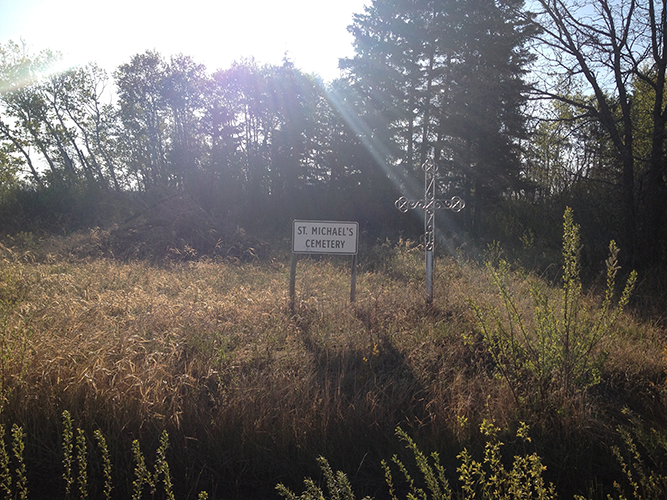
Update

I’ve been working on a new post that is still not finished yet but in the meantime I’ve added a number of names to the Mossey River Honour Roll.

I’ve collected these names from the Dauphin Herald under an article entitled “Dauphin Men in Arms”. It is by no means a complete list, however I hope to update it with more information including date of birth, date of death, and service number.

I will be adding posts on these soldiers including the causality list.

52 Ancestors – Week 21 – William Samuel Wood

It has been several long weeks since I last updated 52 Ancestors but I hope I will get back into the habit. For this week in Amy Johnson Crow’s genealogist challenge: 52 Ancestors in 52 Weeks, I hope to make up for my absence by writing about several people, specifically the husband of my 1st cousin 4x removed, William Samuel Wood (1868-1901) and his family.

William Samuel Wood was born on 23 Aug 1868 in Mountain, Dundas, Canada West to parents Daniel Wood (1841-) and Melissa Ann Lennox (1845-). He had eight other siblings and the family continued to live in the Dundas area until the 1890s when they moved to Renfrew.

My guess is not only did his family bring him to Cobden village but also the nature of his work. William was a brakeman and this would have most likely allowed him to travel across areas of southern Ontario.

Moving to Renfrew was beneficial for William as this is where he met his future wife, my 1st cousin 4x removed, Martha Ritchie (1871-1906). Martha was born to parents Robert Ritchie (1842–1922) and Sophia Esther Holt (1837–1910). Sophia was the sister of my 3rd great grandmother Nancy Adeline Holt (1829-1923) who was married to the patriarch of our family line James Patrick Johnston (1827–1905). Unlike her future husband Martha was from a smaller family with only four siblings.

William Samuel Wood married Martha Ritchie on 18 Nov 1891 in Ross, Renfrew North, Ontario. The happy couple moved out west to the area of Schreiber, Algoma, Ontario where they can be found in the 1901 census. Happier still is that a son was born to them on 8 Dec 1898 named Robert Colin Wood.

Sadly, not long after the 1901 census William passed away at the age of 33 on 6 Oct 1901 from what appears to be some sort of work related accident.

wood, william samuel death

I couldn’t decipher all the writing but I believe it says ‘exhaustion following train injury, fracture spine, chest, and head. six weeks’. I would think that an accident such as this would be found in the local newspapers but I have had no luck finding anything in archives online and have yet to check with local town archives.

Martha Ritchie remarried on 18 Oct 1905 to Alex McFarlone, however their marriage was short lived.

Tragically, Martha passed away at the age of 34, from heart failure, leaving her young son Robert an orphan. Robert went to live with his paternal aunt Martha and her husband Richard Gogg who had no children of their own.

World War War broke out in 1914 and in Mar of 1917 Robert enlisted and became a private of the 28th Battalion. Regimental Number: 1069577. Once more tragedy struck the family when Robert Colin Wood died of his wounds not even a year later on 12 Aug 1918. He is buried in St. Sever Cemetery Extension located in France.

Update

It’s been rather quiet lately on my blog. I’ve been busy with life mostly, however I have added a new page under Mowat Pioneers.

The Mossey River Honour Roll is a collection of names of settlers who fought in WWI, WWII, and the Korean War that I’ve gathered from Memoirs “From The Past”, CEF Attestation Records, the Canadian Virtual War Memorial, the Dauphin Herald, and the Winnipeg Free Press.

It is by no means a complete list, however I hope to update it with more information including date of birth, date of death, and service number.

52 Ancestors – Week 15 – Robert Carl Moxam

For this week in Amy Johnson Crow’s genealogist challenge: 52 Ancestors in 52 Weeks, I am going to write about my maternal 2nd cousin 3x removed, Robert Carl Moxam (1890-1921).

Robert Carl Moxam was born 30 Apr 1890 in the town of Forrester Falls, in the county Renfrew North, Ontario, Canada. His parents were Emmanuel Moxam (1854–1943) and Ann Johnston (1852–1918) and he had eight other siblings. He later moved to the city of Winnipeg with the majority of his family and can be found in the 1911 census at 534 Newman Street. He worked as a monotype operator before WWI.

Robert was part of the active militia, 79th Camerons, when he signed his attestation papers on 22 Sept 1915. His regimental number is: 153838. He became the Company Quarter Master Sergeant of the re-designated the 43rd Battalion (Cameron Highlanders of Canada). It is interesting to note that this regiment produced one of the three Victoria Cross (VC) winners for which Valour Road in Winnipeg, Manitoba, was named: Lieutenant Robert Shankland. I’m curious as to whether Robert Carl knew Robert Shankland and whether they were friends.

On 30 Oct 1919 Robert married an English lady named Emma Boulton Cain in Winnipeg, Manitoba, Canada. Their marriage, however happy it might have been, was brief because Robert died on 28 May, 1921, from the ‘deceased action of his heart’. The Canadian War Graves Registers indicates that his death was a result from his time served with the military. I wonder what sort of injuries he received in the war that would have plagued him for years after the war ended.

Robert is buried in the Elmwood Cemetery. His wife Emma is recorded as living with her father-in-law in Jun of the 1921 Census. It must have been a frightening time for Emma, being so far from the land she once called home, with the husband she followed to Canada having died only a few short years.

52 Ancestors – Week 11 – Hyacinth Pelletier

For this week in Amy Johnson Crow’s genealogist challenge: 52 Ancestors in 52 Weeks, I am going to write about my maternal 2nd great-grandfather, Hyacinth Pelletier (1849-1911).

Researching my maternal ancestors has been a rather difficult process. In the case of my 2nd great-grandfather I believe some sort of transcription error occurred in several Canadian census records.

Just below you can see Hyacinth and his wife living near Crooked Lake in the Assiniboia area of the Territories in the 1901 Census. They’re recorded as being ‘F.B.’, Roman Catholics, with their mother tongue being French. I wasn’t sure what ‘F.B.’ meant but a look at what the Métis National Council had on information about the 1901 Census indicates that this was how enumerators recorded individuals with mixed blood. In this case, Hyacinth and his wife are what they described as being ‘French breeds’. A look at the LAC had on the census also noted that Aboriginal tribes would have been traced through their mothers and the specific tribe name was to be recorded. It is interesting to note that this was not done by the enumerator.

1901

1901

I’ve been unable to find Hyacinth and his wife in the 1906 census. Furthermore, something odd occurs in the census records that follow. Hyacinth Pelletier is now a widowed woman. She is recorded as being Cree, Roman Catholic, and can speak ‘Indian’ and French. She is also living with her son Joseph Pelletier (1876-?) and their family.

1911 Hyacinth

1911

Hyacinth is then recorded as living with her son Joseph Pelletier as well as her nephew and niece Emmanuel and Angelique LeRat in the 1916 Census. The same information from the 1911 Census is recorded regarding her race, religion, and languages.

1916

1916

Hyacinth is then recorded as living with her son Joesph Pelletier and his family in the 1921 Census. She is recorded as being blind while the same information is recorded for race and religion, however she is recorded as being unable to speak French.

1921

1921

The changes in the census records from 1911 to 1921 make me believe that the person recorded as ‘Hyacinth Pelletier’ is in reality his wife Julienne LaVallee (1853) and that Hyacinth must has died sometime before the 1911 census. If I could find either person in the 1906 census it would make matters a little clearer but it could be the case the Hyacinth passed away before the 1906 census. Furthermore, my knowledge of Julienne as his wife and the rest of the family is murky at best as I used unsourced family trees from Ancestry. I do know from speaking with family that we are related to the LaVallee and LeRat family names but I have no firm knowledge on specifics.

52 Ancestors – Week 9 – Unknown Ladies

For this week in Amy Johnson Crow’s genealogist challenge: 52 Ancestors in 52 Weeks, I would like to present an interesting photo in my possession.

c. 1880s

c. 1880s-1890s

This small photo was found in the very front of an old photo album that my great-aunt Ruth owned. Along side this photo was a set of two others of nearly the same size that said ‘Pa Johnston’ and ‘Pa with girlfriends’.

c. 1900s

c. 1890s-1900s

My best guess is that the young ladies from the first photo are somehow related to Pa Johnston, what my great-aunt called her step-father, my great grandfather, James Washington Johnston (1876-1967). The first photo appears to be possibly older than the second if we compare by way of the fashion.

The first photo must have been taken sometime during the winter as the ladies seem to be wearing heavy winter coats. I especially like the details on the second lady’s coat, they seem to be some sort of flowery piping right along the front opening. The hats / bonnets worn by the ladies in the first photo are also very interesting. I’d hazard a guess that the lady on the left is younger than the lady on the right because of her youthful face, her hair seems to be worn down, and her bonnet seems more youthful.

The second photo is easier to date, based on my limited knowledge of historical fashion, because the ladies seem to be sporting the Gibson Girl fashion popular in the 1890s and early 1900s. James Washington would have been in his early twenties.