Update

It has been several months since my last post.

Presently I have been working on creating a more concrete list of Marion Harland’s weekly column entitled “School for Housewives.” I have collected approximately 313 different articles published between 1902 and 1911 from various newspapers across Canada and the United States.

Considering there are 52 weeks in a year and the articles seem to have been published once a week over a 10 year period I should need to collect a total of 520 articles. This means I may still be missing 207 articles as I have not found a continuous publication of her column within newspapers to browse online.

Year Number of Articles Collected
1902 18
1903 31
1904 43
1905 38
1906 19
1907 39
1908 33
1909 27
1910 46
1911 5

I am hoping to post more regularly on these articles in the coming year on top of more regular blog posts including in the Dauphin Herald.

52 Ancestors – Week 45 – Fredrick John Childs Storrar

It has been several long weeks since I last updated 52 Ancestors but with Remembrance Day just around the corner I thought I would write up a post or two on some relatives who fought in the First Great War. For this week in Amy Johnson Crow’s genealogist challenge: 52 Ancestors in 52 Weeks, I will be writing about Fredrick John Childs Storrar (1893-1969) who is my first cousin twice removed.

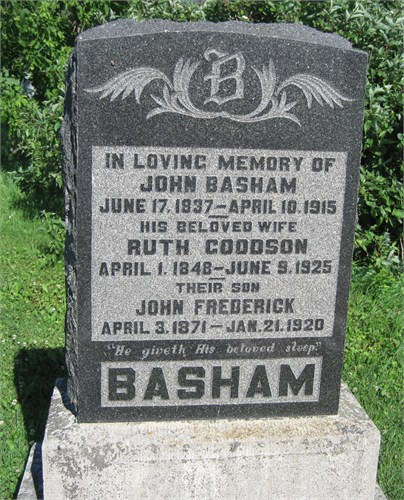
Fred Jr. was born to parents Fredrick Alfred Storrar (1859-1934) and Ruth Edith Basham (1872-1948). Ruth was the eldest daughter to John and Ruth Basham who were my my 2nd great grandparents. Fred Sr. was born to William Storrar and Fanny Bishop though I do not know much about his family. It appears he is living with his maternal aunt and uncle at the age of 12 and later with his sister at 16 Ballance Road in 1891. This is where I suspect Fred Sr. met Ruth Basham as her family also lived on Ballance Road, 18 Ballance Road to be exact. Fred and Ruth married on Jul 31, 1892, Ruth was fourteen years younger than her new husband but I don’t believe such an age gap was an anomaly.

The young couple would have their first son, Fredrick John Childs on Aug 6 1893 in Homerton, Hackney, just over a year after they were married. Their baby boy was baptized in St. Luke’s, the same church that they had been married in. I must make note of one of Fred Jr.’s middle names – ‘Childs’. I always found this to be a strange name and often wondered if this was just a misspelling but in fact in one instance where the name ‘Charles’ was written on a document it had been crossed out and corrected to ‘Childs’. My best guess at this point is that there is some sort of relation to the surname ‘Childs’ but at present I have been unable to find one.

Fred was not an only child, in fact, he had several younger siblings named Owen Alfred, Edith Grace, and Eva May. Sadly both Owen Alfred and Edith Grace died before they reached their first birthday although both were baptized at St. Luke like their older brother.

After his children Owen Alfred and Edith Grace died the older Fredrick Alfred traveled on the S.S. Victorian to Canada in May 1905. Perhaps hearing how the Basham family had made a new start in Manitoba, Ruth, missing the support of her family, urged Fred Sr. to travel and find a job in the same area so they could be close to her relatives. He would work as a farm labourer in the Mossey River area at least until the age of 62 years.

Just over a year later Ruth would follow her husband to Canada on the S.S. Virginian along with her two young children Fred Jr. and Eva in Oct 1906. Ruth and Fred Sr., however, did not live together when she arrived in the Mossey River Municipality. Instead, Ruth and the children went to live with her older brother John Basham at SW-6-29-18-W1. Were the strains of marriage too much to handle or was it more economical to live separately?

Fred Jr. and Eva were 13 and 9 respectively when they arrived in Canada and I can only assume they attended one of the local school such as Mowat, however I have been unable to locate school records before 1916 to confirm this information. On Aug 21, 1915 Fred Jr. along with his cousin William Henderson Johnston traveled to Dauphin to join the military. Together, these two young men fought in the 31st Battalion that was also known as the Bell’s Bulldogs but only one of them would ever return to Canada again.

Fred Jr.’s sister, Eva, also worked to help support the war effort and moved to Winnipeg in 1916 to join the Red Cross. She would later marry Alexander Reader, an English immigrant, who joined the military and fought in the 45th Battllion. Eva would have two sons, Ronald (Ron) and Fredrick (Jack), but would not live to see them grow up. Eva died at the age of twenty four in Winnipeg, Manitoba.

Dauphin Herald – 7 Oct 1915
Fork River
Private F.J. Storrar is home from Sewell camp for a few days visiting his friends and looks quite spruce in his Kaki.

Indeed he did! Here is a picture of Fred Jr. Storrar in his military uniform. I wish I had a similar one of William Henderson Johnston in his uniform but I’m afraid I have no photographs of him at all. I would have also liked to see a photograph with clearer insignia but I am happy to have this picture which is in fact a postcard.

c. 1916

c. 1915

Dauphin Herald – 16 Jun 1916
Fork River
Max King is with the 61st Batallion at Shorn Cliff England. He writes that he was over and visited Billy Johnston, F. Storrar and the Lintick before they left for France and all were well.
Dauphin Herald – 11 Apr 1918
Fork River
Private F. Storrar has arrived home from England after being away two years. He is still suffering from the injury to his leg.

This article above mentions an injury to his leg. I was curious as to what exactly this injury was and how it affected him during the war and so I ordered Fred Jr.’s military files from the LAC. On one of the first medical sheets I came across there was a note that he had injured his left knee in 1915 and consequently he had constant aches and pains, swelling that made marching difficult, and could only flex his leg about 30 degrees.

Now, how exactly did Fred Jr. injure his knee? It was in Sept of 1915, not even a month after he enlisted, that Fred Jr. fell into a trench and twisted his left knee at Sewell Camp. He was put on light duties but returned to normal duties after several weeks. After contracting rheumatic fever in France in 1916 Fred Jr. received another injury to the same knee. No longer able to perform heavy work, Fred Jr. would go between light duties and the infirmary for his entire military career spending approximately 176-468 days in hospital.

These complaints eventually required surgery in Jul 1917 to remove loose cartilage. Further surgery to his knee occurred in Oct of 1917 but there would be little to no improvement. Fred Jr. now would walk with a permanent limp and would require a cane. Due to his injury Fred Jr. was discharged from the military on Apr 23, 1918 once he returned to Winnipeg.

Dauphin Herald – 16 May 1918
Fork River
On Friday evening May 10th a large number from Fork River and Winnipegosis met at the Orange Hall to welcome Private F. Storrar who has returned from the front. S. Gower read an address and Wm. King presented him with a gold watch and chair on behalf of the citizens. The ladies provided supper and dancing continued till morning.

In 1919 Fred Jr. began the purchase of 160 arces of CPR land at NE-5-29-18-W1 however this was cancelled on Sep 28, 1925. In the 1921 Census Fred Jr. is living in a small log home at 6-29-18-W1 with his mother Ruth. To my understanding this is the same home John Basham lived in that he passed down to his sisters Ruth and Ada after his death in 1920. After this I am not sure what happened to Fred Jr. but I am certain he remained living in the Mossey River Municipality to farm though he never married.

c. 1920

c. 1920

In the Mar 29, 1968 issue of the Dauphin Herald Fred Jr. shared two photographs, one is of a 490 Chev with Max King in the driver’s seat and beside him is Fred himself. Through the windshield standing near the building may be seen the late William King, the postmaster at that time, and the late T.N. Briggs Sr. I hazard a guess that this photograph was taken sometime in the 1920s after Fred Jr. returned from the war as the 490 was not built until 1918.

Fred Jr. passed away on Jan 25, 1969 at the Dauphin General Hospital in Dauphin, Manitoba and he is buried in Riverside Cemetery.

Thanksgiving baking, some delicious recipes…

I enjoy baking more than I enjoy cooking a main meal and this year I decided to make a few goodies for Thanksgiving this Monday. This lead me to one of the books I have in my collection, The R.M. of Mossey River Homecoming Cookbook 1996, that my family purchased while at the reunion.

One of the memories that sticks out during this reunion is helping my grandmother, Pauline Johnston, serve ice-cream. While I don’t enjoy eating Tiger, Tiger it stands out as one of the most pleasant memories I have with my grandmother. I also remember during one presentation during the festivities that a coordinator read a letter from my great-aunt, Ruth Galbraith, who was unable to attend but wanted to send well wishes as she taught at a number of schools in the area including Mowat.

R.M. of Mossey River Homecoming Cookbook 1996
ACKNOWLEDGEMENT
The publication of the cookbook was in honour of the celebration of he Homecoming of the R.M. of Mossey River held on July 19, 1996.Special thanks to all those who contributed their treasured recipes for our cookbook. The response was overwhelming, we had received almost 1600 recipes.Unfortunately we were not able to print all the recipes. Please accept our apologies for those recipes that space did not permit us to include and also any errors and/or omissions.As you read these recipes in this cookbook, we hope that it will become a cherished memento of an old school friend, an old acquaintance or neighbour, and that it will continue to be read by generations to come.Cookbook committee:
Emily Pylypchuk – Co-ordinator
Marlene Hafenbrak
Kathy McGill
Phyllis Momotiuk
Stella Monchka
Angela Pylypchuk

A special thank-you to Kathy McGill for the beautiful artwork on the cover and divider pages, also to Evelyn Remple of D&E Computer Services for helping us to set up the artwork and lettering. Thanks to Michelle Monchka for helping with the typing.

Many thanks to those who have supported us to make this cookbook a success.

This cookbook has been sponsored by the Fork River Community Hall.

RICE KRISPIE SQUARES April Mrozowich (Natrasony)
Darren – Fork River School
1/4 cup margarine 1/2 teaspoon vanilla
5 cups miniature marshmallows
or 40 regular, cut in half
6 cups Kellogg’s Rice Krispies
In a large saucepan over low heat, melt margarine. Add marshmallows, stirring until melted and well blended. Remove from heat, then stir in vanilla. Add, Rice Krispies, stirring until well coated. With a lightly buttered spatula, press into a buttered 9×13 inch pan.
** For a festive look drizzle with melted chocolate or sprinkle with cake sprinkles.

Very easy recipe but tasty none-the-less.

CARROT SPICE CAKE Freda Brown (Benson) – Odda School
In a bowl beat 4 large eggs with 2 cups of white sugar until light. Beat in 1-1/4 cups of vegetable oil, a little at a time, beating well after each addition. Stir in 2 cups sifted all-purpose flour sifted again with 2 teaspoons each of cinnamon and baking soda, and a pinch salt. Stir in 3 cups loosely packed grated carrots (1/2 pound). Add 1 cup chopped pecans or walnuts and teaspoon vanilla. Transfer to well buttered and floured 9×19 inch pan. Bake at 350 degrees F, for 35 to 45 minutes.
Icing
8 ounce pkg. cream cheese 2 cups icing sugar
1/4 cup butter 1 teaspoon vanilla
Cream icing ingredients together.

The carrot cake seemed a little dry by itself but when paired with icing it was a nice combination.

The recipe below is a family favourite. Whenever the grand-kids or great grand-kids went to visit grandma at the farm she would bake each child a whole ice-cream pail full of kiffles. These have a nice cinnamon sugar taste and are good on their own or with a little ice-cream or hot chocolate.

KIFFLES Pauline Masiowski
1 tablespoon yeast
1/2 cup warm water
1 teaspoon sugar 3 cups floor
1 tablespoons sugar 1/2 teaspoon salt
1 cup butter or margarine 1/2 cup water or milk
2 eggs
Soak first 3 ingredients; meanwhile mix as for pie crust the remaining ingredients, adding yeast mixture, knead until soft and place in fridge over night. In the morning divide dough into 4 or 5 pieces. Roll as for pie in sugar and cinnamon mixture (1 cup sugar and 1 tsp cinnamon). Cut into wedges of 8 per piece and roll from wide end to middle. Bake in over at 350 degrees F for 20 minutes or until golden brown.

Snake Island Fish Hatchery

While I have highlighted a few of my relatives with the help of 52 Ancestors I thought I would do something different this week. This week, instead of a person, I am going to focus on a government institution that employed a number of local men from Mowat and beyond, including my great-grandfather, who lived along the shores of Lake Winnipegosis.

This week I will be looking at the Snake Island Hatchery.

Now what exactly is a fish hatchery you may ask? Well, as Wikipedia has neatly written a fish hatchery is a place where artificial breeding, hatching, and rearing of fish occurs and is typically done to support the aquaculture industry.

Much of the information below can be found in the Department of Natural Resources Fisheries Branch 1984 report The Past, Present and Projected Demands on Manitoba’s Freshwater Fish Resources. The first records of commercial fishing in Manitoba date back to 1872 when a few men from Winnipeg established a fishing station on the Little Saskatchewan River, now called the Dauphin River. This early venture failed due to a number of factors such as poor transportation, the abundance of fish, and heavy competition with the Great Lake fisheries. Only in the following decade, with the introduction of efficient freight and fishing boats and the expanding market, did the industry became more commercially successful.

The success found on Lake Winnipeg opened up opportunities for commercial fishing on Manitoba’s other lakes including Lake Manitoba and Lake Winnipegosis. Growth in the industry can be attributed to the development of the railway as well as other modes of transportation. The commercial fishing industry on Lake Winnipegosis developed rapidly when the rail-line to the town was completed in 1897.

Lake Winnipeg, Lake Winnipegosis, and Lake Manitoba have been the three most important fisheries in the province while Whitefish was the most important species caught until their decline in the 1920s and 1930s. Advancements in equipment such as gasoline powered boats and stronger gill-nets made fishing quicker and easier than ever before and consequently with all the success there were also concerns of sustainability and depletion.

As early as 1892 a number of regulations were enacted in order to restrict and confine commercial fishing, some of these regulations include the size and limit of fish, the type of nets and boats used, as well as the start and close of the fishing season. The first fish hatchery in Manitoba was built at Selkirk and was constructed in 1894. This hatchery, however, was closed in 1914 and replaced by another at Gull Harbour that was later moved to the mouth of the Dauphin River. A number of different hatcheries were built to support the fishing industry on the three major lakes but I will only be taking a closer look at one of them.

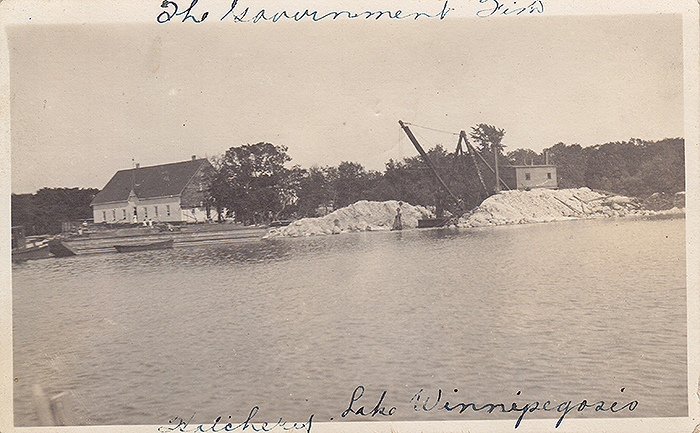
The Snake Island fish hatchery was the first to be built on Lake Winnipegosis, 1909, and was located on the south end of the lake. In fact, Snake Island is one of the closer islands on the lake to the town of Winnipegosis, it was only five miles away. I can only speculate why it is called Snake Island but a note in a 2001 letter to the editor of the Dauphin Herald mentions little red Garter Snakes swimming out to the island on Lake Winnipegosis. While snakes might not be afraid to swim, five miles seem like a long way from the mainland, but I suppose the island could have made a good nesting ground for the snakes away from predators.

Below is a picture taken of Snake Island and what is suppose to be the hatchery however I believe the building in the photograph might actually be the building for the department of forestry that was also on the island.

c. 1916

c. 1916

The first mention of the fish hatchery is in the Winnipeg Free Press in 1907. This small article writes that the building and its equipment have been put into place and they now wait for a dock to be built but it would be some time before the buildings would see any proper use. Two whole years would pass before the fish hatchery would officially open its doors and even then it was a rocky start.

Winnipeg Free Press – 22 Oct 1907
Fishing Season Wound
Winnipegosis, Oct. 19. – Fishing operations are wound up for the season and all are preparing for the winter’s work.
P. Wagner, of the department of the interior, is looking into matters connected with the department this week.
The fish hatchery is completed and the glass jars for the fry will at once be placed in position.
Work is expected to commence at once on the dock at Snake Island. The Island will assume its proper importance when it is made a port.

In 1911 a large scale report of recommendations was published by the Manitoba Fisheries Commission. Commissioners J.B. Hugg, D.F. Reid, and Edward E. Prince traveled all across Manitoba in 1909 and 1910 in order to examine the fishing policies and procedures of the day as well as to speak with fishermen in order to determine how to sustain the commercial fishing industry.

Winnipeg Free Press – 21 Oct 1909
Lake Winnipegosis Fishermen Place Their Opinions Before Commissioners

Fish Are Now Plentiful

Closed Summer Seasons Have Good Effect – Hatchery Would Be a Benefit

Winnipegosis, Man., Oct. 20 – The fishery commission continued its meeting here today, many of the oldest fishermen expressing opinions resection the fishing industry. Commissioner Prof. E.E. Prince gave the fish dealers and the fishermen to understand that they were there to investigate the fishing industry from every standpoint. The principal matter discussed today was as to what part of the lake the fishermen wished to be open for summer fishing, and it was learned that they wished the north end of Lake Winnipegosis to be kept open. Prof. Prince stated that the object of the inquiry was to make fishing regulations and to find out to what extent fishing should be allowed so as not to exhaust the lakes of fish, but to make the fishing industry a permanent livelihood for the fishermen and settlers of this vicinity and to arrange the matter so that the fishermen can get the best price possible for their fish.

Fish Do Not Migrate

The fishermen stated that they require to be allowed to use about two thousand wards of net for each man for winter fishing and about half the amount for summer fishing.

They also claimed that the fish do not migrate from one portion of the lake to the other, but each band of fish has its own home and there live and die. It was claimed that the fish are not now as plentiful as when fishing first began, but that the fish are of a better quality than when they were overcrowded, as then they were half starved. The opinion of the fishermen was that a hatchery would be a benefit, but they thought there should be the usual close season to allow nature to follow its course for keeping up the supply of fish in the lakes. It was sworn by the fishermen that the law regarding summer fishing can be observed.

The commission suggested that the amount of net for each fisherman should be five hundred yards, but this was objected to by the fishermen, who stated that a man could not make a living if this was enforced. It was also shown by the fish dealers and fishermen that the industry could not be carried on without exportation to the United States. The fishermen thought a good protection to the whitefish would be that nothing less than a five and a quarter mesh be allowed.

It was stated during the taking of evidence that the fish had increased considerably during the past three years, as the lake had been closed for summer fishing and the fishermen would like not to see the lake open again, but restrictions would be necessary to prevent the lake from being depleted.

The evidence given by the witnesses today was much the same as yesterday. The commission has not made any statements as to what changes will be made in the fishing laws, but they are in favour of putting the fish industry on a permanent basis so as to have it satisfactory to the fishermen and, at the same time, not to exhaust the lakes of fish. The commission will go to Snake Island tomorrow, where the fish hatchery is located, and will leave here Friday evening, which is the first train out of here. The prospects are good for the lake being opened for next summer fishing.

Two whole years would pass before the fish hatchery would open and even after it was a rocky beginning with the commissioners coming to inspect the building and its workings as part of their inquiry.

Winnipeg Free Press – 23 Oct 1909
Commissioners Inspect Hatchery
Plant at Snake Island, in Lake Winnipegosis, Ready to Commence Operations
Winnipegosis, Man., Oct. 22 – The Fisheries commissioners visited the fish hatchery at Snake Island, about five miles east of town, today. The attempt made in the forenoon failed. The commissioners embarked in a gasoline launch, but as it was turning into the Mossey River, leaving the landing place a rod broke, necessitating an hour’s work by a blacksmith in welding it. In the second attempt the party traveled a couple of miles out into the lake and there the machinery stopped and nothing could be done. Capt. Silton came out with his tug and towed the party back in time for dinner. A steam launch was later obtained and the trip made successfully in the afternoon, starting at 2:30 and returning at 4:30. Snake Island is said to be an ideal place for a whitefish hatchery. It is some two miles and a half in length, and narrow, comprising between 200 and 300 acres. Substantial buildings and up-to-date equipment for hatching purposes on a scale of considerable magnitude, have been provided, and everything is in readiness for operation as soon as the spawn can be brought in.

The Process of Hatching

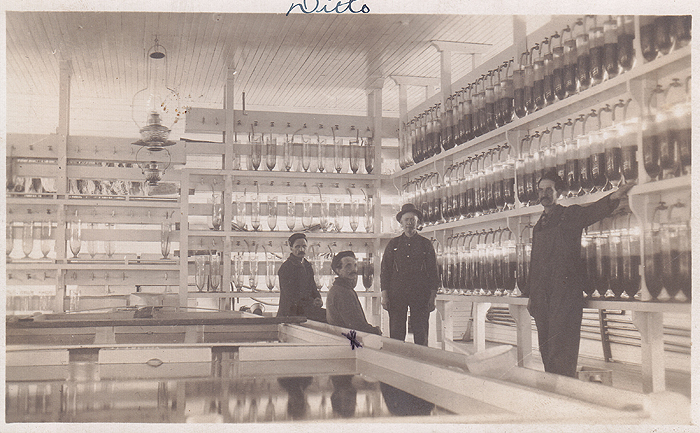
Mr. Finlayson, superintendent of hatcheries, of which there are thirty-give in the Dominion, is one on the lake making preparations for hatching the spawn, which is obtained at this time of year. Allowing for differences of a week or two between the different points on the lake, north and south, as this hatchery is now it is impossible to say even approximately how many whitefish can be hatched in a season, but if the spawn can be obtained in sufficient quantities to fill all the receptacles, there may be perhaps twenty to forty millions hatched each year. The spawn is placed in glass jars, in the centre of each is a glass tube, he top of which is connected by means of a rubber tube with a water tap, and water is pumped up from the lake and kept continually flowing through the jars, the spawn being thereby kept as nearly as possible in the condition in which it would be in the lake.In about six months the fish are hatched out then they are kept for some further time in large tanks through which, as in the glass hank previously, fresh water is kept constantly running. The final operation is the taking of young fish out and depositing them in the lake. Care must be exercised that the temperature of the water be as nearly as possible the same as that in the jars. What proportion of these grew to replenish the lake it is not easy to estimate.

The commissioners proceed to Dauphin tonight to take evidence there tomorrow.

In their interim report the commissioners indicated that more attention needed to be given towards hatchery operations to increase their efficiency. A starting note is that the commissioners found that the Winnipegosis scheme was a serious failure.

“We referred to the prevalent feeling in the province respecting the serious mismanagement which happened in certain seasons formerly, whereby some hatcheries practically were not in operation for one or two seasons…The evidence brought before the Commission clearly provided that on Lake Winnipegosis this was emphatically the case and that there was a serious lack of proper management, and that the system adopted for securing spawn was an altogether unreliable and undesirable one. We are aware that the department, when the matter came to its attention, had a special officer sent to Lake Winnipegosis and we have every reason to believe hat recently a great improvement has taken place and that matters have been put on a more workable basis (p. 15).”

Here is a picture take from the inside of the fish hatchery. My best guess is that it was taken sometime around 1916 as the individual with the X is my great-grandfather who worked at the hatchery. It is interesting to see the inside the of the building given the description of a hatchery from the article above that described the process of hatching.

c. 1916

c. 1916

Dauphin Herald – 20 Feb 1916
Fork River
W.J. Johnston arrived home and intends putting in a few months on the homestead. Johnny has been at the fish hatchery in at Snake Island all winter and says they have they best lot of spawn since the hatchery started.
Dauphin Herald – 17 Apr 1924
Winnipegosis
The government are starting to gather pickerel spawn in the Mossey River, and they have also a number of men destroying suckers in the creeks and small rivers. There is a one cent bounty paid for each sucker destroyed. The reason of destroying these suckers is to prevent them from eating the spawn of the better fish.
The Snake Island fish hatchery is turning out a larger production of fish than it has for years.
Dauphin Herald – 8 May 1924
Commendable Conservation Work
The Fish Cultural Branch of the Department of Marine and Fisheries at Ottawa, last year started a cur safe on the coarse fish in Lake Winnipegosis, particularly on the suckers, which play such havoc by devouring the eggs of the finer and more edible species such as whitefish, for which Lake Winnipegosis is internationally known.Last season upwards of 40 000 suckers were destroyed and a number of the parent fish were distributed to alkaline lakes throughout Manitoba and Saskatchewan, free of all charge.Suckers, being of practically no commercial value, but very prolific, are not fished for, whereas the Whitefish ave been fished very extensively for a great many years and to assist nature to maintain her balance the Department of Marine and Fisheries, some few years ago, established a whitefish hatchery on Snake Island which has proven most effective but it is obvious if the sucker is allowed to multiply unmolested it must eventually predominate.The Department has, therefore, launched a well organized campaign under the supervision of Inspector of Hatcheries S.J. Walker, of Ottawa, and H.J. Reid, Superintendent of the Snake Island Hatchery, and a bounty has been placed on the head of Mr. Sucker with the result that this year approximately 200,000 will be destroyed.To appreciate the result and the ultimate beneficial effect that this commendable action of the Department of Marine and Fisheries will have on the Lake it must be realized that each female sucker will produce, on a conservative estimate, 25,000 eggs, taking 50 percent of the above number destroyed to be females the destruction in eggs will reach the enormous total of 2,500,000,000.While the parent sucker is destroyed, a great number of their eggs are taken and fertilized by officers of the Department and distributed, free of charge, to applicants desiring this species; the sucker being of a hardier variety than most fish found in the Western waters, have a better chance of surviving in alkaline lakes than any other species.

Persons desiring a shipment of these eggs should make application to the Department of Marine and Fisheries at Ottawa, Ont.

Snake Island was not without accident or tragedy as seen in the following articles which mention destruction of property and even death.

Dauphin Herald – 9 Mar 1922
Winnipegosis
The dwelling house at the hatchery on Snake Island was burned to the ground Monday 27th. The maid, who was out milking, on returning to the house found it in flames, and quickly aroused the inmates, who all got safely out. Practically nothing was saved.The fishery overseer from Selkirk was here on behalf of marine and fisheries. He was investigating the need of nouns in the channels. He reports that it is necessary to have buoys, and also one buoy light at a dangerous spot further north.
Dauphin Herald – 30 Nov 1922
Drowned at Winnipegosis
A tragedy occurred at Winnipegosis on Monday evening, in which young Billy McNicol lost his life. Employed at the fish hatchery on Snake Island, he started to skate back the five miles from Winnipegosis just about dark on Monday evening, but never reached there. Being missed the next morning a search part started out, following his tracks, and found his hat on the ice where he had broken through, and the body was recovered about noon.
Mr. Martin, at other employee of the fish hatchery, started to skate across in the opposite direction on the same night, towards Winnipegosis town, and broke through the ice, but was eventually able to crawl back up on the ice, and return to Snake Island.
Dauphin Herald – 14 Jul 1927
Winnipegosis
It was with feelings of deep regret that we learned of the fate of the seaplane which left Snake Island base, Lake Winnipegosis, Monday morning for Victoria Beach, Lake Winnipeg, and met with such fatal results when flying over the Fairford district in which three lives were lost. Aviator Weaver, Mechanic Eardley, and Photograher Wrong, D.L.S. Aviator Weaver has made frequent visit to Winnipegosis in the last few years and all who have been here for some time completing some portions of the air maps. During their brief stay here they had made many friends at Winnipegosis and the Campers at Snake island and members of the hatchery crew all of whom extend their deep sympathy to the relatives in their sad bereavement.
Dauphin Herald – 24 Jul 1930
Cyclone at Snake Island, Lake Winnipegosis
On Thursday evening about nine o’clock a regular cyclone passed over Snake Island. It uprooted dozens of elm and maple trees. The Forestry plane moored at the station there was a complete wreck. The wind tore it from its moorings, breaking both the 1 inch manilla rope and 3-8 inch steel mooring cable with which it was secured to its buoy, turning it over several times smashing both wings and wreaking it in general. Flight Officer H.A. Foley has hone to Winnipeg for another plane. The Provincial Government buildings, where the Hatchery is situated, were undamaged.

Between 1914 and 1918 there was an increase in commercial fishing in Canada due to the demands of the first world war, however with the removal of these demands at the end of the war there was also a decrease in fish production. Another increase in production would be felt again in the 1920s when the international market opened up, however this did not last long as there was another decrease in production at the beginning of the 1930s. This dip proved to be the breaking point of the Snake Island hatchery. The Great Depression also effected how the government managed its budget and the tight purse strings can be seen in the following articles that make mention of debt.

Winnipeg Free Press – 28 Feb 1930
Dominion Government Reduces
Expenditures by Nearly $5 000 000

Harbours and Rivers

In regard to harbours and rivers, the estimate deal generously with the Red River and Lake Winnipeg areas.
A sum of $96500 is provided for Manitoba, to be used as follows:
Arnes wharf repairs … $6000
Habours and rivers, generally, repairs and improvements … $15 000
Hnausa wharf extension … #13 000
Hecla wharf extension … $24 000
Red River renew of jetty … $9500
Roseau River improvements … $10 000
Schist Creek improvements … $2000
Selkirk wharf reconstruction … $3000
Snake Island … $4000

Arnes is a fishing town on Lake Winnipeg, and, in reality, a new wharf will be built, the old one being hopelessly out of repair. The wharf at Hnausa, also a fishing village on Lake Winnipeg, was built two years ago, but offered little, if any, protection against storms. The government, this year, will build an extension to it in the form of an L, thereby providing shelter from high seas. The Snake Island fishing community, also on Lake Winnipeg, is to be given a wharf. The item for the Red River jetty includes the pair of the navigation channel to the north of Selkirk where the river passes through a vast swamp, an also at the outlet to Lake Winnipeg.

Dauphin Herald – 9 Mar 1932
$110,651 Deficit in Natural Resources

Fisheries

Three fish hatcheries are maintained and operated, at Gull Harbour, Lake Winnipeg; Snake Island, Lake Winnipegosis; and Swan Creek, Lake Manitoba. According to Dominion statistics during 1930 the output of these Manitoba hatcheries was equal to the total output of all the other hatcheries in the Dominion.

The hatcheries at Gull Harbour and Snake Island are each capable of handling one hundred million whitefish eggs or a smiler quantity of pickerel eggs, while the hatchery at Swan Creek has handled over two hundred million pickerel eggs. These eggs are distributed in various parts of lake Winnipeg, Winnipegosis and Manitoba, and pickerel eggs are also distributed to numerous small lakes throughout the province.

The Annual Report of the Department of Mines and Natural Resources for the Fiscal Year Ending April 30th, 1933 reported it was found necessary in the interest of economy to close down the Winnipegosis (Snake Island) Hatchery. The Superintendent was placed in charge of the Hatchery at Gull Harbour on Lake Winnipeg (p. 150).

It wasn’t till more than a decade later, after the second world war, that the buildings on the island were put up for sale.

Winnipeg Free Press – 22 Jan 1947
MISC. PROP. FOR SALE 91A
OFFERS TO PURCHASE will be received by the undersigned up until 12 o’clock noon, February 15, 1947, for the following Provincially owned buildings and contents located on Snake Island in Lake Winnipegosis:One double storey frame dwelling, approximately 24’ x 24’ and lean-to.
One Fish Hatchery Building, frame, approximately, 76’ x 36’ and lean-to.
One Frame building approximately 12’ x 16’.
The purchaser to remove the buildings before May 1st, 1947 and leave the site in a work-man-like condition.

HON. ERRICK F. WILLIS.
Minister of Public Works (Man.)
203 Legislative Building, Winnipeg, Manitoba.

In the 1970s and 1980s various youth groups such as the Boy Scouts and the Cubs would visit Snake Island just like those who had taken pleasure trips to the island in the early years. These pleasure seekers would walk and camp among the interesting flora and fauna that made the two mile island their home.

Dauphin Herald – 21 Jul 1910
Winnipegosis
Mrs. H.M. Park and children, are spending the summer holidays at Snake Island, Winnipegosis.
Dauphin Herald – 7 Aug 1913
C.N.R. Employees Excursion August 21st
Three launches have been engaged to play between Winnipegosis and Snake Island which will afford much interest to many, it being a very good picnic ground and also has a large fish hatchery.
Dauphin Herald – 25 Sep 1919
Winnipegosis
A quartette of duck hunters, composed of J.L. Bowman, E.N. McGirr, Dr. Harrington and Dr. Walker returned on Tuesday from a duck hunt at Snake Island on Lake Winnipegosis. They found the bird numerous and got good sized bags. Since their return the hunters have been busy distributing the water-fowl among their friends.
Dauphin Herald – 24 Jun 1920
Winnipegosis
The senior pupils of the Winnipegosis School with principal A.V.B. Lamont and wife and a number of the parents, spent a pleasant afternoon Sunday on board the S.S. Odinak, which sailed to Snake Island hatchery. After touching at the dock they went on south to McArthur point, where a landing was made on the beach. After a pleasant hour’s ramble and swim, lunch was served. A threatening wind and rain storm caused a hurried embarkation. The Odinak touched at Snake Island on the homeward trip, taking off a Dauphin party, who alarmed at the rising storm, were glad of the safety of the larger vessel. About seventy-five were landed safely by Captain J. Denby, who was in charge. All enjoyed themselves, especially the excitement of the trip home.
Dauphin Herald – 13 Jun 1946
Winnipegosis
A large group enjoyed a picnic on the lake last Sunday, visiting Snake Island. Oscar and Sternie Fredrickson obligingly used their gas boats to accommodate the crowds.

In the 1984 report on the department of Manitoba fisheries there is mention of rebuilding the Snake Island fish hatchery. Furthermore, in the late 1980s there is also mention of developing Snake Island into a sheltered picnic area to be marketed first to the local people in the Parkland and then to all of Manitoba and beyond. To the best of my knowledge nothing came about on the development of Snake Island though I am interested in visiting the place one day. It would be interesting to walk along the shoreline and see where this institution stood as it had such an impact on the area just over 100 years ago.

Update

I’ve been working on a new post that is still not finished yet but in the meantime I’ve added a number of names to the Mossey River Honour Roll.

I’ve collected these names from the Dauphin Herald under an article entitled “Dauphin Men in Arms”. It is by no means a complete list, however I hope to update it with more information including date of birth, date of death, and service number.

I will be adding posts on these soldiers including the causality list.

52 Ancestors – Week 21 – William Samuel Wood

It has been several long weeks since I last updated 52 Ancestors but I hope I will get back into the habit. For this week in Amy Johnson Crow’s genealogist challenge: 52 Ancestors in 52 Weeks, I hope to make up for my absence by writing about several people, specifically the husband of my 1st cousin 4x removed, William Samuel Wood (1868-1901) and his family.

William Samuel Wood was born on 23 Aug 1868 in Mountain, Dundas, Canada West to parents Daniel Wood (1841-) and Melissa Ann Lennox (1845-). He had eight other siblings and the family continued to live in the Dundas area until the 1890s when they moved to Renfrew.

My guess is not only did his family bring him to Cobden village but also the nature of his work. William was a brakeman and this would have most likely allowed him to travel across areas of southern Ontario.

Moving to Renfrew was beneficial for William as this is where he met his future wife, my 1st cousin 4x removed, Martha Ritchie (1871-1906). Martha was born to parents Robert Ritchie (1842–1922) and Sophia Esther Holt (1837–1910). Sophia was the sister of my 3rd great grandmother Nancy Adeline Holt (1829-1923) who was married to the patriarch of our family line James Patrick Johnston (1827–1905). Unlike her future husband Martha was from a smaller family with only four siblings.

William Samuel Wood married Martha Ritchie on 18 Nov 1891 in Ross, Renfrew North, Ontario. The happy couple moved out west to the area of Schreiber, Algoma, Ontario where they can be found in the 1901 census. Happier still is that a son was born to them on 8 Dec 1898 named Robert Colin Wood.

Sadly, not long after the 1901 census William passed away at the age of 33 on 6 Oct 1901 from what appears to be some sort of work related accident.

wood, william samuel death

I couldn’t decipher all the writing but I believe it says ‘exhaustion following train injury, fracture spine, chest, and head. six weeks’. I would think that an accident such as this would be found in the local newspapers but I have had no luck finding anything in archives online and have yet to check with local town archives.

Martha Ritchie remarried on 18 Oct 1905 to Alex McFarlone, however their marriage was short lived.

Tragically, Martha passed away at the age of 34, from heart failure, leaving her young son Robert an orphan. Robert went to live with his paternal aunt Martha and her husband Richard Gogg who had no children of their own.

World War War broke out in 1914 and in Mar of 1917 Robert enlisted and became a private of the 28th Battalion. Regimental Number: 1069577. Once more tragedy struck the family when Robert Colin Wood died of his wounds not even a year later on 12 Aug 1918. He is buried in St. Sever Cemetery Extension located in France.

Update

It’s been rather quiet lately on my blog. I’ve been busy with life mostly, however I have added a new page under Mowat Pioneers.

The Mossey River Honour Roll is a collection of names of settlers who fought in WWI, WWII, and the Korean War that I’ve gathered from Memoirs “From The Past”, CEF Attestation Records, the Canadian Virtual War Memorial, the Dauphin Herald, and the Winnipeg Free Press.

It is by no means a complete list, however I hope to update it with more information including date of birth, date of death, and service number.

52 Ancestors – Week 15 – Robert Carl Moxam

For this week in Amy Johnson Crow’s genealogist challenge: 52 Ancestors in 52 Weeks, I am going to write about my maternal 2nd cousin 3x removed, Robert Carl Moxam (1890-1921).

Robert Carl Moxam was born 30 Apr 1890 in the town of Forrester Falls, in the county Renfrew North, Ontario, Canada. His parents were Emmanuel Moxam (1854–1943) and Ann Johnston (1852–1918) and he had eight other siblings. He later moved to the city of Winnipeg with the majority of his family and can be found in the 1911 census at 534 Newman Street. He worked as a monotype operator before WWI.

Robert was part of the active militia, 79th Camerons, when he signed his attestation papers on 22 Sept 1915. His regimental number is: 153838. He became the Company Quarter Master Sergeant of the re-designated the 43rd Battalion (Cameron Highlanders of Canada). It is interesting to note that this regiment produced one of the three Victoria Cross (VC) winners for which Valour Road in Winnipeg, Manitoba, was named: Lieutenant Robert Shankland. I’m curious as to whether Robert Carl knew Robert Shankland and whether they were friends.

On 30 Oct 1919 Robert married an English lady named Emma Boulton Cain in Winnipeg, Manitoba, Canada. Their marriage, however happy it might have been, was brief because Robert died on 28 May, 1921, from the ‘deceased action of his heart’. The Canadian War Graves Registers indicates that his death was a result from his time served with the military. I wonder what sort of injuries he received in the war that would have plagued him for years after the war ended.

Robert is buried in the Elmwood Cemetery. His wife Emma is recorded as living with her father-in-law in Jun of the 1921 Census. It must have been a frightening time for Emma, being so far from the land she once called home, with the husband she followed to Canada having died only a few short years.

52 Ancestors – Week 11 – Hyacinth Pelletier

For this week in Amy Johnson Crow’s genealogist challenge: 52 Ancestors in 52 Weeks, I am going to write about my maternal 2nd great-grandfather, Hyacinth Pelletier (1849-1911).

Researching my maternal ancestors has been a rather difficult process. In the case of my 2nd great-grandfather I believe some sort of transcription error occurred in several Canadian census records.

Just below you can see Hyacinth and his wife living near Crooked Lake in the Assiniboia area of the Territories in the 1901 Census. They’re recorded as being ‘F.B.’, Roman Catholics, with their mother tongue being French. I wasn’t sure what ‘F.B.’ meant but a look at what the Métis National Council had on information about the 1901 Census indicates that this was how enumerators recorded individuals with mixed blood. In this case, Hyacinth and his wife are what they described as being ‘French breeds’. A look at the LAC had on the census also noted that Aboriginal tribes would have been traced through their mothers and the specific tribe name was to be recorded. It is interesting to note that this was not done by the enumerator.

1901

1901

I’ve been unable to find Hyacinth and his wife in the 1906 census. Furthermore, something odd occurs in the census records that follow. Hyacinth Pelletier is now a widowed woman. She is recorded as being Cree, Roman Catholic, and can speak ‘Indian’ and French. She is also living with her son Joseph Pelletier (1876-?) and their family.

1911 Hyacinth

1911

Hyacinth is then recorded as living with her son Joseph Pelletier as well as her nephew and niece Emmanuel and Angelique LeRat in the 1916 Census. The same information from the 1911 Census is recorded regarding her race, religion, and languages.

1916

1916

Hyacinth is then recorded as living with her son Joesph Pelletier and his family in the 1921 Census. She is recorded as being blind while the same information is recorded for race and religion, however she is recorded as being unable to speak French.

1921

1921

The changes in the census records from 1911 to 1921 make me believe that the person recorded as ‘Hyacinth Pelletier’ is in reality his wife Julienne LaVallee (1853) and that Hyacinth must has died sometime before the 1911 census. If I could find either person in the 1906 census it would make matters a little clearer but it could be the case the Hyacinth passed away before the 1906 census. Furthermore, my knowledge of Julienne as his wife and the rest of the family is murky at best as I used unsourced family trees from Ancestry. I do know from speaking with family that we are related to the LaVallee and LeRat family names but I have no firm knowledge on specifics.

52 Ancestors – Week 9 – Unknown Ladies

For this week in Amy Johnson Crow’s genealogist challenge: 52 Ancestors in 52 Weeks, I would like to present an interesting photo in my possession.

c. 1880s

c. 1880s-1890s

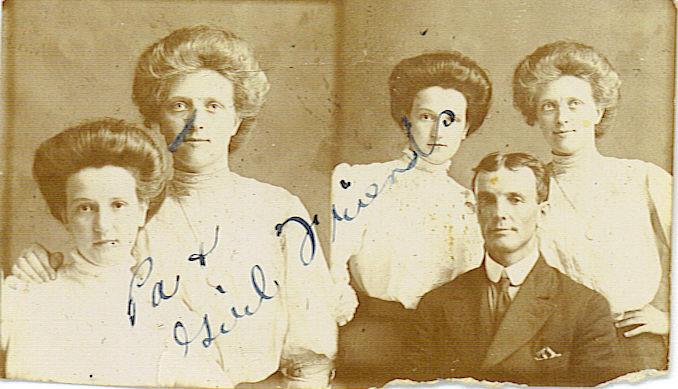
This small photo was found in the very front of an old photo album that my great-aunt Ruth owned. Along side this photo was a set of two others of nearly the same size that said ‘Pa Johnston’ and ‘Pa with girlfriends’.

c. 1900s

c. 1890s-1900s

My best guess is that the young ladies from the first photo are somehow related to Pa Johnston, what my great-aunt called her step-father, my great grandfather, James Washington Johnston (1876-1967). The first photo appears to be possibly older than the second if we compare by way of the fashion.

The first photo must have been taken sometime during the winter as the ladies seem to be wearing heavy winter coats. I especially like the details on the second lady’s coat, they seem to be some sort of flowery piping right along the front opening. The hats / bonnets worn by the ladies in the first photo are also very interesting. I’d hazard a guess that the lady on the left is younger than the lady on the right because of her youthful face, her hair seems to be worn down, and her bonnet seems more youthful.

The second photo is easier to date, based on my limited knowledge of historical fashion, because the ladies seem to be sporting the Gibson Girl fashion popular in the 1890s and early 1900s. James Washington would have been in his early twenties.

52 Ancestors – Week 8 – William George Washington Johnston (a 71-year-old mystery)

For this week in Amy Johnson Crow’s genealogist challenge: 52 Ancestors in 52 Weeks, I would like to present a 71-year-old family mystery that has yet to be solved.

Throughout my genealogical research one of the topics that I’ve enjoy the most is learning about family members who have served in war. This is especially true for two of my direct Johnston relatives, consequently, both named William.

William Henderson Johnston was the brother of my great-grandfather, James Washington Johnston. He was born 18 May 1890, in Black River, Michigan and died ‘in action’ just outside of Arras, France on 29 Mar 1917. While not mentioned by name, based on the 31st Alberta Battalion war diary for that day, I’ve concluded that he might have been killed by artillery fire.

Two other ranks are unaccounted for, but I think that it is established that they were struck by a shell when crossing “NO MAN’S LAND” escorting three prisoners. Major Seaton states that he saw a shell strike in the middle of a party that he took to be three prisoners and two of our men, and two others bear witness to having seen such a party. (31st (Alberta) Battalion Order No.138. – 29-3-17.)

I digress, William Henderson is not the subject of this post, that honour belongs to his nephew, my grandfather’s brother, William G.W. Johnston. I wanted to give some brief history of William’s uncle for a note further below.

William George Washington Johnston was born 10 Jun 1917, to parents James Washington Johnston (1876-1967) and Sophia Harriett Basham (1890-1959). A brother to my grandfather, James Henderson Johnston (1913-1981), he was my great uncle, and like many of my relatives he was one that I will never get to meet in this lifetime.

c. 1929 (Ern, Jim, Bill)

c. 1927 (Ern, Jim, Bill)

Like his siblings, he attended, Mowat School where he completed seven and a half years of classes and can be found in the school records from 1924 to 1931. In the image below, the 1929 Mowat December Attendance Record, you can see that Bill is 12 years old and in Grade 6 while his older brothers are in Grade 7 and Grade 9.

c. Dec 1929 (Mowat School Attendance)

c. Dec 1929 (Mowat School Attendance)

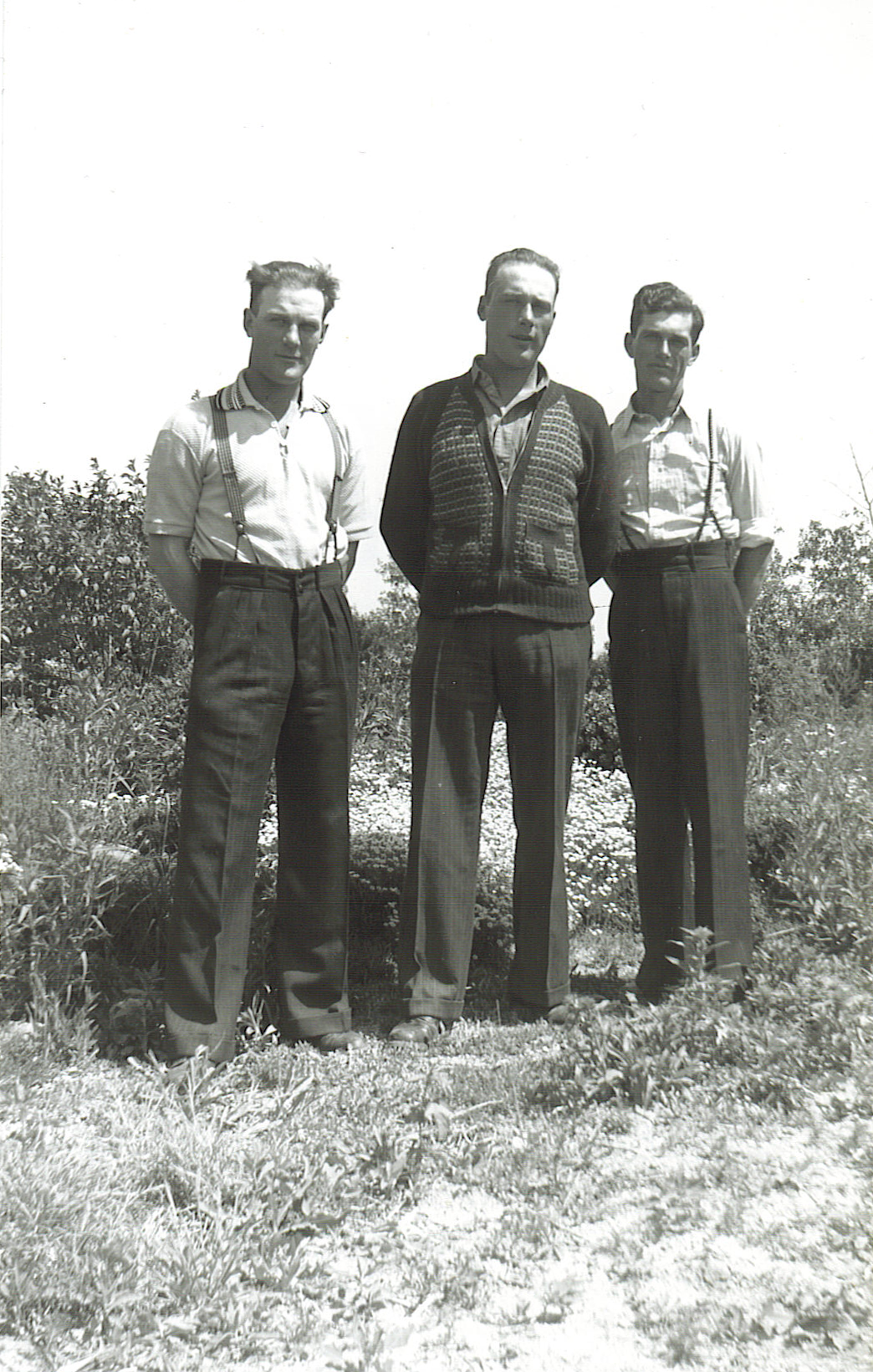
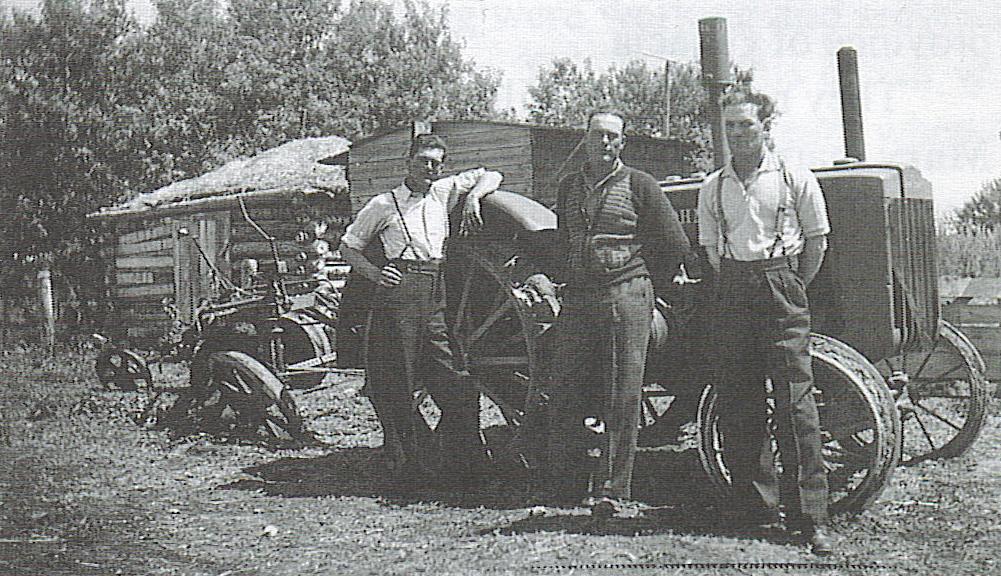
My great aunt wrote a bit about her step-brother, “Brother Bill was a born farmer. But World War II was just around the corner and life changed for all of us.” The two photos below are some of my favourites; I love the poses and the clothing they’re wearing. I wish I had a better copy of the tractor photo.

c. 1939 (Bill, Jim, Ern)

c. 1939 (Bill, Jim, Ern)

c. 1939 (Ern, Jim, Bill)

c. 1939 (Ern, Jim, Bill)

On 15 June, 1942, Bill was called up to the Canadian Military in Winnipeg, MB. On the occupational history form he listed his occupation as a farm labourer and he wished to return to this type of work when the war was over. He completed 60 days of basic training as well as 60 days of advanced training with the Winnipeg Light Infantry.

On 11 January, 1943, he was interviewed in W.L.I. Vernon, B.C. The interviewer noted a few interesting things about Bill, “Doesn’t smoke and drinks very little. He would like to be in the heavy artillery because he thinks he’d like it. Dull type, average physique, and not particularly interested in anything. Limited learning ability and no particular liking for Carrier Pl. Unlikely to improve greatly.” He was recommended as either an infantry rifleman or a carrier pl. (Bren Gunner).

Bill was admitted to the Vernon Military Hospital on 11 July, 1942, and was discharged on the 31st. He was then granted sick furlough from 1st of August to the 22nd. His sick leave was extended to 5 September and he returned on the 4th of September.

On 1 March, 1943, a transport warrant #A362, 085 d/17 Feb 43 was issued.
S.O.S. W.L.I. on t’fer to 3rd ??? BN Regina Rifles on 23 July, 1943.
S.O.S. for A-P 3 rd Regina Riles on 17 August, 1943.
T.O.S. for A-P 2nd Airfield Defence Bn. (Regina Rifles) on 18 August, 1943.
Attached for a/p ex pay to #12 Dist Depot (Farm Duty) on 31 August, 1943.
Ceases to be att’d f.a.p. on retuning to Unit 17 October, 1945.
S.O.S. F.A.P. on transfer to 31st (Alberta) Recce Regiment on 5 November, 1943.
T.O.S. 31st (Alberta) Recce. Regiment on transfer from 2nd Airfield Defence Bn. (R.R.) on 6 November, 1943. Rank is now a trooper.
Granted leave and furlough with R.A. to 3 December, 1943. TWA547586
Att. for rations and qtrs. to KORC(CA) Victoria to 7 December, 1943.

Bill never made it to any battlefields. The record of military service indicates that he was listed as being A.W.L. at 2200 hours of 27 February, 1944. He was never seen alive again.

Sadly, with special grief to Jim and our mother, Bill had died while in the army…Bill of the blue, blue eyes and the kind and honest heart.

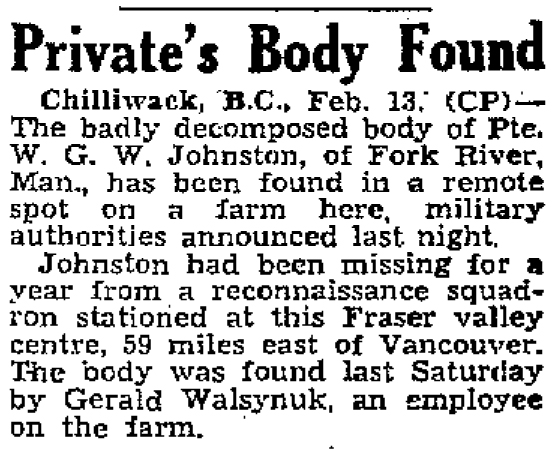
On 10 February, 1945, Bill’s body was found in brush outside of Chiliwack, B.C. The causality notification form indicated that the presumed date of death was the day he went missing on 27 February, 1944. A letter was sent from G.S. Perrin, Brigadier, of the Department of National Defence Army, to my great grandmother, Sophia Johnston, that indicated the body of her son had no evidence of bone fractures and because of the advanced state of decomposition the coroner was unable to record the actual cause of the death.

Winnipeg Free Press

Winnipeg Free Press (13 Feb 1945)

Bill’s body was discovered wholly by accident when an 18-year-old boy, Gerald Walsynuk, found it in a remote spot of Oscar Hotchkiss’ Farm near Lickman Road. The body was found lying behind a log, under some cedar trees, near a stream of water. The body was fully dressed in battle dress including black coveralls and a black tam on the head.

The British Colombia Police report sent along with military records from LAC is able to fill in a few questions. Lieut. Chet Woods, who was attached to the 41st. Alberta reconnaissance Regiment, Vedder Crossing, B.C., while talking to a Miss A. Flynn, informed her that a private of that unit had gone insane and wandered away from the camp and that they had searched for the man but without success. If the above is true then it is possible that William G.W. Johnston is the man in question. Capt. Mooney was there that night and might be able to shed some light on the matter.

This is where the report ends abruptly. I do not know whether the police were able to get a hold of Capt. Mooney or whether they were able to conclude the report. I contacted the Chilliwack RCMP office but to no avail as their records only go as far back as 1971 and anyone who might have known if there were earlier records have either died or retired. The Chilliwack Archives were able to provide me with a few newspaper articles but they also do not provide a conclusive answer. My next step is to contact Canada National Defence to determine whether they have an archives department that might hold something. I also want to contact the Canadian Military Education Centre Museum to see if they have any ideas on where I should turn next, however, their hours of operation are limited and I have not had the time to contact them.

I have no idea what happened to my grandfather’s brother and I don’t know if I ever will. Was the pressure of his post too much for him? Did he loose his mind and commit suicide or was he a victim of homicide? I wonder if a more conclusive answer would have been made if his body was found sooner. It seems like such a bizarre set of circumstances I really don’t know what to make of it. Based on my current knowledge of Johnston family we have no obvious history of mental illness. The closest instance I can think of is that Jane Atchison (1854-1893), William’s grandmother, died of asphyxiation during an epithetic fit.

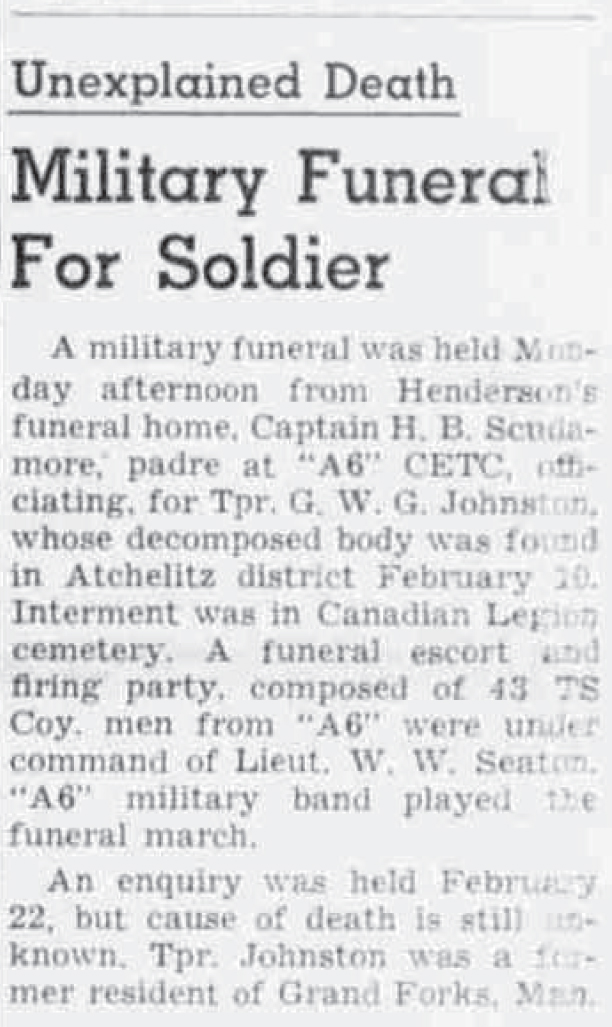
Chilliwack Newspaper (7 Mar 1945)

Chilliwack Newspaper (7 Mar 1945)

Bill was buried on 5 March, 1945, with full Military Honours in the Canadian Legion Cemetery in Chilliwack, B.C. Row C, plot 57. He is one of 9 individuals buried there. After the death of William George Washington there was some superstitious feelings on naming any further Johnston babies William in case further tragedy might befall the family again. Consequently I have no uncles, cousins, or nephews named William.

52 Ancestors – Week 7 – Elizabeth Atchison

For this week in Amy Johnson Crow’s genealogist challenge: 52 Ancestors in 52 Weeks, I am going to write about my 2nd great grand aunt, Elizabeth Atchison (1857-).

Elizabeth was the sister to my 2nd great grandmother, Jane Atchison (1854-1893), who was married to my 2nd great grandfather Noah Holt Johnston (1851-1940). She was born to Irish immigrants George Atchison (1818-) and Margaret Clark (1825-) and had five other siblings (two brothers and three sisters). They lived in Renfrew county Ontario, more specifically the township of Alice and Fraser.

Elizabeth, as well as her parents and siblings, can be found in the 1861, 1871, and 1881 Canadian census records. What is interesting to note is that in the 1881 census another young girl is living with the family by the name of Margaret Clarke Atchison (1874-). Who is this young girl, another sister perhaps?

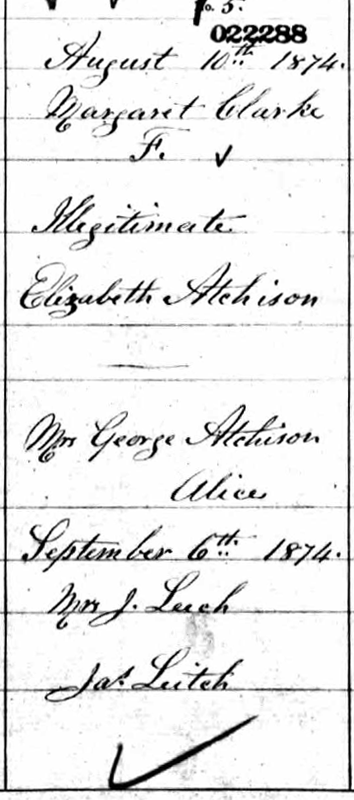
In reality she is the illegitimate daughter of Elizabeth Atchison! At only seventeen Elizabeth born a young daughter- the father is not listed in the birth record. I wonder who he could have been, a young boy her own age or someone older, perhaps a married man? Elizabeth was so young and in 1874 I can only imagine that her reputation would have been ruined within the township considering the views of illegitimate children and their mothers in the Victorian era in both England and America.

1874. Ontario Births

1874. Ontario Births

I am unable to find George and Margaret, nor their daughters Jennie, Elizabeth, or Nancy in the 1891 Canadian census. I know that Noah and Jane had moved across the US border to Michigan where Noah worked on the railway. My grand uncle William Henderson Johnston (1890-1917) was born in Black River, based on attestation record, and it is in Alcona where Jane died in 1893, from a fit, today I have had the luck in finding a record of her death! (She is recorded as Mrs. Noah Johnson) I have just come across a website for Alcona genealogy that I will now spend time looking over for the Atchisons.

Back to the Atchisons- I am inclined to believe that George and Margaret also moved south along with their daughters: Jennie, Jane, Elizabeth, and Nancy. Nancy Atchison can be found in the 1880 US census as living in Alcona county which is where Black River is also located. I imagine that young Margaret Clarke would have been said to be the daughter of her grandmother giving Elizabeth a better chance at marrying some gentleman without the worry of her tarnished background.

Today, I have found what appears to be a marriage record for Elizabeth Atchison to Alexander Sloan, an Irish immigrant, in the town of Black River in 1892. While the record does not indicate the bride’s parents it does indicate that the bride was born in Canada during the right birth year (1857) to make this a likely match.

52 Ancestors – Week 6 – Mary Sarah Pelletier

For this week in Amy Johnson Crow’s genealogist challenge: 52 Ancestors in 52 Weeks, I am going to write about my maternal grand aunt, Mary Sarah Pelletier (1898-).

I do not know much of my grand-aunt, what I do know I’ve gathered from census records. My mother tells me she remembers little of her aunts who seemed to have been all given ‘Mary’ or ‘Marie’ as a precursor to their name.

Mary Sarah can be found in the 1901, 1906, 1911, 1916 and 1921 census living on the Crooked Lake Indian Reserve. On the 1916 census she can be found living with her husband James Agecoutay. Mary Sarah and her three children (David, Emma, and Stephen) are later found living with her father in the 1921 census; Mary Sarah’s marital status is listed as widowed.

1921 census

1921 census

From here on I do not know what became of my great-aunt or my cousins. I wonder what happened to James Agecoutay, he likely died by disease or misfortune. The birth of his youngest child indicates that he most likely was still alive only 15 months prior to the census. A basic search of Saskatchewan’s vital records has provided me with no new information. I’m not sure what sort of records I can search to progress in finding how what happened.

When the TRC public archives opens I may be able to search available records of Residential Schools to find relatives who attended them. It is likely that my cousins attended the Crooked Lake Residential School like their mother (and most likely their father too).

52 Ancestors – Week 5 – Napoleon Pelletier

EDIT: Please visit this blog post for new research. Portions of the following blog entry on Napoleon Pelletier are now out-of-date based on research done on Treaty annuity records.

I want to keep the information in this post unchanged beyond this addendum about the identity of his mother. I was previously under the impression that Marie Adele Lerat (1888-) had been his mother, but in fact, she was his step-mother.

You can read more about this discovery here.

For this week in Amy Johnson Crow’s genealogist challenge: 52 Ancestors in 52 Weeks, I am going to write about my maternal grandfather, Napoleon Pelletier (1905-1985). He was born on the Cowessess First Nation to parents Joseph Pelletier (1876-) and Marie Adele Lerat (1878-) in 1905. He had six other siblings that I am aware of although it is highly possible he may have had more.

Napoleon attended the Cowessess Indian Residential School and he can be found in the 1916 census. Cowessess Indian Residential School opened in 1898 and was later renamed Marieval. Residential schools that ran during this era typically used the half-day system where students would attend classes for half the day and work the other half. Napoleon would have most likely worked in the fields to provide food for the rest of the students or done other chores to keep the costs of the school low. My grandmother- his wife, Marie Cecilla Allary, also went to Cowesses. Her memories of the school during this era were not very pleasant, she remembers that the uniforms were rough, almost like potato sacks, and that she worked mostly in the kitchen to provide food for others students rarely ever spending time in a classroom.

pelletier, nap 1916 census

c. 1916

One of the issues I have with researching my Aboriginal ancestors are the records. First, there is nothing much in regards to census records before Saskatchewan became a province in 1905. The area where my family would have lived was known as The Territories, more specifically Assiniboia, but what complicates the search for them in official records is the fact that they traveled between the Canadian and United States border.

Another issue in regards to researching Aboriginal ancestors are the names. Names that I am related to are Agecoutay, Allary, Lerat, and Lavallee – this is not an exhaustive list. When looking at the census records between 1901-1921 there are many families on the reserve and just outside of it with these names and it’s hard to determine who is the right Napoleon Pelletier. Furthermore, the spelling of these names are varied and it is difficult to look for family when Pelletier has been recorded as Pelter, Peliter, or even Pelger! What worries me further is whether family members also went by traditional names which I would have no know of thereby missing individuals entirely.

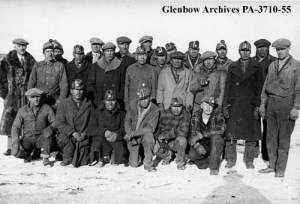
Napoleon married my grandmother sometime in the late 1920s or very early 1930s; he and his family moved to southern Alberta where they lived on the Blackfoot (Siksika) reserve and where Napoleon worked as a miner. I have located two photos of my grandfather from the Glenbow Archives during this time. My grandfather is in the second row, second on the left.

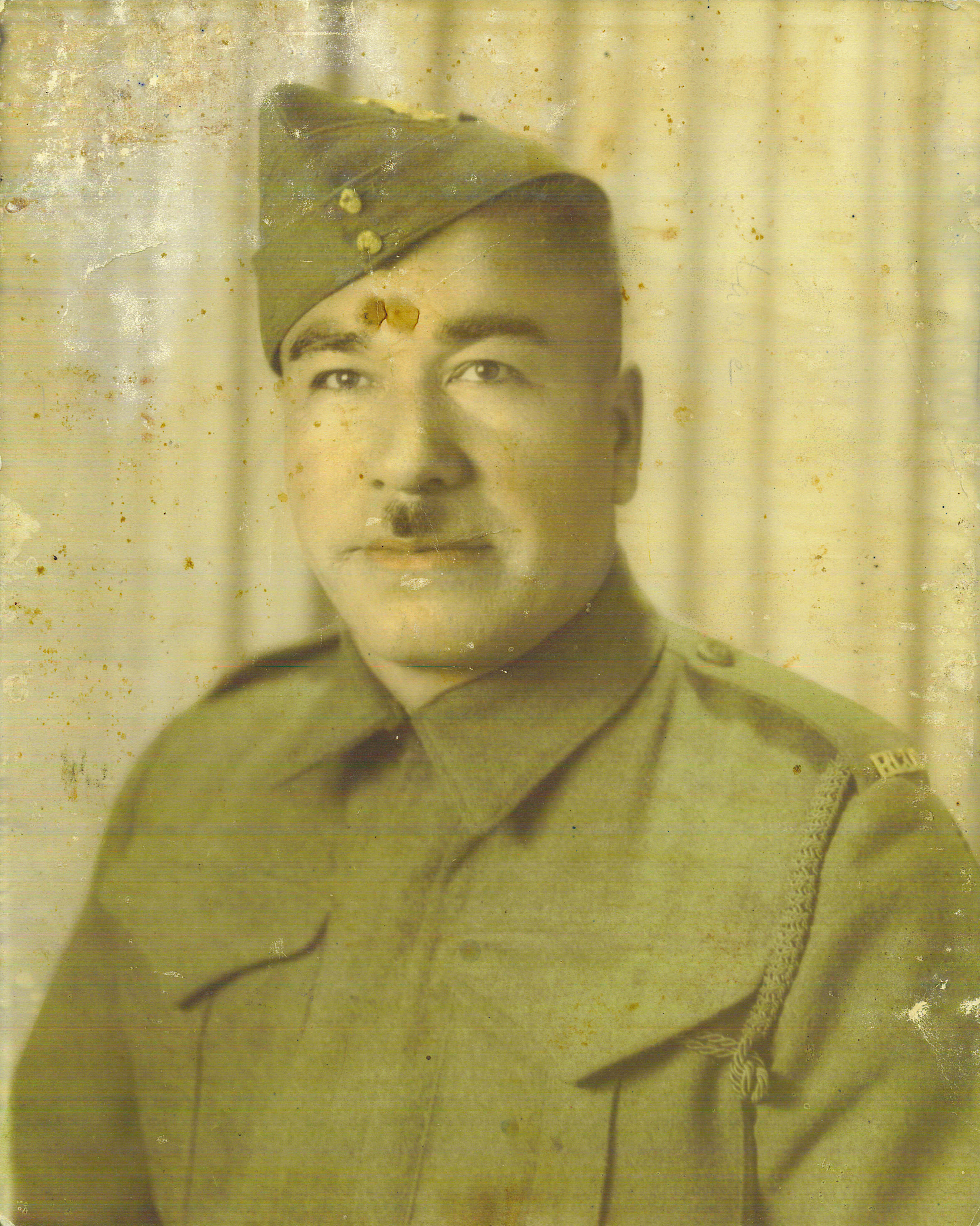
Napoleon fought in Italy during the second world war. I have yet to get a copy of his military records although I’m very interested in taking a look at them. Apparently, Amsterdam was one of his favourite cities and when my mother came to visit me this past summer she lit a candle in one of the churches in his memory. My mother says he never spoke about his time in the army but that when he returned his once black hair had turned white and said it was because of what he had seen. (I have gotten the photo below restored and gave it to my mother as a Christmas present in 2012.)

c. 1941

c. 1941

Napoleon passed away just before Christmas in 1985. He is buried alongside his wife in Marieval, Saskatchewan, at the Sacred Heart of Mary Roman Catholic Church. There is still much that I want to know about my grandfather and the fact of the matter is that I just haven’t asked enough questions. This is the year that I am going to sit down with my mother and contact my other relatives in order to get as much as I can.

52 Ancestors – Week 4 – Joseph Pelletier (the Carnegie Hero)

This week in Amy Johnson Crow’s genealogist challenge: 52 Ancestors in 52 Weeks, I am going to write about my mother’s side of the family. Being the ‘baby’ of the family I have missed meeting many of my older relatives simply because I am the age of many of my nephews and nieces, as a consequence, many events that my siblings have been privy to have happened long before I was born.

Today, I am going to write about one of my uncles, Joseph Pelletier (1947-1973). Joey was born the second last of my mother’s siblings, eleven children in total. My mother and her siblings, including Joey, grew up on a Blackfoot reserve in southern Alberta.

Being Aboriginal children in the 1930s-1960s they would have been required to have attended Indian Residential School. I do not know much about their lives during their childhood and youth as there are only three of the eleven siblings alive today, including my mother, and I believe this reflects on the harsh lives they lived. I can only speculate, based on my studies and work with the Truth and Reconciliation Commission of Canada, on the treatment of my mother’s siblings in the residential school system. My mother is lucky, she can remember mostly good memories of her time at Crowfoot IRS either because her experience was better than most or because she has blocked any painful memories out for good reason. Anyway I am getting off topic- more on Indian Residential Schools in a future post.

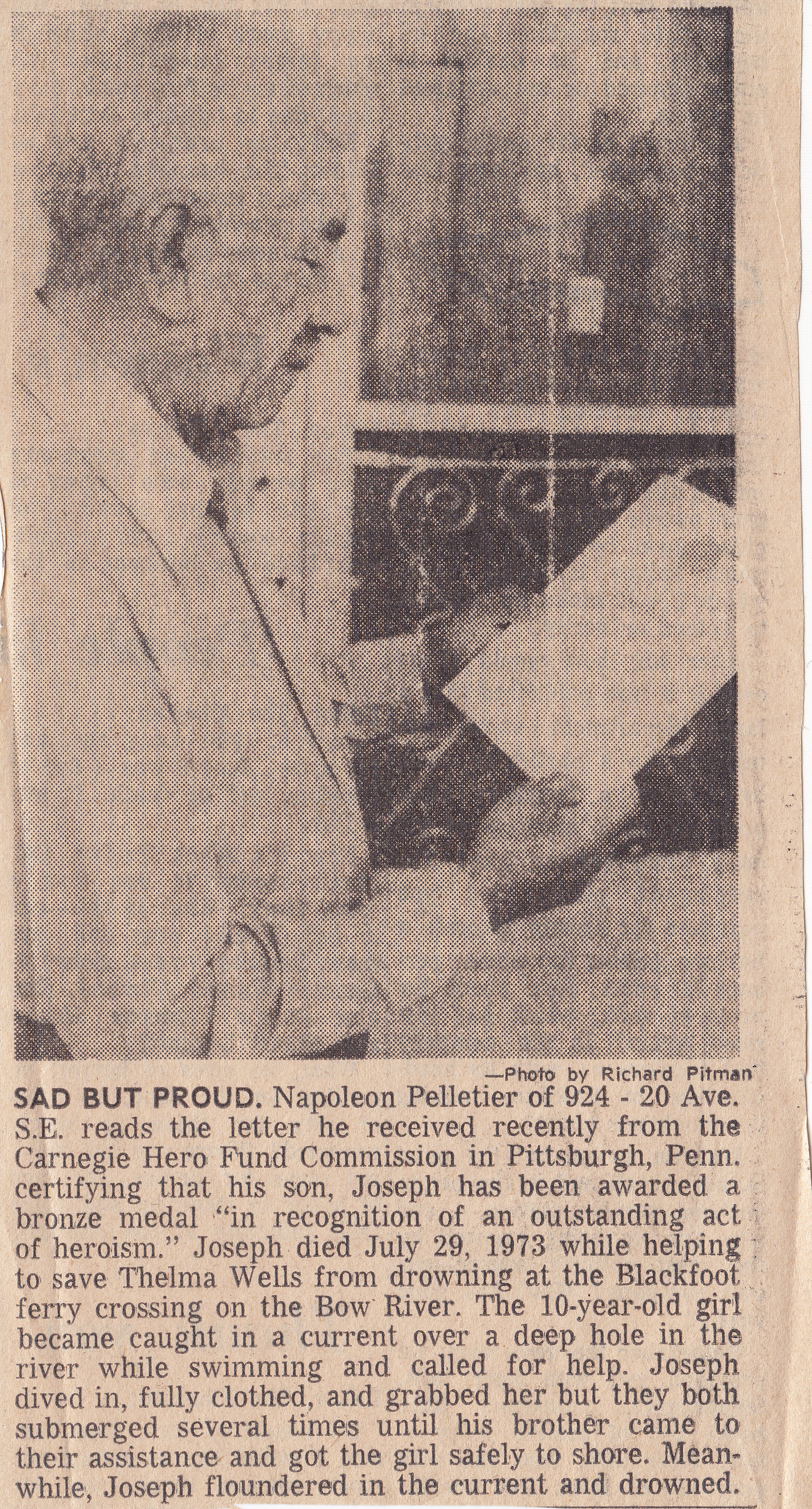
On the morning of 29 Jul 1973, while swimming in the Bow River, 10-year-old Thelma A. Wells, became caught in the revolving current over a hole in the river bottom and called for help. Joey, my uncle, having heard her cries, entered the water fully clothed and swam to her. A struggle ensued; and both were submerged briefly several times. Joey called for assistance. His younger brother, Robert, entered the water and swam to them. While Robert was able to take Thelma safely to the bank, Joey floundered in the spinning current over the hole and drowned before help reached him.

The Carnegie Hero Fund Commission awarded Joey the bronze Carnegie Medal in recognition of his outstanding act of heroism. The purpose of the Carnegie Hero Fund is to award individuals in the United States and Canada who risk their lives to an extraordinary degree saving or attempting to save the lives of others.

pelletier joey newspaper

c.1973 (Calgary)

Above is a clipping from a newspaper, most likely from Calgary, that was with the Carnegie award certificate in our basement. I do not know what has happened to the bronze metal itself because we do not have it. I can only hope one of my aunts have it in their possession otherwise it has been lost, most likely when the government seized my grandmother’s property when she passed away in 1990. I am tempted to contact the Carnegie Hero Fund to see whether a replacement medal can be given to the family again. Couldn’t hurt to ask anyway.

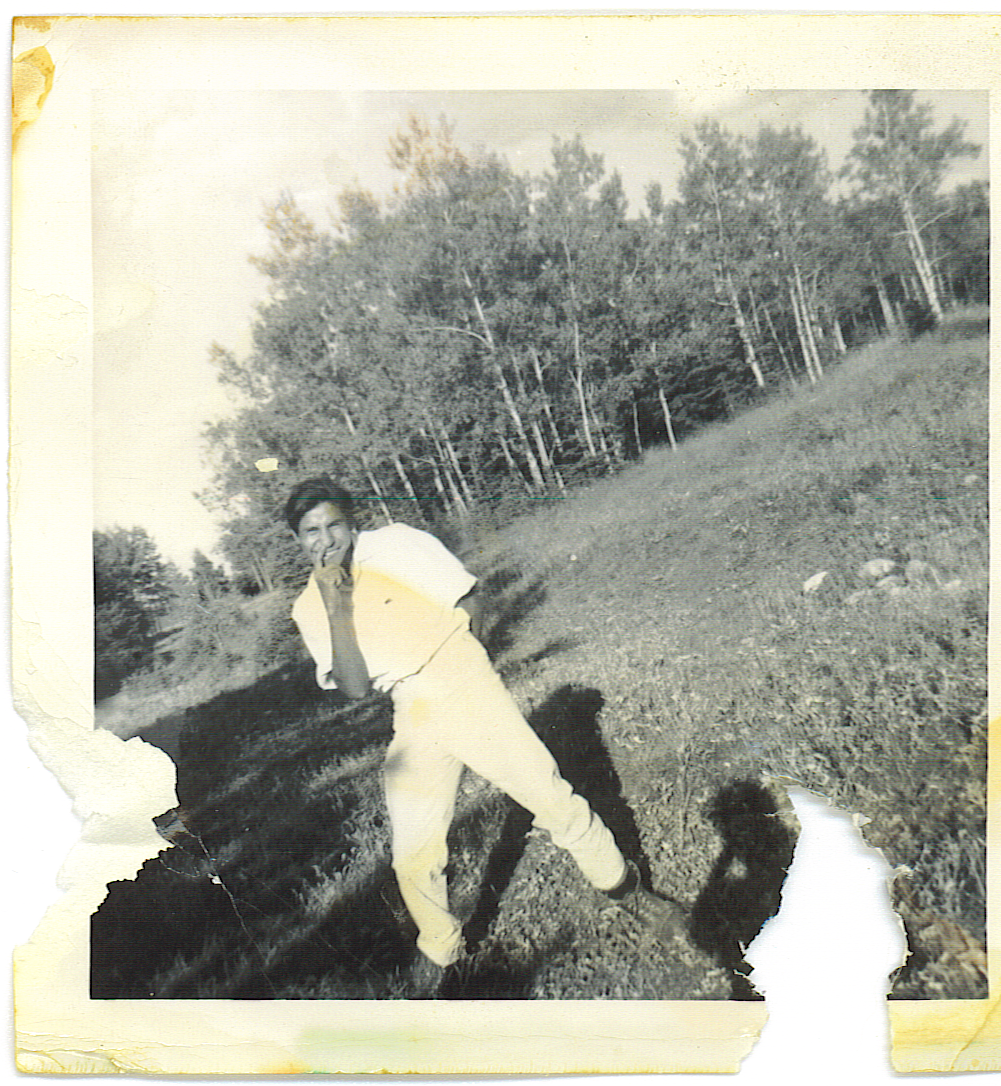
c. 1962

c. 1962

While I do not know much of my uncle Joey this act of bravery makes me wish I could have known him during his brief life. One of the rare photos I have in my possession shows a smiling young man full of life– even a bit of a comedian, but who isn’t at 15? I wish I had more photos of him as well as other members of my family whose faces are now lost to memory and time. This is why I treasure the photos, documents, and artifacts I am able to get my hands on. It is important to me to discover and uncover as much information as I can about my family- the more I get to know them the more I get to know myself.

Jan 2014 Update

I just wanted to let my readers know what’s been going these past few weeks into Jan 2014.

Right now I’m backdating ‘Today in the Dauphin Herald’ for the 1910s for 2013. It seemed to make more sense if I did it that way than continue to update it into the new year just yet. I will post Nov articles and then move to Aug, Jul, Jun etc until I’ve completed the year.

I’ve got myself a day job so I haven’t been able to get to the Archives downtown to go through the microfilm rolls between 1924-1929 to get started on the 1920s. An annoyance I have is that the typeface has changed for the Herald making it difficult to spot communities names as they are now the same size as the regular text. This is compounded by the fact that I have to hold my head at a 90 degree angle to view the microfilm reel. This makes it difficult to get as much information as I can copied with any real speed. I don’t doubt that I’ve missed an interested related article or two simply because everything blends together unless I’m scanning the page inch by inch. After that I still have the 1930s and 1940s which I am really excited to post as it has more relation to my family history.

I’m also trying to post a few transcript copies of Mowat school attendance records from 1916-1944. I’ve been having some trouble find records past 1944 due to either them being lost or misplaced within the microfilm reel. Records from before 1916 seem to have also been lost or destroyed.

I’ve been trying to plan out future 52 Ancestors posts and there are a number of them I’ve written and are ready to go. There is going to be a heavy disproportion of paternal ancestors than maternal ones but I will get to the reason why in future writing.

Finally, a project that I’ve been working on for quite some time is a more flushed out version of Pioneers of the Mowat School District, No. 1232, 1904 – 1968. This booklet was published in 1988 by the Mowat School District Heritage Committee (Joe and Kay Robertson, Pauline Johnston, Earl and Ailie Gower, Mary Miller, Ernie and Viola Johnston, Beatrice Dewbury, John Zabiaka, and Laverne Carriere). In 1999 a large book, Memoirs “From the Past”: Rural Municipality of Mossey River, was published after the 1996 reunion. Using the Internet and better access to sources such as census records, land grants, newspapers and archives records I would like to create another Mowat centered booklet full of more information. I’ve already recreated a more accurate map of the Mowat district with a list of pioneers on the Mowat Pioneers page. I want to develop this more in the coming year.

52 Ancestors – Week 3 – Ruth Sarah Goodson (the girl who married a dustman)

For this week in Amy Johnson Crow’s genealogist challenge: 52 Ancestors in 52 Weeks, I am going to write about my paternal 2nd great-great grandmother, Ruth Sarah Goodson (1848-1925). She was born in London to parents Joseph Goodson (1796-1865) and Ruth Blanchard (1812) in Apr 1848 and was later baptized at St. John at Hackney Church.

An interesting piece of writing that I have is a copy of a letter sent to Ruth Goodson, by her teacher, Emma Johnson. Ruth would have gone to a school in the Hackney area but I have yet to determine what school she would have attended. While I wouldn’t be surprised that Ruth and her sister would have had a governess in the home I’m not completely sure whether this would have been feasible but I will continue this thought further below.

2 Tyssen Terrace
London, England
December 27, 1863

Dear Ruth,
I was sorry I was not at home when you brought me that very beautiful present.
I shall always think of your kind heart when I use the Bible, but indeed you should not have allowed yourself to purchase such an expensive present.
It makes me feel quite grieved when I look at it, and were it not that I know you feel such pleasure in giving it, I should hardly like you accept so very handsome a book.
I thank you very much indeed from the very kind and grateful feeling which prompted the gift.
Such feelings are all very delightful to a teacher, coming from those whom she has loved and tried to train in the path of duty.
With kind regards to your excellent mother, and with best wishes that your care towards her may bring stronger health, and with best homes of a Happy New Year for you, death Ruth, believe me.

Your affectionate friend,
EMMA JOHNSON

I wonder what kind of relationship Ruth had with her teacher to give such a nice present. Ruth would have been fifteen in 1863 and it would be my guess that she would have been learning proper Victorian etiquette and how to run a home. It would have been nice to have the original letter but I don’t have it and don’t know where it would have been kept. I’m not sure where my great aunt Ruth’s personal papers were taken after her death; whether they were destroyed or if someone took them. It would be nice to find out where many of her original papers were taken.

Ruth married John Basham on 7 Feb 1869. My great aunt Ruth wrote of her grandmother in her essay entitled “The Bashams of Mowat.”

John had been born on a farm in Essex, England, later coming to London, with some of his brothers, to set up a small business as garbage men. It was while making his rounds, that he often met, at the back gate, the genteel and educated Ruth Goodson. In spite of her father’s warnings and threats, Ruth was captivated by the charms of the handsome John, and later they married and became the parents of eight children, all of whom came to Canada, at different times, except Jessie, who became Mrs. Owen Gower, and Amy, who married a London bus driver, named Joe Charles.

What kind of ‘threats’ did Ruth and John suffer at the hands of her father? Was she cut off from the rest of her family or did she lose any dowry or inheritance? Based on where they lived in the Hackney area, which was destroyed in the blitz of WWII, and what Ruth’s father did as an occupation I do not know that they were so well off as described. Joseph Goodson was born in Bethnal Green and worked as a ‘dust collector’ and ‘labourer’ and so I don’t know why he would have looked down on John Basham so harshly. Joseph, himself, would have come from an impoverished background and might understand the struggles of finding a wife. It’s possible he hoped his daughter would have made a better prospect for someone of higher class.

Ruth had three sons and five daughters:

John Fredrick (Did not marry)
Ruth Edith Married Fredrick Alfred Storrar
Jessica Grace Married Owen Levenson Gower (Stayed in England)
Amy Florence Married Joseph Charles (Stayed in England)
George Edward (Did not marry)
Sophia Harriett Married Thomas White
Married James Johnston
Ernest Henry Married Jane Murray-Ross Taylor
Ada Louisa Married Alexander Munro

Ruth immigrated to Canada along with her husband, John, in 1903 and settled in the Mossey River area. They left Liverpool in Jun 1903 and traveled on the S.S. Tunisian with their son George Edward and their daughter Ada Louisa. A large two-story log house was built on the south side of the Fishing River, a half-mile from where the Mowat School was built. Mr. and Mrs. Basham lived there the remainder of their lives, their home a welcome stopping-place for travelers and for preachers who came in the summertime to hold church services at the school. John passed away in 1915 and Ruth passed away on 9 Jun 1925 of a massive heart attack, both are buried in the Fork River Cemetery along with their eldest son John Fredrick.

(Jul. 2012)

52 Ancestors – Week 1 & 2

To help me in regulating my blogging activity, outside of the Dauphin Herald, I’ve decided to participate in Amy Johnson Crow’s genealogist challenge:  52 Ancestors in 52 Weeks. Each week I will be writing about an ancestor of my choosing and will describe a little about their life or the challenges I’ve come across while researching them.

This week I will be writing about two ancestors for the 1st and 2nd week of the challenge, they are a husband and wife pair who came to Canada in the early 1900s.

Thomas White (1880-1909) was the first husband to Sophia Harriett Basham (1880-1959), my paternal great grandmother. He was born abt 1880 in Hackney, London, and resided in the Hackney area for the majority of his youth where he worked as a cabinet worker. Before 2012 I had very little information on Thomas other than what was written about him by his only child, my great-aunt Ruth, who I have written about in a previous post. I had no information on his parents or if he had any siblings and so it was a mystery for some time but I will continue on this thought a little further below.

Sophia Harriett Basham was born on 1 Jun 1880 in Homerton, Hackney, London, to parents John Basham (1837-1915) and Ruth Sarah Goodson (1848-1925). She was baptized at St. Barnabas Church in Aug 1880 along wit her brother George Edward and sister Amy Florence; she resided with her parents and siblings in the Hackney area for much of her youth. They can be found in the England Census in 1881, 1891, and 1901.

Thomas can be found in the 1901 England Census residing, as a border, at 23 Ballance Road with Joseph Charles and his wife Amy Basham. Based on this information I concluded that this is how Thomas might have become acquainted with Amy’s sister, Sophia, who would later become his wife. He married Sophia Basham in Apr 1904 in West Ham, Essex; I believe they married at St. Michael and All Angels Church in Walthamstow and that their marriage record is located at the Waltham Forest Archives. This information is based on the fact that Sophia’s sister, Jessica Grace Basham, married her husband Owen Leveson Gower at St Michael & All Angels Church on 2 Sep 1900 and lived in the same area; it wouldn’t be far fetched to think that Tom and Sophie could have married at this church as I’ve been unable to locate a record at any Hackney churches. When I was passing through London in August 2012 I was unable to make it to the Waltham Archives and can’t confirm whether their record is there.

The young couple traveled to Canada on the S.S. Canada in May of 1904 and arrived at the port of Montréal, Québec, on 15 May 1904. They moved to the Mossey River Municipality of Manitoba possibly for the fact that Sophia’s older brothers John Fredrick and George Edward immigrated in 1896 and 1903 to the area as well as her parents in 1903. A CPR land sale record indicates that Thomas bought 160 arces of land on the NE-1-29-19-W1. There he erected a small farmhouse on the north bank of the Fishing River and the couple can be found on in the 1906 Canadian Census. On 23 Jan 1908, a daughter, Ruth Elizabeth White, was born.

On 22 Oct 1909, Thomas died of typhoid fever. He is buried at the Riverside Cemetery in Dauphin, Manitoba. While visiting the cemetery I was able to locate the approximate location of his burial plot but I was unable to locate his gravestone. All markers in this area of the cemetery have been damaged or destroyed and so it’s not possible to identify whose stone belongs to whom with any real certainty. Based on his date of death I was able to order his death certificate from Manitoba Vital Statistics in the summer of 2012 and low and behold there was information that indicated that Thomas had a brother who lived in Dauphin, named George William White, at the time of his death. From this information I was able to locate George White and his family in the Canadian Census records of 1911 and 1916 as well as their records in Canadian passenger lists and furthermore in the English Census records where I was able to make an educated guess as to their parents and siblings.

On 26 Mar 1912 Sophia married James Washington Johnston (1876-1967) and would have three sons: James Henderson Johnston (1913-1981), Ernest John Johnston (1915-2001), and William George Washington Johnston (1917-1944). Ruth wrote of her mother’s hardships in her 1983 essay entitled “The James Washington Johnston Place.”

Sophie remained ambitious for the welfare of Riverside Farm as she and James worked hard throughout the pioneer years. She has no running water or electrical power to help her. She often needed medical attention which she could not readily get. Much of her brave spirit faded through the years, but her sense of humour never wavered. Her hearty laugh is something Ruth tenderly remembers. As Ruth grew older, she realized that some of her mother had truly gone with her father, when he was laid to rest in Riverside Cemetery, Dauphin, Manitoba. But Sophie was always loyal to James, and appreciated his outstanding good qualities of good nature and kindness, and his very clever hands, which could build almost anything and “fix” everything.

After the second world war, Riverside Farm was passed down to the eldest Johnston son, James Henderson, while Sophia and her husband, James Washington, retired to Dauphin. Sophia passed away on 21 Apr 1959 while her husband James passed away eight years later in 1967.

Today in the Dauphin Herald – Dec 25 – 1913, 1919

1913 Dec 25 – Fork River

F.F. Hafenbrak, T. Needham and R.C. Sparling, of Dauphin, all old timers, were here renewing old acquaintances on the 16th. We were pleased to see them.
Miss Alice Clark returned to her home at Paswegan, Sask., after spending a month visiting friends here.
Messrs. J. and P. Robinson, of Mowat, have returned from a business trip to Winnipegosis in connection with their fish business at Lake Dauphin. They have shipped a large number of boxes of fish from this point.
Several Americans have been looking over the district lately. They have returned to their home with the impression that this is a good country and promised to pay us a visit later on. They hope to get land where a number can settle together.
Wm. King wishes to thank the ratepayers of Mossey River municipality for their hearty support on the 16th. He says he will do all in his power for the benefit of the municipality.
The many friends of Mrs. A. Snelgrove are pleased to see her around after her recent illness.
Business here is dull, principally on account of the poor condition of the roads. A fall of snow would be much appreciated.
A large party of young folks from here attended the ball at Sifton on Fright night. They report a good time.
The New Year’s ball will be held in the Orange Hall under the auspices of the members of purple Star L.O.L., 1765, on the night of January 1st, 1914. Good music and refreshments. Admission $1.00 per couple. Everyone welcome.

1913 Dec 25 – Sifton

The most successful ball ever given in the history of the village was attended Friday evening last by some sixty couples. From the opening Grand March at 9 p.m. to the “Home Sweet Home” waltz at six o’clock the next morning not a single untoward incident distributed the harmony of the gathering. A number of guests came from Fork River, Dublin Bay, Melton and Dauphin and seemed to thoroughly enjoy themselves. Mrs. Norman Gray and other ladies very kindly and ably accompanied several of the various violinists on the piano. The flute and zither accompaniment was also much appreciated. The music was good, the floor good, and the Sifton cooking of the best. A well-known critic was heard to remark that the hall, owned by the Kennedy Mercantile Co., is the best between Dauphin and Prince Albert. A vocal and instrumental programme, somewhat shortened by the unexpected absence of several of the artists was put on after supper, Mr. Henry Woods very ably acted as chairman. Mr. Paul Wood, on behalf of the hosts, the residents of Sifton, in a few words, bade everybody welcome and the compliments of the season. Amongst other prominent old-timers and friends were noticed. Mr. and Mrs. Mooney, Mr. and Mrs. Ed. Woods, Mr. and Mrs. W.J. Walker, Mr. and Mrs. Norman Gray, Mr. and Mrs. W. Fair, Mr. and Mrs. Howard Love of Melton and Dublin Bay; Mr. H. and Miss Little, the Misses Nelson, Miss Cooper, Miss Weatherhead, Fork River.
Miss (Nurse) Reid’s Sunday school class Christmas tree is to take place in the Kennedy Hall on Tuesday evening, the 23rd. All the kiddies are looking forward to a visit from Santa Claus. A fine program is promised.
While business has not been quite as brisk as in some former years every indication points to better times ahead. But, at this, the festive season, let us for the time, at least, forget our troubles and join in the gaiety and happiness that always prevail at the close of the year.

1913 Dec 25 – Winnipegosis

Constable Hunking took two Indians to Winnipeg on Monday, where they will appear before the chief Indian agent. The redskins have been getting liquor from some quarter and an effort is being made to find out who the guilty parties are. When this is done there is going to be something doing. Up to the present it is not definitely known who supplied the liquor but there are grave suspicions. It is understood some of the officials will visit this district before long.
Mr. McKerchar went to Dauphin on Monday.
Now that the cold weather has set in the fishing industry will take on more life. It’s an ill wind that blows nobody good.
Mr. and Mrs. J. Sieffert left for Brandon on Tuesday to spend Christmas with Mr. S’s parents.
Councillor elect Hechter appears to be hearing the honours of his office with the due gravity. There is one thing we may look for now that the portly Frank is in office, and that is, that the municipality of Mossey River and Winnipegosis will get some publicity. That is all this town and district needs to be appreciated by outside investors. Three Dakota men were in the district last week and they said it was surprising that such a fertile belt was so little known. They are going to move here and say others will follow. Let us advertise like Dauphin and Ochre Rive have done and then we will come into our own.
H. Wilson, L.C. Doran and C. Hober from Dakota were here last week looking over the district. They intend buying lands and with others making their homes here.

1919 Dec 25 – Sleeping Sickness at Swan River

The Swan River Star reports that the Board of Trade of that town has died from “sleeping sickness.”

Today in the Dauphin Herald – Dec 24 – 1914

1914 Dec 24 – Twenty-Seven Recruits Accepted

The following recruits have been accepted for the third contingent which is at present being recruited. Twenty-seven have already enlisted. There are openings for 110.
A. Day (Arthur Archibald Day, 1896, 424013), R.D. Reeve (Robert Drury Reeve, 1882, 74195), W. Coleman (William Coleman, 1876, 424688), W.F. Percy (???), J.E. Welch (John Edward Welch, 1891, 74199), J.D. Munson (Jack Devereux Munson, 1895, 424039), G. Prieur (Gabriel Prieur, 1896, 425219), E. Burnett (Edwin Burnett, 1896, 424323), W.J. Wallace (William John Wallace, 1895, 74200), T.M. Ray (T.M. Ray, ???, 74206), Wm. Donaldson (William Donaldson, 1885, 74188), F. Clark (Frank Clark, 1883, 424009), R. Smith (Richard Smith, 1889, 74196), W.C. Mitchell (William Charles Mitchell, 1885, 74202), B.A. Whitmore (Burton Alfred Whitmore, 1890, ??? A74750), H. Lys (Hugh Ernest Lys, 1875-1876, Capt.), H.L. Pearson (Harry Lindley Pearson, 1896, 425194), C.W. Shaw (Charles Wallace Shaw, 1875, 424037 or A24015), A.G. Sanderson (???), Dauphin; A. Grove (???), Swan River; P.E. Millard (Percy Edward Millard, 1878, 74190), McCreary; A.H.G. Whitaker (Albert Henry Guilym Whittaker, 1891, 424077 or 424245), Grandview; J.S. Blundell (James Stuart Blundell, 1893, 74201), Winnipegosis; H. Gardiner (Hugh William Gardiner, 1894, 424020), Kelwood; J. Gallant (Joseph Gallant, 1892, 424019), Asheville; I. Zufelt (Isaac Zufelt, 1891, 425518), Gilbert Plains; G. McDonald (???).

1914 Dec 24 – Ethelbert

Mr. K.F. Slipetz house caught fire from the chimney on Wednesday morning and the interior in the vicinity of the roof was damaged.
We are all waiting for snow. Until it comes there will be very little wood marketed.
The Presbyterian Christmas tree entertainment on Tuesday night was largely attended. The programme was a good one.
Mr. and Mrs. W.H. White went to Dauphin on Wednesday to spend the Christmas holidays.

1914 Dec 24 – Fork River

Several men have left here to put up ice for the A.T. Fish Co.
Mrs. Williams has returned home from Dauphin Hospital.
Mr. Jean Rosald and Miss Christina were visitors to Dauphin this week.
Mr. Joe Johnston left for Winnipegosis, where he intends to reside in future.
Reeve King, Councillors Hunt and Lacey were present at the council meeting at Winnipegosis on Friday.
D.F. Wilson, clerk, has returned from a three day visit to Winnipegosis collecting taxes. The council decided to leave the rebate for taxes open till Dec. 31st.
Professor J. Robinson has returned from visiting in the States and is now satisfied that there are worse places than Fork River to live in.
Paul Delcourt and several others from here visited Winnipegosis recently.
The members of Purple Star, L.O.L., 1765, at their annual meeting decided to hold their annual New Year’s ball on January 1st. Grand march at 9 o’clock. Admission $1.00 a couple. All are cordially invited to come and have a good time.
The following officers were elected for L.O.L., No. 1765 for the year 1915:
W.M. – C.E. Bailey
D.M. – W. King, re-elected.
Chaplain – W. Northam, re-elected.
Recording-Secretary – Wm. King, re-elected.
Financial-Secretary – A. Hunt.
Treasurer – S. Bailey, re-elected.
Director of Ceremonies – F. Cooper, re-elected.
Lecturer – F.F. Hafenbrak.
2nd Lecturer – S. Reid.

Today in the Dauphin Herald – Dec 23 – 1915

1915 Dec 23 – News from War Front

Lieut. Denis Cockrill, who was recently wounded, has sufficiently recovered to return to the trenches. (Ashton Dennis Cockrill, 1887, 12656)
Private Jos. Gallant who enlisted at Dauphin last winter, has been recommended for the D.S. medal. He rescued two officers after they had been wounded by the Germans near their trenches. (Joseph Gallant, 1892, 424019)

1915 Dec 23 – Sixty now Enlisted

Recruiting for the battalion with headquarters at Dauphin is going on briskly. The officers and men here now total 60, and it is expected by the 1st of the New Year will be over 100 strong.
The officers state that the men enlisted are well suited for the service and are engaged drilling every day. Physical drill exercises are held in the town hall and platoon work at the agricultural grounds. The officers in command and privates are as follows:

OFFICERS
Lieut.-Col. R.A. Gillespie, O.C. (Robert Alexander Gillespie, 1881, xxx)
Capt. and paymaster, H. Hunter (Henry Cecil Hunter, 1888, 234232)
Lieut. V.N. Severn, keeper of records (Vernon Nicholl Severn, 1890, xxx)
Lieut. J.W. Skinner (Joseph Winstanley Sinner, 1875, xxx)
Sergt. M.A. Young (Martin Albert Young, 1880, 460218)
Sergt. A.C. Wade (Arthur Ca?ebourne Wade, 1871, 693015)

PRIVATES
F. Crowe (Frederick Crowe, 1870, 1000002)
H.R. Tarzwell (Hugh Robert Tarzwell, 1884, 1000026)
R. Merrell (Robert Stanley Merrell, 1892, 1000020)
J. Meader (James Henry Meader, 1875, 1000019)
J.C. Henwood (John Charles Henwood, 1895, 1000011)
T.M. Jones (Trevor Morgan Jones, 1876, 1000013)
H.V. Cousans (Henry Victor Cousans, 1885, 1000003)
F. Kilborn (Frank Kilborn, 1875, 1000015)
J.R. Smith (James Russell Smith, 1880, 1000025)
W. McClernon (William McClernon, 1887, 1000021)
J.E. Hooper (Joseph Edgar Hooper, 1872, 1000012)
C.W. Elliott (Charles William Elliott, 1891, 1000006)
H. Gardiner (Henry Gardiner, 1891, 1000008)
A.G. Peers (Arthur George Peers, 1878, 1000023)
C. Klyne (Charles Klyne, 1886, 1000016)
W.E. Demery (William James Demery, 1890, 1000005)
J.H. Klyne (James Henry Kylne, 1893, 1000017)
J.E. Bickel (James Edward Bickel, 1881, 1000001)
J. Gough (John Gough, 1874, 1000007)
M. Jacobson (Martin Jacobson, 1881, 1000014)
E. Sandgrew (Earnest Sandgrew, 1893, 1000024)
A. Douglas (Arthur Douglas, 1897, 1000004)
J.W. Lane (James William Lane, 1879, 1000018)
R. Pollard (Robert Pollard, 1871, 1000022)
W. Hatt (Wilfred Hatt, 1888, 1000010)
P. Harrigan (Patrick Harrigan, 1883, 1000009)
J. Hickie (James Hickie, 1895, 1000027)
A.F. Tigg (Arthur Frank Tigg, 1892, 1000028)
T.G. Kirk (Thomas George Kirk, 1882, 1000029)
W. Greenshields (William Greenshields, ???, 1000031)
J.E. Donnelly (John Edward Donnelly, 1878, 1000030)
S. Hesson (Samuel Hesson, 1880, 1000071)
G. Montgomery (George Albert Clash Montgomery, 1898, 1000032)
W.J. Crittenden (William James Crittenden, 1896, 1000058)
J.F. Calder (???)
A.E. Taylor (Albert Edward Taylor, 1893, 1000063)
J.H. Codd (John Codd, ???, 1000064)
J. Love (John Love, 1877, 1000067)
A. Love (Andrew Love, 1883, 1000072)
J. Minnis (James Minnis, 1876, 1000073)
M.W. Primrose (Malberry Whittington Primrose, 1894, 1000077)
J. McLetchie (John McLetchie, 1885, 1000070)
F. Hicks (Fredrick Hicks, 1891, 1000080)
C. Benson (Christian Benson, 1887, 1000081)
J. Humphry (???)
W.F. Terrell (William Francis Terrell, 1890, 1000141)
M.J.T. Cathcart (William Joseph Tidmarsh Cathcart, 1898, 1000147)
G. Douglas (George Douglas, 1897, 1000148)
J.G. Cathcart (John George Cathcart, 1872, 1000146)
C. Wilkey (Charles Henry Wilkey, 1895, 1000149)
G. Wilkey (George Wilkey, ???, 1000155)

NOTES
Tuesday was pay day, and the bank tellers were given a heavy bombardment for an hour.
Marsh Cathcart has enlisted as regimental bugler.

1915 Dec 23 – Had Head Cut Off

Ochre River, Dec. 21 – A fatal accident occurred on Tuesday, Dec. 21, about noon when Charlie Blackman, a farmer of this district was instantly killed by the bursting of a circular wood saw. Mr. Blackman had just returned from the poll where he had been recording his vote and was cutting wood
Deceased was an old resident of the district and leaves a wife and ten children, 5 sons and 5 daughters. The eldest being a son 17 years of age. The saw that Mr. Blackman was operating was known to be cracked, but had been working for some time in that condition.
Coroner Rogers, from Dauphin visiting the scene of the accident, and after learning the facts decided an inquest was not necessary.

1915 Dec 23 – Young Ruthenian Accidentally Shot

A young Ruthenian, 24 years of age, accidently shot himself at Ethelbert on Monday evening. He was hunting rabbits at the time, and pushed the butt end of the gun in a hole, discharging it, the contents entering his abdomen, making a bad wound. Drs. Culbertson and Bottomley were sent for and went to the northern town on Tuesday morning. They dressed the wound but have little hopes for the recovery for the young man.

1915 Dec 23 – Fork River

Mrs. N. Little and daughter, Grace have returned from two weeks’ trip south.
Mrs. A. Hunt and children left on Wednesday’s train for a two months’ vacation with her friends at Ottawa.
It seems to be the order of the day of late for the Dauphin train to arrive late and take a rest at Winnipegosis for from 4 to 3 hours while they catch a load of fish for the return ship. Passengers waiting to go to Dauphin have to hang around all day. How long will the suffering public have to put up with this kind of service?
Mrs. Craig, of Weyburn, is here on a visit to her parents, Mr. and Mrs. Wm. Northam.
Mr. W. Williams, our lumber magnets, has a gang out on his Lake Dauphin limits preparing for the winter’s out of lumber.
The returned hunters report big game hard to get this year. They have not had the success of other years. In a few years, if the present slaughter goes on, there will be no big game left to hunt. To preserve these fine animals a close season of two or three years should be put in force at once by the government.
F.O. Murphy paid the burg a long visit between trains last week. Fred took a cargo of eggs with him as he says “Murphys” are not too bad an old time. The only thing that it takes the train so long to go to Dauphin the eggs might hatch out on the road and he would have to get a hen coop on his arrival.
The Orangemen of Fork River will [1 missing line] ball on December 31st in the Orange Hall. Admission, gents $1, ladies free. Good music and supper provided. An invitation is extended to all.

1915 Dec 23 – Winnipegosis

A grand patriotic concert, including a ladies Indian Club display song tableaux, a dramatic dialogue and the orchestra will be held in the Rex Theatre, on Tuesday, Jan. 4th, 1915, at
Eddie Chermok’s new store is all ready for business now. His stock arrived last train.
Mrs. McEachern, of Fork River, spent Wednesday in town.
The whist drive of the Cosmopolitan Club took place on Friday evening. The prize winners were Miss Margaret Goodman and Mr. Wiseman. The bobby prize went to Miss Bertha Magunson and Mr. J. Campbell.
The Xmas tree held n the Presbyterian Church was a great success and the turn out was the nest in the annals of the town. Miss Gracie Whale was presented with a prize for the best attendance at Sunday school for the yea and John Wallace won second prize. Santa Claus did not forget any of the children.
Jas. McInnes, Walter Grenon, Joe Mossington, and Capt. Buck, returned from their hunting ground and report a good time. They brought back some good specimens of the wild steers of the Northlands.
Settlers are still flocking into the vacant lands north of here. There is room for all comers yet.
The school is closed for the festive season and we regret to say that we are losing Miss Whitemore who will attend Normal at Winnipeg after holidays. Miss Whitore will be greatly missed as she has endeared herself to her pupils and her many friends alike in this town.
Miss McMartin left on Wednesday’s train for her home at Franklin to spend the holiday season.
D.S. Hatties’ rink beat E.R. Black’s rink by 9-7. The ladies are taking an active interest in curling this season and can throw as good a rock as many of the boys.
Harry Hunter, of Fork River, spent Wednesday in town.
Mr. Goodman returned from a business trip to Winnipeg on Wednesday’s train.
Miss Augusta Crawford arrived from Dauphin on Wednesday’s train to spend Xmas at her home here.
If the mail gets any heavier Comf. will have to get a horse and rig. What price, Casey.
Mrs. Ben Hechter left on Wednesday’s train for Winnipeg on a visit.
F. Hechter left, for Waterhen on Tuesday afternoon.
We had a special train up for fish on Tuesday.
Don’t forget the Red Cross concert next week. Buy your ticket now.
The secretary treasurer of the village reports the taxes coming in very will and a great many took advantage of the discount up to the 15th Dec. The taxes are payable at par up to July 1st.
The Council of the Village meet in the Council Chambers at 2 p.m. on Monday, 3rd, of January.
Mrs. Ben Hechter and Miss Molly Hechter left on Wednesday for Winnipeg on a visit.
Ray Burley, Bert Arrowsmith, G. Johannason, A. Allan and Rev. Clixby are up from Brandon for the holidays.
On the night of the 21st inst. the Bicton Heath children were coming to Winnipegosis to the Xmas tree with Supt. Tom Toye as driver and on arriving inside the town limits a few of our children in happy spirits were singing. “It’s a Long Way to Tipperary,” which patriotic song so scared the wild quadrupeds that they bent it for the tall timbers leaving Supt. Toye and his whole school in the ditch singing “Will Ye Na Come Back Again?” However, nothing daunted by this little mishap Supt. Toye marched with his flock to the Presbyterian Church, where they enjoyed a most pleasant time.
Last week an old Frenchman at Waterhen left his nephew’s house to go to the house of a neighbour and got lost and froze to death.
Geo. Adam, of the Fishery spent Wednesday in town.
Jas. Alex and W. Walmeley returning from Waterhen Saturday and report fishing good.
Alex. Bickel arrived to town on Saturday with two loads of fish and returned from there Friday.
We are glad to report all well at Ed. Morris’ camp. The teams returned from there on Friday.
We regret to lose for a little while, and yet we are so proud to report that our worth citizen, Mr. Frank Hechter has enlisted for active service with the 107th Battalion and will be leaving us to join his regiment about the 10th of January. Frank will be badly missed but we hope to give him a royal welcome on his return. We understand he takes the rank of quarter-master sergeant. The business will be carried on by his brother, Ben Hechter until his return.

1915 Dec 23 – Winnipegosis

Dr. Medd and Rev. Kirkpatrick returned last week from the hunting ground. Rev. Kirkpatrick got a nice elk.
The trains are very late in arriving and leaving lately.
Mr. Robertson, surveyor, is in town after inspecting the roads at Cowan and Camperville.
The snow low left for the north at the latter end of last week.
Mr. James, of Winnipeg, is spending a few days in town.

Today in the Dauphin Herald – Dec 21 – 1916

1916 Dec 21 – The Week’s Causalities

Pte. J.D. James, Grandview, killed. (James Daniel Stanley James, 1892, 151767)

1916 Dec 21 – Frank Meader Wounded

Mrs. Meader received a telegram on Wednesday notifying her that her son, Pte. Frank Thomas Morris Meader was wounded on Dec. 7th, at Camlers, France. The wounds consist of a gunshot in the back and left thigh. (Frank Thomas Morris Meader, 1896, 425693)

1916 Dec 21 – Another Returned Soldier

The list of returned soldiers continues to grow. There are now five of these men in town. On Wednesday Pte. John Ball, who was recently wounded in France, reached home. He is suffering from paralysis on one side and it will be sometime before he is able to be about.
Pte. Bird McKinstry is expected to arrive this week.

1916 Dec 21 – Fork River

What are the Fork River farmers doing in the mater of the proposed Mossey Agricultural society? The Ruthenians and South Bay people seem to be setting them as example.

Today in the Dauphin Herald – Dec 20 – 1917

1917 Dec 20 – The Week’s Casualties

Pte. W.R. Watson, Magnet, Man., killed in action. (Robert William Watson, 1891, 424075 ???)
Pte. W. Lee, Dauphin, killed in action. (Wilford Lee, 1897, 100095)

1917 Dec 20 – Fork River

W.R. Snelgrove has sold his farm on the Mossey River and is intending going east for the winter.
E. Hunter and Sid Frost have returned from a trip to Dauphin.
The C.N.R. bridge gang are driving piles for a new bridge over the Fork River at the town.
A pile bridge is being built over Mink Creek at P. Solomon’s. It appears to your correspondent that the time has arrived for the municipality to put in concrete abutments in new bridges it intends erecting.
T.N. Briggs has received word from Walter Clark, who is doing his bit in the trenches, that he is well.
Post office hours on Christmas Day, 10 to 12 a.m.
The train service, if you can dignify by such a name, is to say the least, erratic. The train may arrive, and then again, it may not. But I guess there is nothing to do but grin and bear it.
We wish the herald staff a merry Christmas.
We understand that our Pro-German resident now intends taking a trip south.

1917 Dec 20 – Winnipegosis

The shipping of fish is in full swing. Teams are hauling from every point and the catch seems to be good. Six cars were shipped out on Saturday the 15th, and as many more will likely go on Tuesday.
The memorial service on Sunday was well attended. The names of seven of our noble men who have died at the front were read out. Miss F. Grenon played “Consolation” as a voluntary, and Miss McArthur sang “Rock of Ages” by request.
The Red Cross entertainment of Wednesday, 12th, under the management of Mrs. Paddock’s committee, netted $42.
Owing to the general interest in Red Cross work and the lack of assistants the Presbyterian Sunday school will not give their usual concert. Instead he members of the school will take part in an entertainment, from 3 to 6 o’clock on the afternoon of Monday the 24th. A silver collection will be taken at the door, and a 10c fishpond will be arranged. The tree, of course, will be the chief attraction, and each child will receive a bag of candy.
Mrs. Theodore Johnston wishes to thank all friends and others who, by their presence at the memorial service held in honour of her son, showed their sympathy with her in her sad bereavement.

Today in the Dauphin Herald – Dec 19 – 1912, 1918

1912 Dec 19 – Fork River

Herman Godkin, real estate agent of Dauphin, spent a few days with W. Williams.
We have been informed that Mr. Walter Clark was fortunate to get a moose. The head is said to be the finest seen in these parts with a spread of forty-four inches.
Sid. Gower, engineer, returned from Dauphin and intends working with W. Williams this winter.
We were pleased to meet Peter Robinson, an old-timer, in town. He is spending a short time with his parents on the Mossey River.
The C.N. telegraph gang is here renewing the poles, which work was needed.
The Newell moving picture show that was booked for Tuesday and Wednesday did not come off at the orange Hall for lack of accommodation. We need a good boarding house here for the travelling public.
There was not a very large turner to the masquerade ball in the Orange Hall on account of the farmers being busy threshing.
Mr. McIntosh, of Valley River, was here on business.
The Rev. H.H. Scrase will hold a Xmas service in the school house, Winnipegosis on Xmas morning at eleven o’clock, and in All Saints’ Church, Fork River, in the evening at eight o’clock.

1912 Dec 19 – Winnipegosis

Mr. Malley, from Brandon, arrived in town Tuesday. We trust the weather will be favourable for his trip up the lake.
The municipal elections are on now. May we hope that the wiser promises made by the candidates be fulfilled by the successful ones. We certainly need more passable roads, and here be it remarked that if our church wardens finds transportation between here and Fork River too difficult to accomplish in the future, the vision of the rectory, seen here, will have to materialize.
A Christmas morning service will be held in the school house 11 a.m. Come and help sing the carols insuring a “Merry Christmas.”
The Santa Claus fund seems to be a popular one. Perhaps it is because he is such an adept of minding his own business. He is remembering our bachelors with many plum puddings.
The Card Circle will be closed this week for the year. It is a matter of serious consideration if it should be reopened as so many lovers of the game do not enter before 9 p.m., which is near the time when wise and honest heads seek their rest; besides beige started to while pleasantly away a couple of hours, thus inviting congenial spirits, and finding ourselves entertained by a stranger proves a mental lack which should more advantagely be supplied at home, nevertheless we trust for a closing game this week that will reveal its true merit and may the winners of the prizes make good use of them. A certain Mr. Webber is to be thanked for the gentleman’s, which is a gun metal watch.
If we hurt ourselves as much by falling when climbing up hill, as we would so doing when running down hill, no one could be blamed for refusing to climb; but one of nature’s mercies is that we cannot.
The Christian League held a very successful meeting ask week.
The hunting season being closed may the stronger sex once more settle down to “the daily round.”
No moose, no heads, no tales.
Wm. Parker, of this Armstrong Trading Co. is up the lake or out to Pine Creek auditing books.
The young people of our town have a bond of sympathy with Dauphin ones in the difficulty (met here) of preparing a skating rink – see the lake.

1918 Dec 19 – Had Both Legs Crushed

Orval McInnes, a boy about 15 years of age, met with a bad accident at Winnipegosis on Tuesday. The boy was assisting to put ice in an ice house when the block that was being raised slipped from the grippers and fell on his legs, crushing them badly. He was brought to the hospital here the same afternoon.

1918 Dec 19 – Bicton Heath

Winnipegosis, Dec. 14.
Heath Officer Dr. Medd was through this district this week and has closed the school for the time being as some of the scholars are down with influenza.
D. Crerar has sold the Hudson’s Bay farm for a good figure. What about the herd law now?
Mr. Laidlaw has finished threshing. The cattle will have a chance to feed considerable land next spring.
Hechter Bros.’ gasoline tractor has arrived and they intend to turn over considerable land next spring.
W. Paddock has broke considerable land this year. Steam and gasoline engines materially aid in preparing the land for crop.
Mr. Winger has sold his flock of sheep to Mr. Venables for a good figure. There is no doubt but sheep pay well and in the future more will be kept in the district.
Mr. Waddell, from Missouri, is the new teacher engaged for the Bicton Heath School. It is up to us to “show Mr. Waddell.”
F. Sharp has completed his house and stable. The buildings are the right type for the farmers and we hope to see more of them erected.
Thos. Toye, our local weather prophet, says the winter will be a mild one. Tom, it may be said, does not make his observations from charts, but seeks his weather lore from wild animals, such as the muskrat, which he says you can depend on.

1918 Dec 19 – Fork River

Chas. Bugg, of Ochre River, was in town lately renewing acquaintances.
Pte. Arthur Shannon is home, having received his discharge.
The election is over and we are now already to shake hands and enter into the Christmas spirit, good will toward all men.

1918 Dec 19 – Winnipegosis

The Dominion Government is making headway with the cutting of a canal at Meadow Portage which, when completed, will open up a waterway with Lake Winnipegosis and Lake Manitoba. The land through which the canal will run has already been cleared and boarded and in the spring about 600 men will be employed doing excavation work.
A card party, in aid of the Red Cross, is being held every Wednesday evening in the Rex theatre. A good musical program is provided and refreshments are served.
A special Xmas service will be held on Sunday, Dec. 22nd, in the Union Church. Special Xmas hymns and solos will help to make the service attractive. Subject will be “The Brotherhood of Man.” A hearty welcome is extended to all.
On the afternoon of Xmas day a Xmas tree entertainment will be held in the above church and a huge tree loaded with toys and decorations will be exhibited to delight the hearts of the children. Santa Claus has arranged to give every child a present from the tree.
A bank will shortly be established at Winnipegosis.
A recent traveller on the Dauphin and Winnipegosis express complains bitterly of having to have an extra washing day in the same week owning to the dirty condition of the train.
The Armstrong Independent Fisheries is sending ten teams up the lake this week to bring in fish. Other companies also have teams employed bringing down fish.

Today in the Dauphin Herald – Dec 18 – 1913, 1919

1913 Dec 18 – Ethelbert

Postmaster Skaite is still confined to his home by illness. Mrs. S. is attending to the duties of the office during her husband’s absence.
The deer season is over and quite a few people here are dining on venison.
Sleighing is needed to give an impetus to the wood business.
Clerk K.F. Slipetz was a visitor to Dauphin on Saturday.
A branch of the Grain Growers’ Association was organized here last week under favourable auspices. The branch starts of with a membership of 60 and the members are all enthusiastic. The following are the officers: President, M. Pacholok; vice, J. Pachkowski; sec.-treas., K.F. Slipetz.

1913 Dec 18 – Fork River

Thomas Shannon returned from a few days visit to Dauphin.
W. Williams has left with his outfit to take out lumber on his limits east of Lake Dauphin.
Miss Bessy Wilson returned from a few weeks visit among friends in Sifton and Dauphin.
D. Kennedy has purchased a handsome pair well-bred colts for drivers.
Mrs. J. Parker and daughter left for Winnipeg for a short visit.
Mrs. W.D. King, of Dauphin, is having a week’s visit with her sister, D. Kennedy.
The Orangemen of Fork River appreciate very much the kindness shown them by the ladies in coming out and cleaning out their large hall gratis. The brethren wish to tender them a hearty vote of thanks for same.
D. Briggs, of Brandon, and Mr. Ed. Briggs, of Hartney, had the good luck to get a moose each.
Those who shot large game are, Harold Shannon, a fine elk; Fred King, moose; Frank Hafenbrak, moose; S. Munro, elk; J. Richardson, moose.
On Friday night the ladies of Fork River gave a ball in the Orange Hall. The ladies supplied the refreshments and paid a fee of 25 cents. The gentlemen were free. There was a large turnout and a most enjoyable evening.

1919 Dec 18 – Fork River

The Unity Christmas tree of the school districts of Mowat, Mossey River and Fork River will be held in the Orange Hall on the evening of Monday, 22nd inst. This promises to be the event of the season. A large attendance is requested as Santa is bringing Mrs. Santa. Admission, gentlemen 50 cents; ladies and children free.