The following transcription is from the 1916 Canadian Census of Prairie Provinces which captured the names of staff and students at the Marieval school.
You can find copies of the census on the government of Canada’s website. The pages that captured this information are from the Indian Reserves electoral district, sub-district description is Crooked Lake Agency, Reserve no. 73 – Cowessess – Qu’Appelle, pages 11 and 12.
The Marieval Indian Residential School, also known as the Cowessess school, was located in the Qu’Appelle valley, south of Crooked Lake. It opened on December 19, 1898 and closed on June 30, 1997. During its operation, it was managed by the Oblate Fathers of Mary Immaculate, then later the Oblate Indian and Eskimo Commission and finally the Cowessess Board of Education.
You can learn more about the Marieval Indian Residential School, and other recognized schools under the Indian Residential Schools Settlement Agreement (IRSSA), by visiting the National Centre for Truth and Reconciliation’s digital archive. I highly recommend reading the School Narrative which outlines important information and major events at the school.
The following transcription is from the 1926 Canadian Census of Prairie Provinces which captured the names of staff and students at the Marieval school. You can find copies of the census on the government of Canada’s website. The pages that captured this information are from the Qu’Appelle electoral district, district number 30, sub-district 61, pages 1 and 2.
For ease of access, I have made these pages available here (page 1) and here (page 2).
A note about the transcription, I’ve transcribed the information as written in the census record. The term “Indian” is outdated and may be considered offensive. The term should only be used when in reference to status persons under the Indian Act.
You can read more about terminologies such as Indigenous, Aboriginal, Indian, Métis, Inuit, etc. here.
1926 Census Marieval Residential School Staff
Name
Position
Sex
Age
Tribal Origin
Mother Tongue
Joseph
Carriere
Head
Male
59
French
French
Fiebranie
Bergeron
Employee
Female
36
French
French
John
Chisholm
Employee
Male
86
Scotch
English
Laura
Collins
Employee
Female
44
French
French
Dovat
Fafard
Employee
Male
59
French
French
Ida
Hibotte
Employee
Female
29
French
French
Pierre
Kerouanton
Employee
Male
32
French
French
Alexina
Kerouanton
Employee’s wife
Female
21
French
French
Louis
Kerouanton
Employee’s son
Male
3
French
French
Joseph Paul
Kerouanton
Employee’s son
Male
2/12
French
French
Rose
Langstaff
Employee
Female
45
French
French
Alice
Lapierre
Employee
Female
36
French
French
Graziella
Maynard
Employee
Female
36
French
French
William
Moss
Employee
Male
38
English
English
Henry
Pichon
Employee
Male
26
French
French
Claudia
Rochelian
Employee
Female
42
French
French
Nocla
Tougas
Employee
Female
31
French
French
1926 Census Marieval Residential School Students
Name
Sex
Age
Tribal Origin
Mother Tongue
Agnes Bella
Acoose
Female
14
Saulteaux Indian
Saulteaux
Joseph Gabriel
Acoose
Male
15
Saulteaux Indian
Saulteaux
Joseph Riel
Acoose
Male
13
Saulteaux Indian
Saulteaux
Mary Jimamia
Acoose
Female
14
Saulteaux Indian
Saulteaux
May Lucy
Acoose
Female
11
Saulteaux Indian
Saulteaux
Rosalie
Acoose
Female
11
Saulteaux Indian
Saulteaux
Edward
Agecoutay
Male
9
Cree Indian
Cree
Emma
Agecoutay
Female
7
Cree Indian
Cree
Eva
Agecoutay
Female
14
Cree Indian
Cree
Isidore
Agecoutay
Male
7
Cree Indian
Cree
Agnes
Aisaican
Female
14
Cree Indian
Cree
Albert
Aisaican
Male
12
Cree Indian
Cree
Andrew
Aisaican
Male
10
Cree Indian
Cree
Emanuel
Aisaican
Male
16
Cree Indian
Cree
Isadore
Aisaican
Male
17
Cree Indian
Cree
Jeremie
Aisaican
Male
14
Cree Indian
Cree
Joseph Victor
Aisaican
Male
9
Cree Indian
Cree
Leon
Aisaican
Male
8
Cree Indian
Cree
Marie Louise
Aisaican
Female
8
Cree Indian
Cree
Olivia
Aisaican
Female
10
Cree Indian
Cree
Delvina
Bellehumeur
Female
10
French Half-Breed1
French
Esther
Bellehumeur
Female
13
French Half-Breed
French
Mary Catherine
Bellehumeur
Female
15
French Half-Breed
French
Agnes
Borden
Female
6
Cree Indian2
Saulteaux
Josephine
Borden
Female
10
Saulteaux Indian
Saulteaux
Alice
Delorme
Female
11
Indian3
Cree
Amable
Delorme
Male
7
Cree Indian
Cree
Ambrose
Delorme
Male
8
Cree Indian
Cree
Ambrose Charles
Delorme
Male
12
Cree Indian
Cree
Clara
Delorme
Female
10
Cree Indian
Cree
Clement
Delorme
Male
10
Cree Indian
Cree
Florence
Delorme
Female
13
Cree Indian
Cree
Francis
Delorme
Male
8
Cree Indian
Cree
Francoise
Delorme
Female
17
Cree Indian
Cree
Helene
Delorme
Female
11
Indian
Cree
Isabella
Delorme
Female
12
Cree Indian
Cree
James
Delorme
Male
14
Cree Indian
Cree
Rosalie
Delorme
Female
8
Cree Indian
Cree
Phillippe
Henry
Male
16
French Half-Breed
Cree
Gilbert
Lafontaine
Male
16
French Half-Breed
French
Marie
Lafontaine
Female
12
French Half-Breed
French
Norman
Lafontaine
Male
10
French Half-Breed
French
Peter
Lafontaine
Male
8
French Half-Breed
French
Agnes
Lavallee
Female
17
Cree Indian
Cree
Celina
Lavallee
Female
15
Cree Indian
Cree
Florestine
Lavallee
Female
15
French Half-Breed
French
Virginie
Lavallee
Female
13
Cree Indian
Cree
Emilie
Lerat
Female
11
Cree Indian
Cree
Florence
Lerat
Female
10
Cree Indian
Cree
George
Lerat
Male
16
Cree Indian
Cree
George
Lerat
Male
11
Cree Indian
Cree
Henrietta
Lerat
Female
16
Cree Indian
Cree
Alice
Louison
Female
6
Cree Indian
Cree
Moses
Northwind
Male
8
Saulteaux Indian
Saulteaux
Eliza
Nowekeseswape
Female
15
Saulteaux Indian
Saulteaux
Clementine
Pelletier
Female
11
Indian
Cree
Dovat
Pelletier
Male
14
Cree Indian
Cree
Edward
Pelletier
Male
10
Cree Indian
Cree
Elizabeth
Pelletier
Female
14
Cree Indian
Cree
Robert
Pelletier
Male
11
Cree Indian
Cree
Sampson
Pelletier
Male
15
Cree Indian
Cree
Theresa
Pelletier
Female
9
Cree Indian
Cree
John Baptiste
Redwood
Male
13
Cree Indian
Cree
Joseph
Redwood
Male
15
Cree Indian
Cree
Georgina
Smoker
Female
9
Cree Indian
Cree
Adeline
Sparvier
Female
10
Cree Indian
Cree
Lily Jane
Still
Female
10
Cree Indian
Cree
Rose Alice
Trottier
Female
9
Cree Indian
Cree
Alice
Two Voice
Female
16
Cree Indian
Cree
Marie Anne
Two Voice
Female
15
Indian
Cree
Joseph Paul
Wapamoose
Male
16
Cree Indian
Cree
Joseph
Williams
Male
14
Saulteaux Indian
Saulteaux
Joseph Cleophas
Young
Male
10
Cree Indian
Cree
1 Outdated and insensitive term for Métis of French and Indigenous ancestry.
2 I believe this is an error, and Agnes should be listed as from the Saulteaux Tribe.
3 For some students the enumerator did not list their tribe of origin, however, this information can likely be assumed based on information found in this table.
Edited January 23, 2022, with updated information provided to me by a Lerat cousin.
Conducting research on my Indigenous ancestors has always posed a challenge for me. Limits to records—their availability, ease of access, and even their existence has made research much slower.
I’ve had very little success with Saskatchewan’s vital statistics records and hit or miss success with census records which have aided me the most in my research. Knowing very little about my Indigenous ancestors at the start of my genealogy journey meant I had to rely on what I could find but that means there are inaccuracies and mysteries abound.
This past year I decided to try searching Treaty annuity records to see if I can find more information on this part of my family. What a treasure trove! Although limited in their capacity, I discovered so much which hadn’t known before 2019.
Only a portion of Treaty annuity records have been digitized, from 1974 to 1909, and there is still leg-work required to go through the microfilm to locate the right reserve. As of January 23rd, 2022, I have created indexes to make less work for researchers.
It was by browsing through these records that I discovered Marie Adele Lerat (1888-1918) was not my grandfather’s biological mother, but his step-mother.
I’ve had a suspicion that this was the case but had no proof to confirm. It does account for the name changes in census records as well as for the gap between my grandfather Napoleon Pelletier (1905-1985) and his brother Robert Louis Pelletier (1915-2001).
In the 1895, band member #46 of Cowessess, Hyacinth Pelletier (1849-1906) had a son who married the daughter of band member #13. At this time, Hyacinth and his wife drew an annuity payment. It also states that one grandson died sometime after the previous year’s payment.
1895. Treaty Annuity List.
The newly married couple would draw from #157. Here we see Joseph Pelletier (1876-1943) and an ‘unnamed’ wife. It’s unfortunate that many of the records at this time only record the name of the person collecting annuity on behalf of their family. The unnamed wife was Marie Caroline Aisaican (1878-1909).
1895. Treaty Annuity List.
Caroline’s (1878-1909) father was Aisaican (English=Clarified Maple Sugar) (1830-???) and her mother was Julie Sparvier (1848-???). In the 1905 census records I found the Aisaican family listed as Sparvier as well. Sparvier is also the surname used for Caroline in some of the Baptisms records.
In 1895, Aisaican (1830-???) had a wife, a son, and two daughters living on reserve with him. One of his sons, William Aisaican (1876-???), married the daughter of #126 and he also had one son who was living at Turtle Mountain. There were also a number of Pelletiers who traveled back and forth to Turtle Mountain.
1895. Treaty Annuity List.
In the 1901 census, Joseph (1876-1943) and Caroline (1878-1909) can be found living with two daughters: Marie Sarah (1897-???) and Marie Josephine (1899-1984). The family had already suffered the loss of two children, an unnamed boy who was born and died in 1896 and Mary Jane who was born and died in 1901.
It’s interesting to note that Caroline (1878-1909) is listed as Saulteaux while Joseph (1876-1843) is listed as French. In other records he’s listed as a ‘French-Breed’ and ‘Cree’. Further research informed me he is a descendent of a Red River Métis family, but that is a post for another day.
1901 Census.
The family is found again in the 1906 records. This is the first record my grandfather is recorded in. It also lists his sisters Marie Sarah (1897-???), Marie Josephine (1899-1984), and Marie Louise (1903-1980). Too bad there is not much else recorded in this census.
1906 Census.
Caroline’s death is recorded in the 1909 Treaty annuity list and in further research I found she died on January 25th, 1909. In this record, we see Joseph has one son and three daughters living on reserve with him. Additionally, there is a mark at the opposite end of the document which shows one woman died between the last annuity payment and this one.
1909 Treaty Annuity List.
Interestingly enough, Joseph (1876-1943) married Philomène Daniel (1888-1911) on July 20th, 1909, less than six months after Caroline’s death. There were four children who needed looking after, I imagine this played a part in the hasty marriage.
I learned the pair had a son on August 23rd, 1910, named J. Albert who died before his first birthday, on January 10th, 1911. Sadly, Philomène died only a few months later on June 28th, 1911. She lived long enough to be recorded in the 1911 census but I don’t have much information Philomène and must conduct more research.
The family can be found in the 1911 census records. All of Joseph’s children from his previous marriage can be found: Marie Sarah, Marie Josephine, Marie Louise, and Napoleon. Additionally, although the document states Hyacinth (1949-1906) is living with them, this is incorrect. Hyacinth died in 1906, this is recorded in the 1906 Treaty annuity payment list. Thus it is Julienne LaVallee (1853-???), his mother!
1911 Census.
On April 22nd, 1912, after Philomène’s death, Joseph (1876-1911) married Marie Adele Lerat (1888-1918). I’ve identified four children by Adele: John (1913-1913), Robert Louis (1915-2001), Theresa Elizabeth (1916-2005), and J. Silvestre (1918-1918).
Adele (1888-1918) and family can be found in the 1916 census where only Robert (1915-2001) is listed with his mother and father. The other children are either at residential school or have married.
1916 Census.
In 1918, Joseph lost both his son and his third wife on November 7th and November 10th, 1918, respectively. There are quite a number of individuals within my family living on Cowessess and Ochapowace who died during the height of the influenza pandemic. In fact, there are Indian Affairs reports which talk about the high number of deaths in the Crooked Lake Agency.
In the 1921 census, Joseph Pelletier (1876-1943) is listed with his children Marie Josephine (1899-1984), Marie Louise (1903-1980), Napoleon (1905-1985), Robert (1915-2001), and a new child born after the death of Adele (1888-1918). Her name was Marie Anne (1920-1999) and it appears she was the daughter of Marie Josephine (1899-1894) and James Atcikate (???-???). I must do further research on Marie’s father James as I have only found him in one document provided to me recently.
1921 Census.
In the 1926 census, Joseph (1876-1942) and his new wife, Ernestina Chaboyer (1880-???) whom he married on December 16th, 1925, are living together. Also living with them is Napoleon (1905-1985) and Joseph’s mother, Julienne LaVallee (1853-???). The other children Robert (1915-2001) and Theresa (1916-2005) can be found at the Cowessess residential school. There is no mention of Marie Anne (1920-1999) who must also be at the residential school but as of January 2022 I have not found yet.
1926 Census.
In a recent document that was provided to me, it appears Joseph (1876-1943) and Ernestina (1880-???) adopted a girl named Eva Patricia Ward (1930-???) who married Andrew Sparvier (???-???). This is new information as of January 2022 and which requires further research.
Joseph (1876-1943) passed away on September 23rd, 1943, in Broadview, Saskatchewan, and that is where my research ends for now.
In any case, this is just some of the information I have been able to unearth in the last year alone thanks to the Treaty annuity list as well as most recently with communications with other family members.
For this week in Amy Johnson Crow’s genealogist challenge: 52 Ancestors in 52 Weeks, I am going to write about my maternal grand aunt, Mary Sarah Pelletier (1898-).
I do not know much of my grand-aunt, what I do know I’ve gathered from census records. My mother tells me she remembers little of her aunts who seemed to have been all given ‘Mary’ or ‘Marie’ as a precursor to their name.
Mary Sarah can be found in the 1901, 1906, 1911, 1916 and 1921 census living on the Crooked Lake Indian Reserve. On the 1916 census she can be found living with her husband James Agecoutay. Mary Sarah and her three children (David, Emma, and Stephen) are later found living with her father in the 1921 census; Mary Sarah’s marital status is listed as widowed.
1921 census
From here on I do not know what became of my great-aunt or my cousins. I wonder what happened to James Agecoutay, he likely died by disease or misfortune. The birth of his youngest child indicates that he most likely was still alive only 15 months prior to the census. A basic search of Saskatchewan’s vital records has provided me with no new information. I’m not sure what sort of records I can search to progress in finding how what happened.
When the TRC public archives opens I may be able to search available records of Residential Schools to find relatives who attended them. It is likely that my cousins attended the Crooked Lake Residential School like their mother (and most likely their father too).
EDIT: Please visit this blog post for new research. Portions of the following blog entry on Napoleon Pelletier are now out-of-date based on research done on Treaty annuity records.
I want to keep the information in this post unchanged beyond this addendum about the identity of his mother. I was previously under the impression that Marie Adele Lerat (1888-) had been his mother, but in fact, she was his step-mother.
For this week in Amy Johnson Crow’s genealogist challenge: 52 Ancestors in 52 Weeks, I am going to write about my maternal grandfather, Napoleon Pelletier (1905-1985). He was born on the Cowessess First Nation to parents Joseph Pelletier (1876-) and Marie Adele Lerat (1878-) in 1905. He had six other siblings that I am aware of although it is highly possible he may have had more.
Napoleon attended the Cowessess Indian Residential School and he can be found in the 1916 census. Cowessess Indian Residential School opened in 1898 and was later renamed Marieval. Residential schools that ran during this era typically used the half-day system where students would attend classes for half the day and work the other half. Napoleon would have most likely worked in the fields to provide food for the rest of the students or done other chores to keep the costs of the school low. My grandmother- his wife, Marie Cecilla Allary, also went to Cowesses. Her memories of the school during this era were not very pleasant, she remembers that the uniforms were rough, almost like potato sacks, and that she worked mostly in the kitchen to provide food for others students rarely ever spending time in a classroom.
c. 1916
One of the issues I have with researching my Aboriginal ancestors are the records. First, there is nothing much in regards to census records before Saskatchewan became a province in 1905. The area where my family would have lived was known as The Territories, more specifically Assiniboia, but what complicates the search for them in official records is the fact that they traveled between the Canadian and United States border.
Another issue in regards to researching Aboriginal ancestors are the names. Names that I am related to are Agecoutay, Allary, Lerat, and Lavallee – this is not an exhaustive list. When looking at the census records between 1901-1921 there are many families on the reserve and just outside of it with these names and it’s hard to determine who is the right Napoleon Pelletier. Furthermore, the spelling of these names are varied and it is difficult to look for family when Pelletier has been recorded as Pelter, Peliter, or even Pelger! What worries me further is whether family members also went by traditional names which I would have no know of thereby missing individuals entirely.
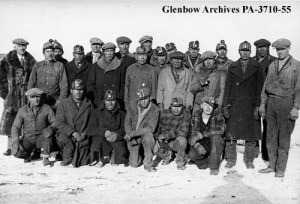
Napoleon married my grandmother sometime in the late 1920s or very early 1930s; he and his family moved to southern Alberta where they lived on the Blackfoot (Siksika) reserve and where Napoleon worked as a miner. I have located two photos of my grandfather from the Glenbow Archives during this time. My grandfather is in the second row, second on the left.
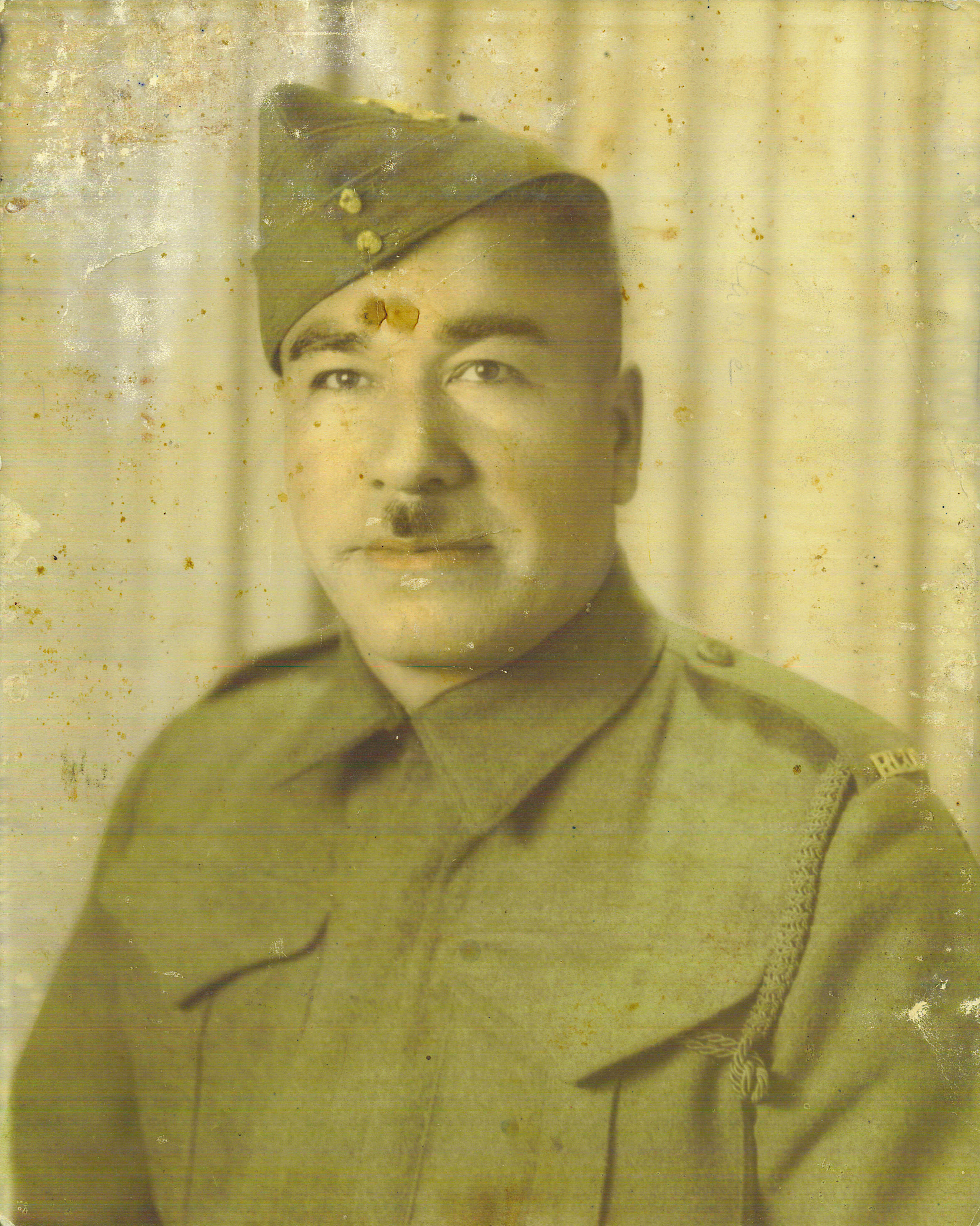
Napoleon fought in Italy during the second world war. I have yet to get a copy of his military records although I’m very interested in taking a look at them. Apparently, Amsterdam was one of his favourite cities and when my mother came to visit me this past summer she lit a candle in one of the churches in his memory. My mother says he never spoke about his time in the army but that when he returned his once black hair had turned white and said it was because of what he had seen. (I have gotten the photo below restored and gave it to my mother as a Christmas present in 2012.)
c. 1941
Napoleon passed away just before Christmas in 1985. He is buried alongside his wife in Marieval, Saskatchewan, at the Sacred Heart of Mary Roman Catholic Church. There is still much that I want to know about my grandfather and the fact of the matter is that I just haven’t asked enough questions. This is the year that I am going to sit down with my mother and contact my other relatives in order to get as much as I can.
This week in Amy Johnson Crow’s genealogist challenge: 52 Ancestors in 52 Weeks, I am going to write about my mother’s side of the family. Being the ‘baby’ of the family I have missed meeting many of my older relatives simply because I am the age of many of my nephews and nieces, as a consequence, many events that my siblings have been privy to have happened long before I was born.
Today, I am going to write about one of my uncles, Joseph Pelletier (1947-1973). Joey was born the second last of my mother’s siblings, eleven children in total. My mother and her siblings, including Joey, grew up on a Blackfoot reserve in southern Alberta.
Being Aboriginal children in the 1930s-1960s they would have been required to have attended Indian Residential School. I do not know much about their lives during their childhood and youth as there are only three of the eleven siblings alive today, including my mother, and I believe this reflects on the harsh lives they lived. I can only speculate, based on my studies and work with the Truth and Reconciliation Commission of Canada, on the treatment of my mother’s siblings in the residential school system. My mother is lucky, she can remember mostly good memories of her time at Crowfoot IRS either because her experience was better than most or because she has blocked any painful memories out for good reason. Anyway I am getting off topic- more on Indian Residential Schools in a future post.
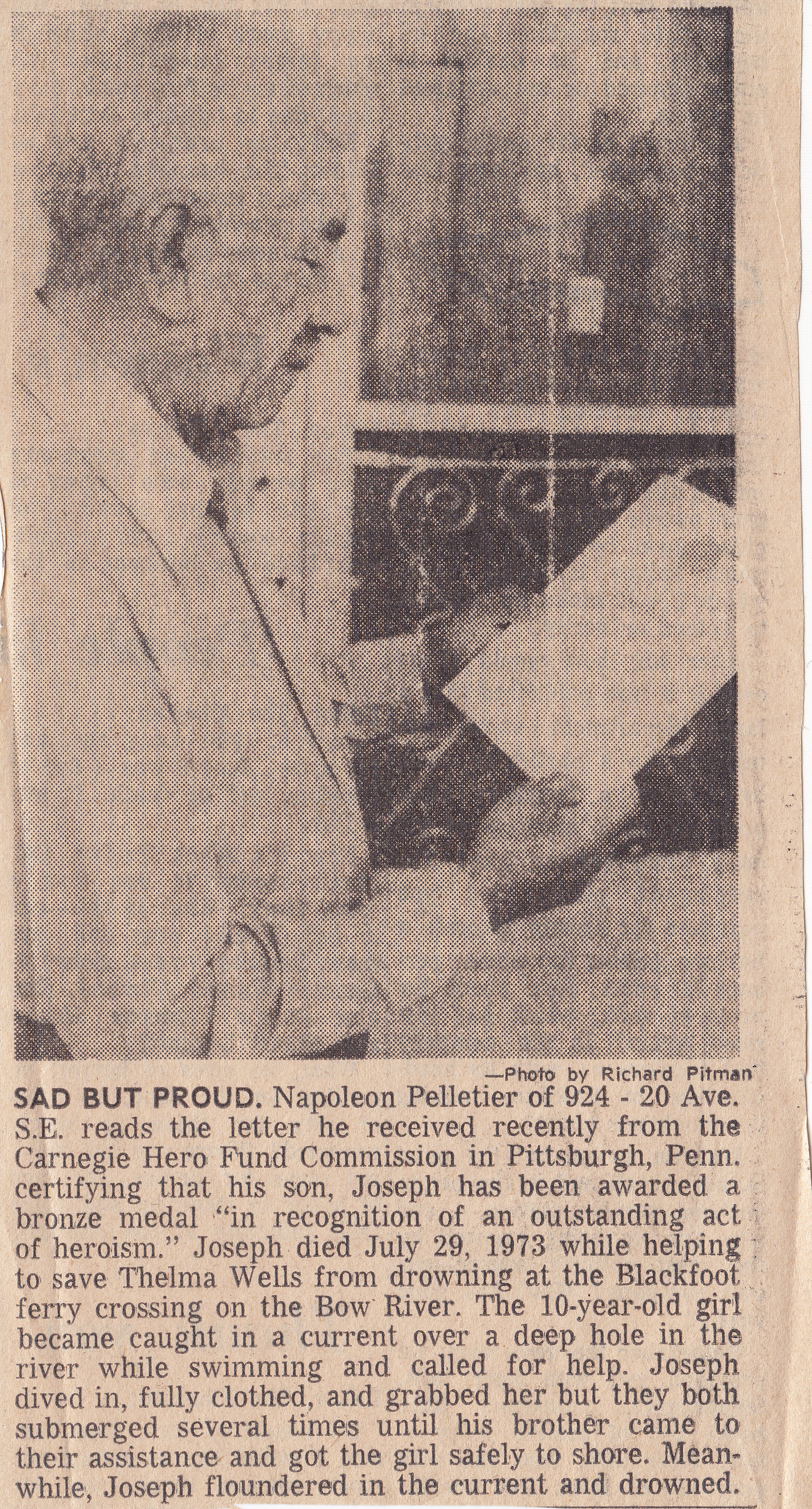
On the morning of 29 Jul 1973, while swimming in the Bow River, 10-year-old Thelma A. Wells, became caught in the revolving current over a hole in the river bottom and called for help. Joey, my uncle, having heard her cries, entered the water fully clothed and swam to her. A struggle ensued; and both were submerged briefly several times. Joey called for assistance. His younger brother, Robert, entered the water and swam to them. While Robert was able to take Thelma safely to the bank, Joey floundered in the spinning current over the hole and drowned before help reached him.
The Carnegie Hero Fund Commission awarded Joey the bronze Carnegie Medal in recognition of his outstanding act of heroism. The purpose of the Carnegie Hero Fund is to award individuals in the United States and Canada who risk their lives to an extraordinary degree saving or attempting to save the lives of others.
c.1973 (Calgary)
Above is a clipping from a newspaper, most likely from Calgary, that was with the Carnegie award certificate in our basement. I do not know what has happened to the bronze metal itself because we do not have it. I can only hope one of my aunts have it in their possession otherwise it has been lost, most likely when the government seized my grandmother’s property when she passed away in 1990. I am tempted to contact the Carnegie Hero Fund to see whether a replacement medal can be given to the family again. Couldn’t hurt to ask anyway.
c. 1962
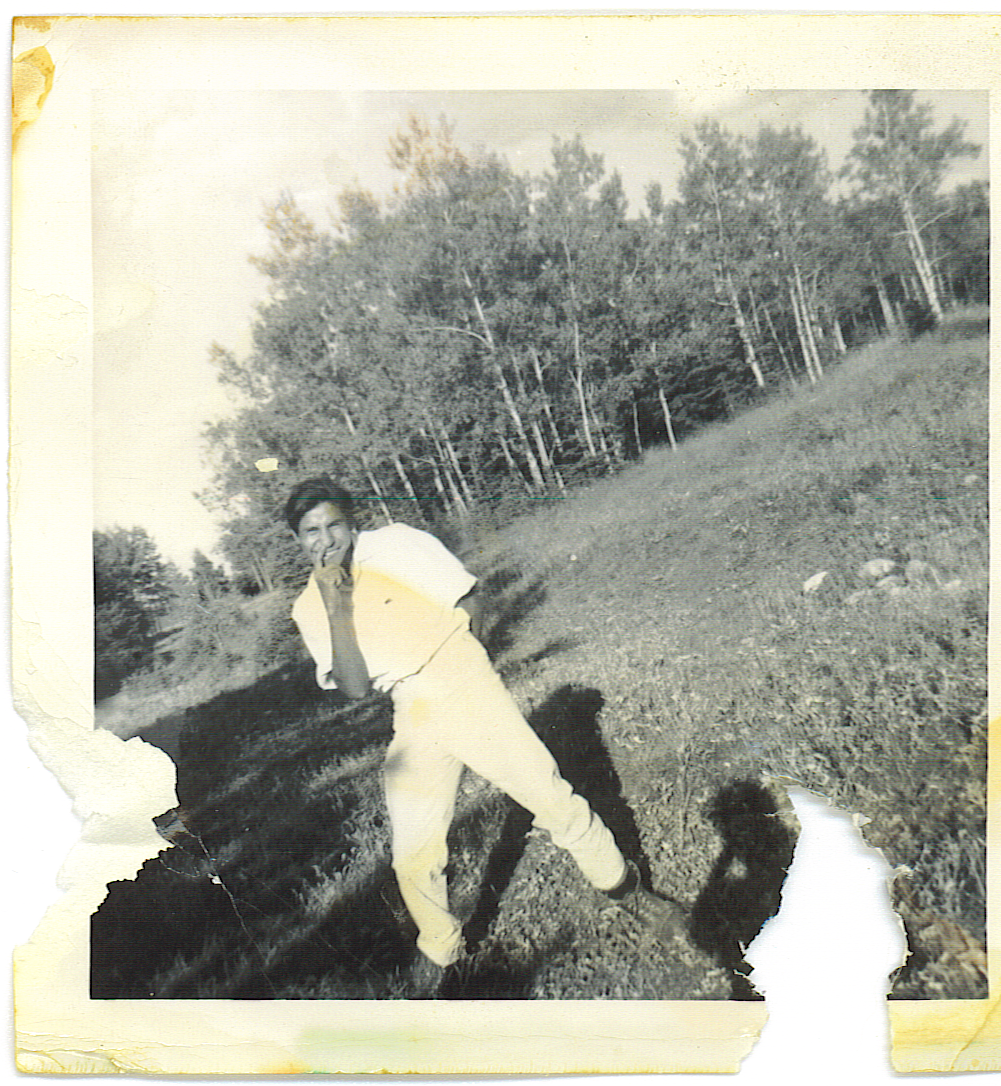
While I do not know much of my uncle Joey this act of bravery makes me wish I could have known him during his brief life. One of the rare photos I have in my possession shows a smiling young man full of life– even a bit of a comedian, but who isn’t at 15? I wish I had more photos of him as well as other members of my family whose faces are now lost to memory and time. This is why I treasure the photos, documents, and artifacts I am able to get my hands on. It is important to me to discover and uncover as much information as I can about my family- the more I get to know them the more I get to know myself.










 From Mowat and Beyond