There are 59 recipes under Appetizers & Beverages and 22 Appetizers in the R.M. of Mossey River Homecoming Cookbook. These were provided by 27 contributors who were connected to 9 schools.
Page
Recipe
Schools
Contributors
1
Holiday Cheese Ball
Small Creek School, Fork River School
Rose Ward (Boyko)
1
Crab Mousse
Cork Cliff School
Lillian Procyshyn (Boyechko)
2
Salmon Ball
Pine View School
Judy Filleti (Cottick)
2
Quick Quichettes
Fork River School
Pat Fedorkiw (Zazuliak)
2
Bacon and Onion Tarts
Pine View School
Pauline Krokosh (Pakulak)
3
Crab & Cream Cheese Puffs
Nordheim School
Mary Bergen (Rempel)
3
Bacon Puffs
n/a
Angela Pylypchuk)
4
French Cheese Puffs with Ham
Borden School, Mossey River School
Natalie Beyak (Zurba)
4
Crab-Vegetable Bites
n/a
Lori Davies (Senyk)
5
Funghi alla Parmigiana (Cheese Stuffed Mushrooms)
Cork Cliff School
Alice Dano (Smendziuk)
6
Pepperoni Stuffed Mushrooms
n/a
Lori Davies (Senyk)
6
Cheese Olives
Small Creek School
Joan Seminchuk
7
Crisp Potato Skins
n/a
JennaLee Natrasony, Brett Natrasony, Lance Nastrasony, Gordon Nastrasony, Laurie Nastrasony
Continuing the post from late last week, here are some additional songs and stories from the Bohdan Medwidsky Ukrainian Folklore Archives.
There were 68 recordings made from Fork River that included 32 recordings from Mrs. John Masiowski, 21 recordings from Dokiia Rozmarynovych, 3 recordings from Mrs. Jacob Harrison, and 4 recordings from Walter Pasternak. Since his recordings were mislabeled I’m unable to link to them as a collection, only one-by-one below.
Additionally, Robert Klymasz recorded stories and songs from Plumas, Rorketon, and Winnipegosis as well as in Alberta and Saskatchewan.
I’ve organized all of the Fork River items alphabetically in the Cyrillic alphabet and linked each one separately.
I found a few of the songs in Robert Klymasz’ publications which I pulled from the University of Manitoba’s Slavic Collection at the Elizabeth Dafoe Library. I’ve marked them in the chart for easy identification and included the musical notation and lyrics from the books in both English and Ukrainian.
Dokiia Rozmarynovych Songs
Rozmarinovich [Rozmarynovyč], Dokija (Mrs. Pavlo, nee Bassarabova) 73, retired. Born in in the village of Ukivtsi, Borshchiv district, Ternopil’ region, Ukraine. Arrived in Canada in 1920. Recorded in Fork River, Manitoba, 10 August 1964.
Bohdan Medwidsky Ukrainian Folklore Archives – Kule Folklore Centre, Faculty of Arts, University of Alberta.
1 Published in Folk Narrative Among Ukrainian-Canadians in Western Canada. Robert B. Klymasz. 1973.
2 Published in The Ukrainian Winter Folksong Cycle in Canada. Robert B. Klymasz. Ottawa. 1970.
Of those who actually participated in Canada’s first influx of Ukrainian peasant settlers at the turn of the century, few are alive today. Having witnessed and survived the early years of toil and hardship, they invariably sense a strong feeling of accomplishment and are eager to relate their experiences to members of the younger, Canadian-born generation which, in their opinion, does not know or fails to appreciate “what we went through.” Many of the Ukrainian old-timers are able to recall the old songs which depicted the immigrant’s experience in his new Canadian environment. These frequently include a popular motif portraying Canada as a deceitful seductress who has lured the hapless peasant away from his beloved ones in the Old Country.
Folk Narrative Among Ukrainian-Canadians in Western Canada. Robert B. Klymasz. 1973. p. 10.
Xodzhu po Kanadi taj myli raxuju, De j nje nich napadyt tam perenochuju.
Kanado, Kanado, jaka ty zradlyva, Ne jednoho cholovika z zhinkou rozluchyla,
Ne jednoho cholovika taj ne jedni dity, Oj hore zh tam hore v Kanadi sysity.
As I walk through Canada I count the miles And bed down for the night wherever night falls.
O Canada, Canada, how deceitful you are! Many a man have you separated from his wife,
Many a man and many children – O how miserable it is to be in this Canada!
Folk Narrative Among Ukrainian-Canadians in Western Canada. Robert B. Klymasz. 1973. p. 10.
Летіла зозулька, Сіла на прутину. Ти мене сестричко, Просила в гостину.
Та й рада б я, сестро, В гостi приïхати, Далека дорога, Не мож сi дiстати.
Далека дорога, Та й щироке море. Як си нагадаю, Ой Боже ж мiй, Боже.
Ходжу я по лiсi, По лiсi блукаю, До своï сестрички Дороги шукаю.
Шукаю дороги, Дороги сухоi. Та й може б я зайшла До родтини своi.
Сестричко, сестричко, Сидиш на посазi. Сидиш на посазi, Сумно виглядаєш, Та й того сестричко, Що мами не маєш.
The cuckoo was flying And perched on a branch. You, my sister, have invited me for a visit.
How gladly, o sister, I would come for a visit, But the way is long, I can’t make it.
The way is long, And the sea is wide. When I think about it – O my God, o my God!
I’m walking through the forest I’m roaming through the forest. I’m looking for the way To my sister’s.
I’m looking for the way, A dry roadway. Maybe I could make my way To my family.
Sister, o sister, You’re seated on the trousseau. You’re seated on the trousseau. You look sad, And that is, o sister, Because you have no mother.
The Ukrainian Winter Folksong Cycle in Canada. Robert B. Klymasz. Ottawa. 1970. p. 146.
Bohdan Medwidsky Ukrainian Folklore Archives – Kule Folklore Centre, Faculty of Arts, University of Alberta.
3 Published in Ukrainian Folksongs from the Prairies. Complied under the direction of the collector with the participation of Andrij Hornjatkevyč, Bohdan Medwidsky, and Paula Prociuk. Collected by Robert B. Klymasz. Canadian Institute of Ukrainian Studies Press. University of Alberta. 1992.
4 Published in Ukrainian Folklore in Canada: An Immigrant Complex in Transition. Robert B. Klymasz. 1970.
Songs from the New World
Ой то би сє дiвчинонька В сих м’ясниць вiддала, Якби вона чайнамена Снгарiв не крала.
Єдна крала сигарети, А друга бинени, Трета з боку заглєдала, Чи йдут чайнамени.
Гелен, Стелла i Тереса Моди сє тримали Та й по двадцiть п’ять поверхiв Дреси вишивали.
Як сє вбере тую дресу, Намалює пику, Вона сибе прикладає За паню велику.
Покинь, дiвче, малювати, Бо висмiют люди, Бо з тих павдрiв i з липстикiв, Газдинi не буде
Oh, the girl would have got married During this meat season, If she hadn’t been stealing Cigars from the Chinaman.
One of them stole cigarettes And another bananas, And a third one was on the lookout from the side Whether Chinaman were coming.
Helen, Stella and Theresa Kept up with fashion, And each had sewn dresses Twenty-five stories high.
When she wears this dress And “colours” her snout, She plays the role Of a great lady.
Stop, girl, putting on make-up Because people will laugh at you, Because those powders and lipsticks Will never make a good housewife.
Songs from the New World. Song 54. Ukrainian Folksongs from the Prairies. 1992. p. 137.
All activities are temporarily suspended about none o’clock at which time all guests line up to present the bridal couple with their cash gifts and to extend their personal wishes. Parents, relatives and close friends are expected to come forth first, followed by the rest of the guests, the attendants, and finally, the groom. On isolated occasions, the wishes themselves are extended in the form of a song, or “cvivat”, the content of which may be traditional or as extemporaneous in nature as the following example:
Recall, O my comrade, What great pals we were, How the both of us used to go To the same house.
To the same house And to the same girl, And we’d never get home Until daybreak.
When we got home The neighbors would know everything; They would point at us with their fingers and say. “They’ll never get anywhere!”
And now you are getting married While I’m just thinking about doing so. I only feel sad That I no longer have a home now.
I no longer have a house Nor my own home; All I do now is wander about aimlessly Through distant, different places.
I think, O comrade, I should now come to an end So, musicians, strike up a vivat! And with this cider I drink a toast unto you!
Ukrainian Folklore in Canada: An Immigrant Complex in Transition. Robert B. Klymasz. 1970. p. 85.
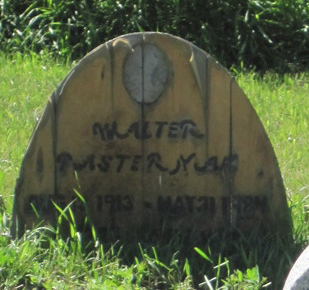
Interestingly enough, as I was reviewing some photographs I realized I had taken a snapshot of Walter’s grave during a visit to Fork River in 2015. He is buried in the Ukrainian cemetery. It’s too bad his little image plaque is missing.
Robert Bohdan Klymasz (1936 – ) was born in Toronto in 1936 and is a Ukrainian-Canadian folklorist. He was the executive director of the Ukrainian Cultural and Educational Centre, an Adjunct Professor at the Centre for Ukrainian Canadian Studies, and a curator at the Museum of Civilization.
I highly recommend reading the following article, A Visit to the Ukrainian Museum and Library, by Thomas Prymak about his visit to the Oseredok in Winnipeg. His article talks about the treasured texts found there as well as his visits and chats with Ukrainian-Canadian scholars including Robert Klymasz.
The reason I’m sharing this information is because one of my cousins stumbled on to the Bohdan Medwidsky Ukrainian Folklore Archives where our great-grandmother Anastasia Masiowski nee Kotlarchuk (1891-1976) has 32 songs and stories recorded when Robert Klymasz visited Fork River on July 20th, 1964. The archive indicates there are 36 songs and stories but 4 of them have been mislabeled as they are sung by Walter Pasternak.
I’ve organized the 32 items alphabetically in the Cyrillic alphabet and linked each one separately.
I was curious as to whether any of the recordings were used in Robert Klymasz’ publications and I found 2 songs from my great-grandmother in his books which I pulled from the University of Manitoba’s Slavic Collection at the Elizabeth Dafoe Library. I’ve marked them in the chart for easy identification and included the musical notation and lyrics from the books in both English and Ukrainian.
It’s so interesting to hear my ancestor’s voice from beyond the grave!
There are additional records from the Robert Klymasz collection at the University of Manitoba’s archives that I’d like to pull in the future. I hope there are more translations of her songs and stories that just didn’t make it into a publication.
Bohdan Medwidsky Ukrainian Folklore Archives – Kule Folklore Centre, Faculty of Arts, University of Alberta.
1 Published in Ukrainian Folksongs from the Prairies. Complied under the direction of the collector with the participation of Andrij Hornjatkevyč, Bohdan Medwidsky, and Paula Prociuk. Collected by Robert B. Klymasz. Canadian Institute of Ukrainian Studies Press. University of Alberta. 1992.
2 Published in The Ukrainian Winter Folksong Cycle in Canada. Robert B. Klymasz. Ottawa. 1970.
Old Country Songs
Nastja Masiowsky – Fork River, Manitoba – 20 July 1964
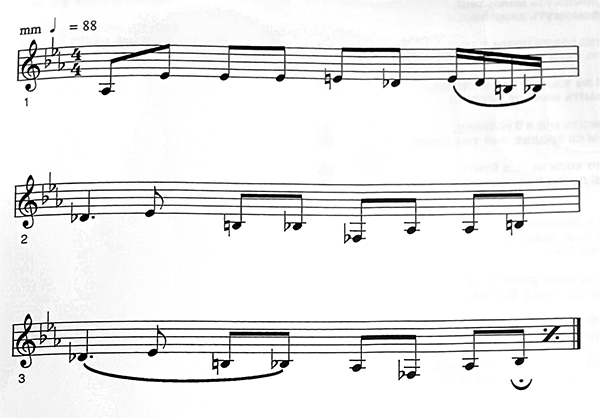
Old Country Songs. Song 12. Ukrainian Folksongs from the Prairies. 1992. p. 29.
«На день добрий Штефанова, Ой чи є твiй Штефан дома?»
«Ой нема Штефана вдома, Ще вечеря не готова.»
«Ой чи вийдеш вiдтворяти, Чи скажеш ся добувати?»
«Ой не вийду я втворяти, Не скажу ся добувати.
В мене дсверi тисовiï, В мене замки стальовiï.»
«Як пiдложу праве плече, Не поможуть эамки твоï, Не поможуть дверi твоï.»
Як пiдложив праве плече, Його куля в саме серце.
«Ой ви хлопцi бай молодцi, Вiэьмiть мене на топорцi.
Эамесiть м’я в Буковину, Де-м ся вродив, най там эгину.
Було ходити та и буяти, Суцi правди не скаэати.»
By the small green grove Goes the young Dovbuš.
He limps on [one] foot He rests on his ace as on a cane.
“Quickly, men, quickly, quickly, Soon snow will fall and cover our path.
“Let’s make our way to Dzvinka, To the wife of Štefan.
“Greetings, o wife of Štefan, Is Štefan, your husband, home?”
“Štefan is not home yet, The supper is not ready.”
“Will you open up willingly, Or am I to force my way in?”
“I shall not open up, Nor will I let you force yourself in.
“I have doors made of yew, I have locks made of steel.”
“When I brace my shoulder against the door, Your locks will not help, Your doors will not help.”
When he braced his shoulder to the door, A bullet hit him straight in the heart.
“O my men, you young stalwarts, Take me up on on your axe [handles],
And take me to Bukovyna, Let me die where I was born.
I should have gone roaming Instead of telling that bitch the truth.”
Old Country Songs. Song 12. Ukrainian Folksongs from the Prairies. 1992. p. 29.
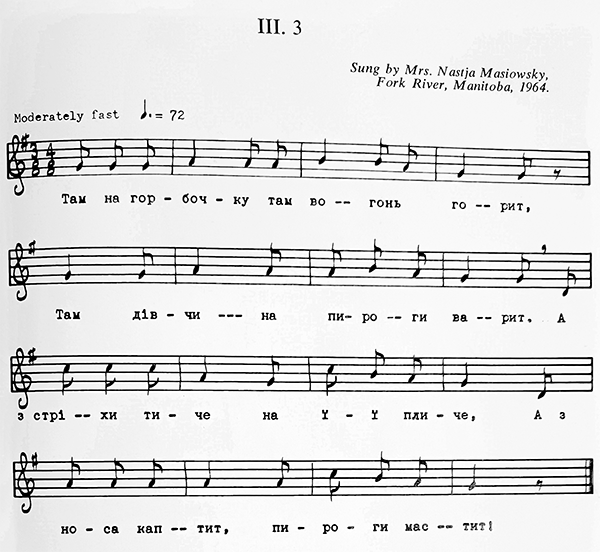
III. 3. The Ukrainian Winter Folksong Cycle in Canada. 1970. p. 139.
NOTE: Singers often grope for the pitch and metre at the beginning of songs. If this song had had more verses, the singer would probably have established a triple metre throughout. The bar 4/8 time would then be sung in 38. [Kenneth Peacock.]
Там на горбочку там вогонь горе Там дiвчина пироги варит. А з стрiхи тиче на ïï пличе, А з носа каптит, пироги мастит!
There on a hillhock burns a fire, And a maiden’s there cooking dumplings. The thatched roof is leaking onto her shoulder And from her nose it’s dripping and buttering the dumplings.
III. 3. The Ukrainian Winter Folksong Cycle in Canada. 1970. p. 139.
This is a typical ditty sung by the mummers to underscore Malanka’s abilities as a housekeeper and cook.