Below you’ll find a series of 16 tables of Indexes for reels C-7135 to C-7139 and C-7145 to C-7155 digitized on the Canadiana Héritage database. I skipped reel T-7139 because there doesn’t appear to be an index for its content which is Letterbooks from Fort Saskatchewan (1888-1896).
Eventually, I would like to do a full linked index but that’s quite a bit of work. Until then, here are the indexes of Annuity Paylists from 1871 to 1914 for bands in Treaty 1, 2, 3, 4, 5, 6, 7, 8, and 10.
In this blog post I’m going to share the transcript from a letter written by Thomas Bear (1801 or 1810-1892) to one of his daughters named Isabella.
I first mentioned this letter in my post about his son, Jacob Bear (1839-1925), and would like to do a full post on Thomas one day as he is the furtherest I can trace in the Bear family beyond mention of his father Wapask in the 1870 Manitoba Census.
I first learned of this letter’s existence while researching the Bear family from St. Peters. In my search for this line of Bears, I came across Angela Jeske’s 1990 Thesis entitled, St. Peter’s Indian Settlement: A House Indian Community at Red River, 1833-1856.
This thesis really helped flesh out what St. Peter’s was like and who lived there during the early and mid-1800s which I previously had been unable to find information. Much of the published materials I have looked at focused on the later 1800s and early 1900s which is too far ahead for what I’ve been focused on.
As well, it is possible to associate specific family names with either “Cree” or “Saulteaux”. Names common to those identified as Cree were Bear, Badger, Cockrane, Johnstone, Stevenson, Thomas, Sutherland, Isham, Whitford, Sinclair, Sandison, Williams, Turner, Kennedy, Garioch and Halco.
Jeske, 1990, p. 68.
The census of 1835 records three separate heads of families with this name [Bear]: Jacob, John, David. It is likely, however, that Thomas Bear “an Indian from Cumberland House” was the brother of the previously mentioned family heads, and was connected to Robert Stranger through both place (Cumberland House) and marriage.
Jeske, 1990, p. 79.
Based on this information I suspect the family hails from northern Manitoba or Saskatchewan as I’ve seen references to both Norway House (Kinosao Sipi – ᑭᓄᓭᐏ ᓰᐱᐩ) and Cumberland House.
This next part just goes to show I need to write down where and how I come across some of my references. In my general search regarding the Bears, I came across another book entitled, The Shady Side of Fifty: Age and Old Age in Late Victorian Canada and the United States by Lisa Dillon.
The economic status of indigenous elderly wives, whose family economies were typically resource based, was undoubtedly less certain than that of their white counterparts. The insecurity of Isabella Beardy old age is evident in a letter written by her husband, Thomas Bear, a Cree born in Rupert’s Land, to his daughter in 1883. A broken gun and lack of a boat impeded Bear’s abilities to hunt for himself and his wife. Their son, Peter, planted wheat and barley, which Isabella was left to reap. A granddaughter, Maggie, arrived unannounced; she helped dig up potatoes but left her grandparents mystified by her sudden departure from their daughter’s home. With Peter away hunting ducks, Isabella and Thomas made their own efforts to repair their house. When Isabella and Thomas attempted to cope with their problems by praying, Peter interrupted them drunk; it was Isabella’s role to pacify their drunken son. Although Isabella had borne nine children, her security and peace in old age was far from guaranteed.
Dillon, 2008, p. 45.
Intrigued by the content of the letter, I was able to have it retrieved from the Manitoba Provincial Archives during my visit in October 2021. A copy of the original letter had been made and then donated by an individual from Thunder Bay in October of 1992.
Ann Morton, Head of Research and Reference at the HBC Archives, wrote in her reply that there was only one Thomas Bear that could be found in the 1870 Census. Based on his age, place of residence, and connection to a daughter named Isabel, it was very likely the Thomas in the census was the same one who wrote the letter.
She also provided additional information from the 1870 Census and Anglican Parish Registers and mentioned that she checked the HBC employment records but could not find any information prior to his marriage in 1835. She suggests that he was either not employed by the HBC or was an undocumented seasonal worker.
A second page was included with some genealogy information related to Thomas and his family. Thomas Bear married Isabella Beardy on December 3rd, 1835 in St. Peters. The pair had the following children recorded in St. Peter’s registers: Thomas (1836), Robert (1837), Jacob (1839), Isabella (1842), Elizabeth (1844), Sophia (1846), George (1848), Joseph (1851) and Mary Joan (1859). The couple also had a son named Peter but he was not included in the parish register. The researcher wondered whether Joseph (1851) could be Peter or if his name was life off altogether.
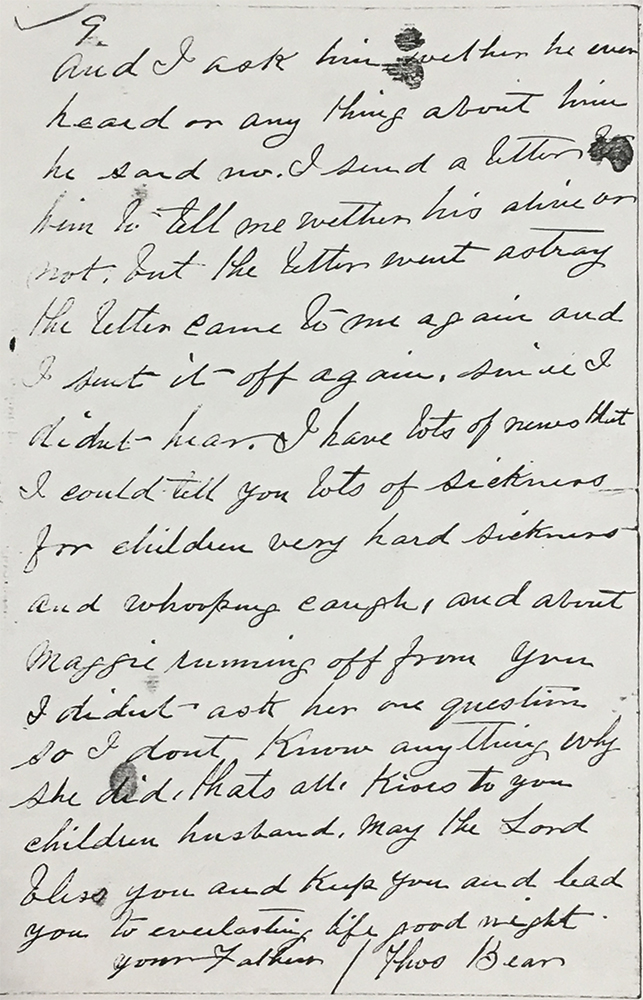
The letter was 9 pages in length and hand-written so I had some trouble deciphering some of the text. I always think of younger generations who are not being taught cursive and the extra work archivists and researchers will have to do in order to familiarize themselves with it before even looking at some of the extra peculiarities with style that come and go.
In any case, I have kept most original spelling and have added my educated guesses within brackets.
St. Peters October 23rd 1883 Mrs. Esibella Hopeboam
dear daughter
I was very glad to receive [your] letter. to learn that you are all still alive. and about what you wish from me [I do it] for you. I could not do it for you. know I am [getting] blind I only killed one duck this summer, and the same time you know that I broke my gun last spring before you went away.
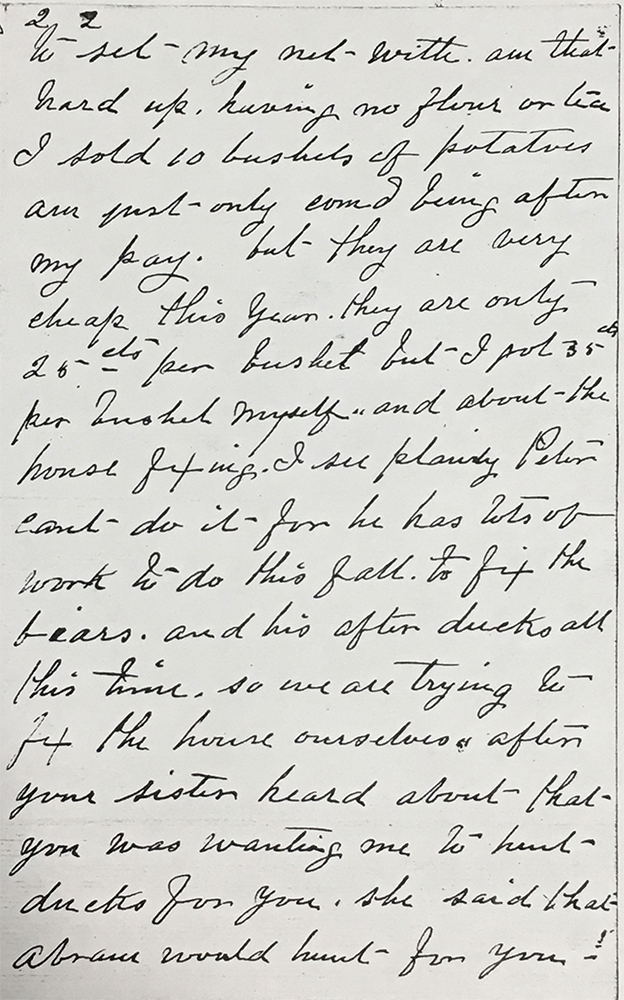
[since] I have no gun nor a boat to hunt with even I have no boat to set my net with. am that hard up having no flour or tea. I sold 10 bushels of potatoes [and past] only [come] being after my pay. but they are very cheap this year. they are only 25 cts per bushel but I put 35 cts per bushel myself and about the house fixing.
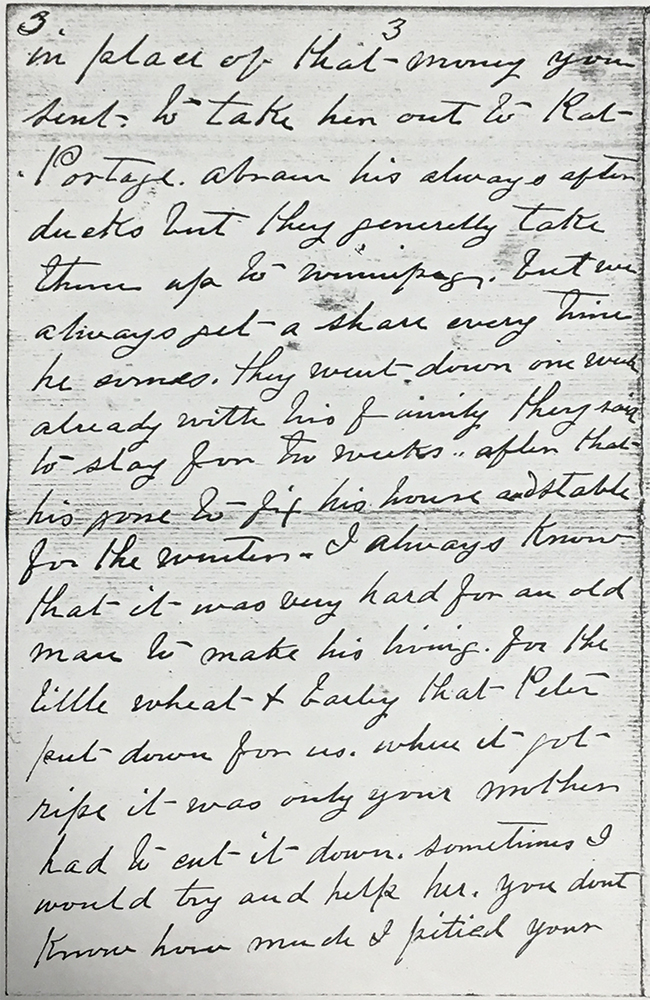
I see plainly Peter can’t do it for he has lots of work to do this fall to fix the [biars] and his after ducks all this time. So we are trying to fix the house ourselves after your sister heard about that you was wanting me to hunt ducks for you, she said that Abram would hunt for you in place of that [money] you sent to take him out to Rat Portage.
Abram [he’s] always after ducks but they generally take them up to Winnipeg. but we always [set] a share every time he [arrives]. they went down one week already with his family. they [plan] to stay for two weeks. after that [he’s gone] to fix his house and stable for the winter.
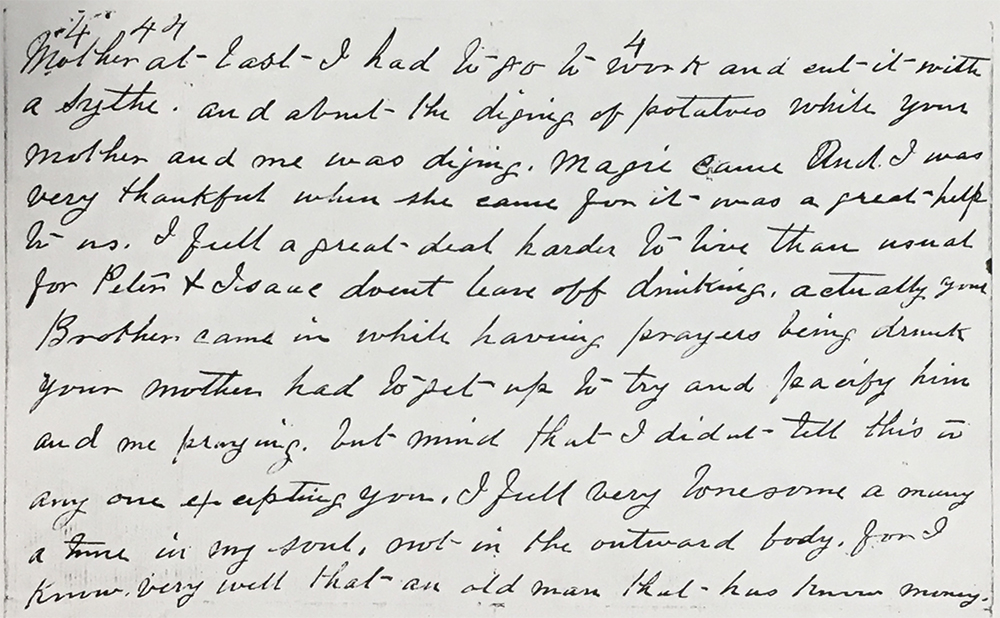
I always known that it was very hard for an old man to make his living. for the little wheat + barley that Peter put down for us. when it got ripe it was only your mother had it cut it down. sometimes I would try and help her. you don’t know how much I pitied your mother at last I had to go to work and cut it with a scythe. and about the digging of potatoes while your mother and me was digging, Maggie came and I was very thankful when she came for it was a great help to us.
I [feel] a great deal harder to live than usual for Peter and [Isauc] [doesn’t] leave off drinking, actually your brother came in while having prayers being drunk your mother had to get up to try and pacify him and me praying. but mind that I didn’t tell this to anyone excepting you. I [feel] very lonesome a many a time in my soul, not in the outward body, for I know very well that am old man that has known many [his] got to be in need a many a time.
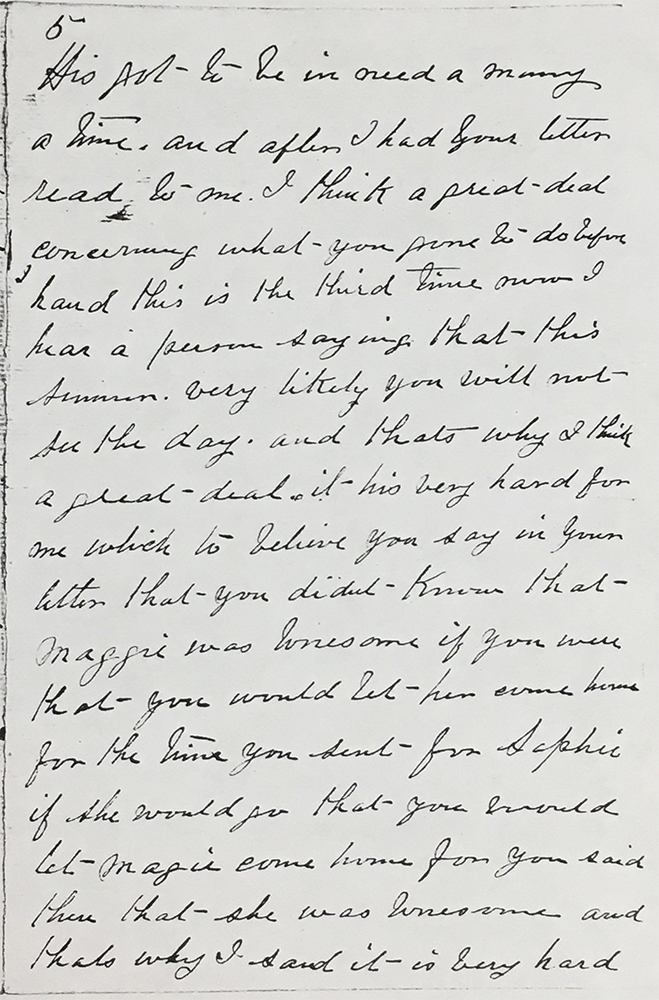
and after I had your letter read to me. I think a great deal concerning what you [gone] to do before hand this is the third time now I hear a person saying that this summer. very likely you will not see the day and that’s why I think a great deal. it [is] very hard for me which to believe you say in your letter that you didn’t know that Maggie was lonesome if you were that- you would let her come [home] for the time you sent for Sophie if she would go that you would let Maggie come home for you said [there] that she was lonesome and that’s why I said it is very hard for me which to believe different stories.
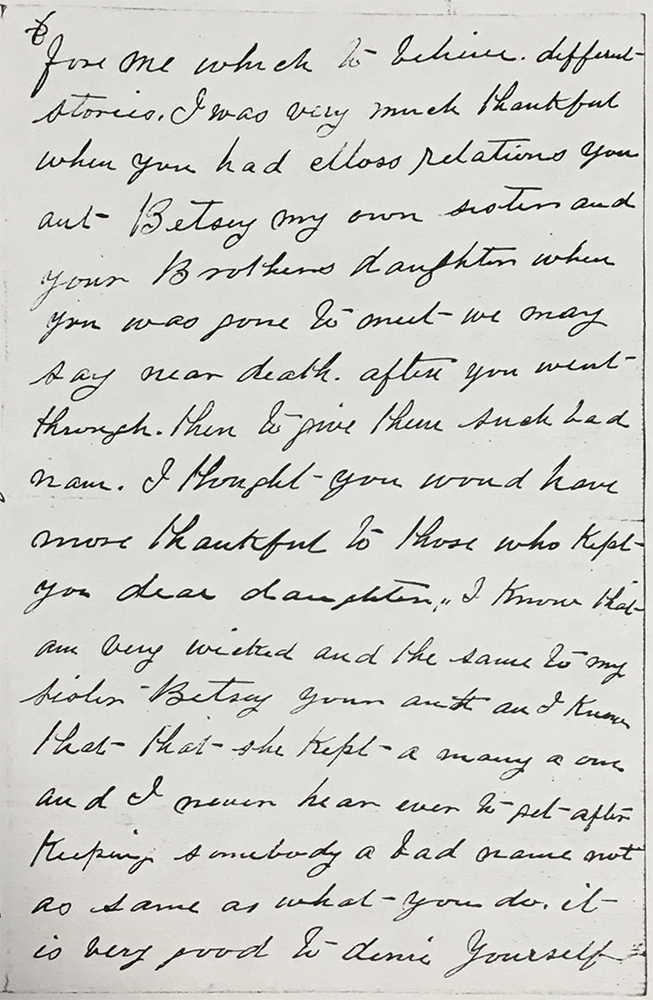
I was very much thankful when you had [elloss] relations you out. Betsy my own [sister] and your brother’s daughter when you was gone to meet we may say near death. after you went through. then to give them such bad name. I thought you would have [more] thankful to those who kept you dear daughter. I know that am very wicked and the same to my sister Betsy your aunt am know that that she kept a many a [cree] and I never hear ever [to set] after keeping somebody a bad name not as same as what you do.
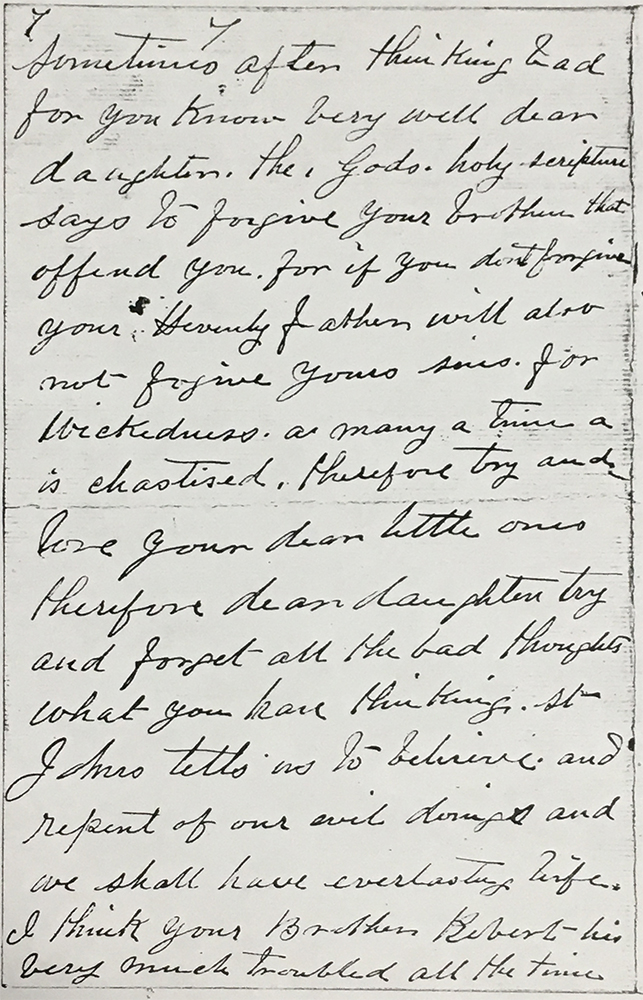
it is very good to [deny] yourself sometimes after thinking bad for you know very well dear daughter the God’s holy scripture says to forgive your brother that offend you. for if you don’t forgive, your Heavenly father will also not forgive your sins. for wickedness as many a time is chastised. therefore try and love your dear little ones. therefore dear daughter try and forget all the bad thoughts what you have thinking. St John tell us to believe and repent of our evil doings and we shall have everlasting life.
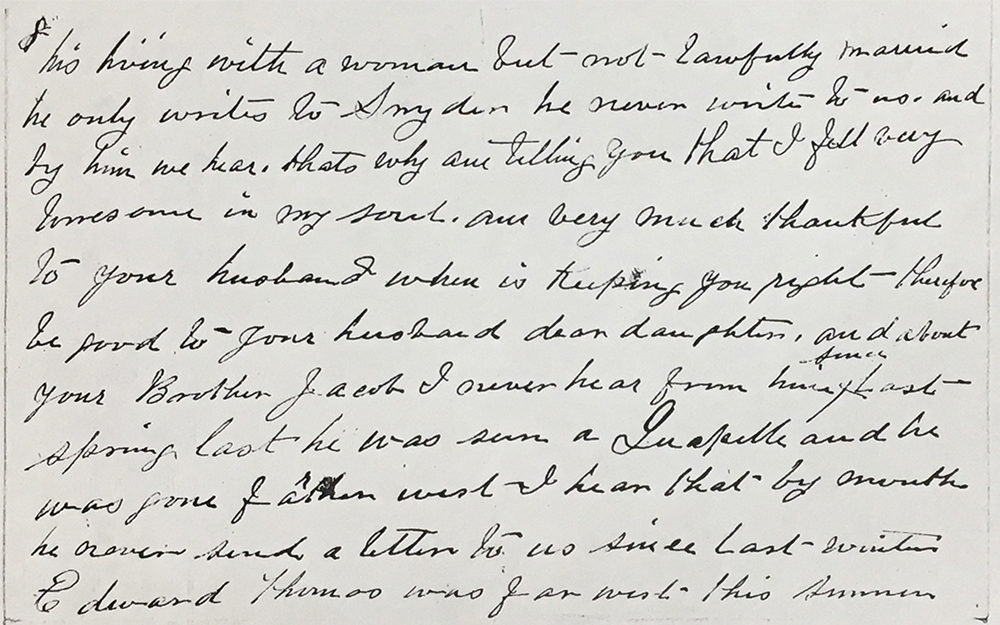
I think you brother Robert [he’s] very much troubled all the time. he’s living with a woman but not lawfully married. he only writes to [Snyder] he never writes to us. and by him we hear. that’s why am telling you that I [feel] very lonesome in my [soul].
am very much thankful to your husband when [he’s] keeping you right-therefore be good to your husband dear daughter, and about your brother Jacob I never hear from him. last spring last he was seen [at] Qu’Appelle and he was gone farther west I hear that by mouth he never send a letter to us since last winter.
Edward Thomas was far west this summer and I ask him [whether] he ever heard or any thing about him he said no. I send a letter [to] him to tell me [whether] [he’s] alive or not, but the letter went astray. the letter came to me again and I sent it off again, since I didn’t hear.
I have lots of news that I could tell you lots of sickness for children very hard sickness and whooping cough, and about Maggie running off from [you]. I didn’t ask her one question so I don’t know anything, why she did, that’s all. Kisses to you children, husband, may the Lord bless you and keep you and lead you to everlasting life, good night.
Your father Thos Bear
Letter from Thomas Bear to Mrs Esibella Hopeboram, St Peters, 23 October 1883, Thomas Bear Collection, P 5098 f.8, Manitoba Provincial Archives.
There is so much interesting information contained in this letter that I’ve used to support ongoing research. Due to the difficulties I’d had in transcribing the content, I have also uploaded copies of my photos of the letter for anyone who might want to take a stab at some of the peculiar words that don’t fit.
References
Dillon, Lisa. The Shady Side of Fifty: Age and Old Age in Late Victorian Canada and the United States. McGill-Queen’s University Press. 2008.
Jeske, Angela. 1990. St. Peter’s Indian Settlement: A House Indian Community at Red River, 1833-1856. Master of Arts Thesis. University of Alberta.
Letter from Thomas Bear to Mrs Esibella Hopeboram, St Peters, 23 October 1883, Thomas Bear Collection, P 5098 f.8, Manitoba Provincial Archives.
In February of this year I wrote about the use of Treaty Annuity Lists in researching my Indigenous ancestors. I had linked to a blog post on dibaajimowin.com where the writer identified what was on each reel hosted on heritage.canadiana.ca but the post has since been deleted or moved.
I’ve created an index of indexes on reels C-7136 to C-7139 from 1871 to 1909 when the lists end. Reel T-7139 are scans of Letterbooks from Fort Saskatchewan from 1888-1896. The information I’ve recorded are of the reel number, the image number, the date, and the Treaty information that can be found. I’ve also taken the step to link directly to the index’s permalink.
I wish such a list had been around when I first started using the annuity lists. It would have beat the man hours I put in scrolling through the thousands of pages looking for the communities of interest I wanted to read.
I have created an index of Kahkewistahaw’s Treaty Annuity Lists from 1874 to 1909 found on reels C-7145 to C-7153.
The information below is of the reel number, the image number, the name of the Band, where the annuity was paid, the date, the Treaty numbers recorded, the page number in the book, and any notes about the list. I would like to revisit the list at a later date to include a permalink for each year.
Although these lists often only included the name of the person taking the annuity payment, I found it very helpful in my research.
I have created an index of Cowessess’ Treaty Annuity Lists from 1874 to 1909 found on reels C-7145 to C-7153.
The information below is of the reel number, the image number, the name of the Band, where the annuity was paid, the date, the Treaty numbers recorded, the page number in the book, and any notes about the list. I would like to revisit the list at a later date to include a permalink for each year.
Although these lists often only included the name of the person taking the annuity payment, I found it very helpful in my research.
I have created an index of Chacachas’ Treaty Annuity Lists from 1874 to 1884 found on reels C-7145 to C-7146.
The information below is of the reel number, the image number, the name of the Band, where the annuity was paid, the date, the Treaty numbers recorded, the page number in the book, and any notes about the list. I would like to revisit the list at a later date to include a permalink for each year.
Although these lists often only included the name of the person taking the annuity payment, I found it very helpful in my research.
2 The bands of Chakachas and Kahkeesheway although paid separately up to 1882, are paid together in that year, separately in 1883, and together 1884 on. Chief Chakachas resigned as chief of his band in 1882, and the band was paid under the Chief Kahkeesheway until 1884, when he died and his son Ochowpowace was elected in his place.
I have created an index of Ochapowace’s Treaty Annuity Lists from 1874 to 1909 found on reels C-7145 to C-7153.
The information below is of the reel number, the image number, the name of the Band, where the annuity was paid, the date, the Treaty numbers recorded, the page number in the book, and any notes about the list. I would like to revisit the list at a later date to include a permalink for each year.
Although these lists often only included the name of the person taking the annuity payment, I found it very helpful in my research.
1 The bands of Chakachas and Kahkeesheway although paid separately up to 1882, are paid together in that year, separately in 1883, and together 1884 on. Chief Chakachas resigned as chief of his band in 1882, and the band was paid under the Chief Kahkeesheway until 1884, when he died and his son Ochowpowace was elected in his place.
In February of this year I wrote about the use of Treaty Annuity Lists in researching my Indigenous ancestors. I had linked to a blog post on dibaajimowin.com where the writer identified what was on each reel hosted on heritage.canadiana.ca but the post has since been deleted.
I have created an index of the indexes on reels C-7145 to C-7153 from 1874 to 1909 when the lists end. The information below is of the reel number, the image number, the date, and the Treaty information that can be found. I’ve also taken the step to link directly to the index’s permalink.
I’m unfamiliar with reels C-7135 to C-7139 and T-7139 but if I remember the post correctly they were related to Treaties 1 to 3. I’d like to create an index for these as well as I continue research on my relatives from those areas.
In addition to this index, I’ve created 3 others in Excel which outlines Treaty Annuity List details for four Treaty 4 communities from the Crooked Lake Agency from 1874 to 1909. They are Chacachas, Cowessess, Kahkewistahaw, and Ochapowace. I find the details about Chacachas to be particularly interesting given its illegal amalgamation with Kakisheway which was later renamed after his son, Ochapowace, after Chief Kakisheway/Kakisiwew (Loud Voice) died in 1884.
The Marieval Indian Residential School, also known as the Cowessess school, was located in the Qu’Appelle valley, south of Crooked Lake. It opened on December 19, 1898 and closed on June 30, 1997. During its operation, it was managed by the Oblate Fathers of Mary Immaculate, then later the Oblate Indian and Eskimo Commission and finally the Cowessess Board of Education.
You can learn more about the Marieval Indian Residential School, and other recognized schools under the Indian Residential Schools Settlement Agreement (IRSSA), by visiting the National Centre for Truth and Reconciliation’s digital archive. I highly recommend reading the School Narrative which outlines important information and major events at the school.
The following transcription is from the 1926 Canadian Census of Prairie Provinces which captured the names of staff and students at the Marieval school. You can find copies of the census on the government of Canada’s website. The pages that captured this information are from the Qu’Appelle electoral district, district number 30, sub-district 61, pages 1 and 2.
For ease of access, I have made these pages available here (page 1) and here (page 2).
A note about the transcription, I’ve transcribed the information as written in the census record. The term “Indian” is outdated and may be considered offensive. The term should only be used when in reference to status persons under the Indian Act.
You can read more about terminologies such as Indigenous, Aboriginal, Indian, Métis, Inuit, etc. here.
1926 Census Marieval Residential School Staff
Name
Position
Sex
Age
Tribal Origin
Mother Tongue
Joseph
Carriere
Head
Male
59
French
French
Fiebranie
Bergeron
Employee
Female
36
French
French
John
Chisholm
Employee
Male
86
Scotch
English
Laura
Collins
Employee
Female
44
French
French
Dovat
Fafard
Employee
Male
59
French
French
Ida
Hibotte
Employee
Female
29
French
French
Pierre
Kerouanton
Employee
Male
32
French
French
Alexina
Kerouanton
Employee’s wife
Female
21
French
French
Louis
Kerouanton
Employee’s son
Male
3
French
French
Joseph Paul
Kerouanton
Employee’s son
Male
2/12
French
French
Rose
Langstaff
Employee
Female
45
French
French
Alice
Lapierre
Employee
Female
36
French
French
Graziella
Maynard
Employee
Female
36
French
French
William
Moss
Employee
Male
38
English
English
Henry
Pichon
Employee
Male
26
French
French
Claudia
Rochelian
Employee
Female
42
French
French
Nocla
Tougas
Employee
Female
31
French
French
1926 Census Marieval Residential School Students
Name
Sex
Age
Tribal Origin
Mother Tongue
Agnes Bella
Acoose
Female
14
Saulteaux Indian
Saulteaux
Joseph Gabriel
Acoose
Male
15
Saulteaux Indian
Saulteaux
Joseph Riel
Acoose
Male
13
Saulteaux Indian
Saulteaux
Mary Jimamia
Acoose
Female
14
Saulteaux Indian
Saulteaux
May Lucy
Acoose
Female
11
Saulteaux Indian
Saulteaux
Rosalie
Acoose
Female
11
Saulteaux Indian
Saulteaux
Edward
Agecoutay
Male
9
Cree Indian
Cree
Emma
Agecoutay
Female
7
Cree Indian
Cree
Eva
Agecoutay
Female
14
Cree Indian
Cree
Isidore
Agecoutay
Male
7
Cree Indian
Cree
Agnes
Aisaican
Female
14
Cree Indian
Cree
Albert
Aisaican
Male
12
Cree Indian
Cree
Andrew
Aisaican
Male
10
Cree Indian
Cree
Emanuel
Aisaican
Male
16
Cree Indian
Cree
Isadore
Aisaican
Male
17
Cree Indian
Cree
Jeremie
Aisaican
Male
14
Cree Indian
Cree
Joseph Victor
Aisaican
Male
9
Cree Indian
Cree
Leon
Aisaican
Male
8
Cree Indian
Cree
Marie Louise
Aisaican
Female
8
Cree Indian
Cree
Olivia
Aisaican
Female
10
Cree Indian
Cree
Delvina
Bellehumeur
Female
10
French Half-Breed1
French
Esther
Bellehumeur
Female
13
French Half-Breed
French
Mary Catherine
Bellehumeur
Female
15
French Half-Breed
French
Agnes
Borden
Female
6
Cree Indian2
Saulteaux
Josephine
Borden
Female
10
Saulteaux Indian
Saulteaux
Alice
Delorme
Female
11
Indian3
Cree
Amable
Delorme
Male
7
Cree Indian
Cree
Ambrose
Delorme
Male
8
Cree Indian
Cree
Ambrose Charles
Delorme
Male
12
Cree Indian
Cree
Clara
Delorme
Female
10
Cree Indian
Cree
Clement
Delorme
Male
10
Cree Indian
Cree
Florence
Delorme
Female
13
Cree Indian
Cree
Francis
Delorme
Male
8
Cree Indian
Cree
Francoise
Delorme
Female
17
Cree Indian
Cree
Helene
Delorme
Female
11
Indian
Cree
Isabella
Delorme
Female
12
Cree Indian
Cree
James
Delorme
Male
14
Cree Indian
Cree
Rosalie
Delorme
Female
8
Cree Indian
Cree
Phillippe
Henry
Male
16
French Half-Breed
Cree
Gilbert
Lafontaine
Male
16
French Half-Breed
French
Marie
Lafontaine
Female
12
French Half-Breed
French
Norman
Lafontaine
Male
10
French Half-Breed
French
Peter
Lafontaine
Male
8
French Half-Breed
French
Agnes
Lavallee
Female
17
Cree Indian
Cree
Celina
Lavallee
Female
15
Cree Indian
Cree
Florestine
Lavallee
Female
15
French Half-Breed
French
Virginie
Lavallee
Female
13
Cree Indian
Cree
Emilie
Lerat
Female
11
Cree Indian
Cree
Florence
Lerat
Female
10
Cree Indian
Cree
George
Lerat
Male
16
Cree Indian
Cree
George
Lerat
Male
11
Cree Indian
Cree
Henrietta
Lerat
Female
16
Cree Indian
Cree
Alice
Louison
Female
6
Cree Indian
Cree
Moses
Northwind
Male
8
Saulteaux Indian
Saulteaux
Eliza
Nowekeseswape
Female
15
Saulteaux Indian
Saulteaux
Clementine
Pelletier
Female
11
Indian
Cree
Dovat
Pelletier
Male
14
Cree Indian
Cree
Edward
Pelletier
Male
10
Cree Indian
Cree
Elizabeth
Pelletier
Female
14
Cree Indian
Cree
Robert
Pelletier
Male
11
Cree Indian
Cree
Sampson
Pelletier
Male
15
Cree Indian
Cree
Theresa
Pelletier
Female
9
Cree Indian
Cree
John Baptiste
Redwood
Male
13
Cree Indian
Cree
Joseph
Redwood
Male
15
Cree Indian
Cree
Georgina
Smoker
Female
9
Cree Indian
Cree
Adeline
Sparvier
Female
10
Cree Indian
Cree
Lily Jane
Still
Female
10
Cree Indian
Cree
Rose Alice
Trottier
Female
9
Cree Indian
Cree
Alice
Two Voice
Female
16
Cree Indian
Cree
Marie Anne
Two Voice
Female
15
Indian
Cree
Joseph Paul
Wapamoose
Male
16
Cree Indian
Cree
Joseph
Williams
Male
14
Saulteaux Indian
Saulteaux
Joseph Cleophas
Young
Male
10
Cree Indian
Cree
1 Outdated and insensitive term for Métis of French and Indigenous ancestry.
2 I believe this is an error, and Agnes should be listed as from the Saulteaux Tribe.
3 For some students the enumerator did not list their tribe of origin, however, this information can likely be assumed based on information found in this table.

 From Mowat and Beyond